
smartbuildingmag.com
16
'26
Written on Modified on
Industrial Axial Fans for Data Center Cooling
ebm-papst expands its AxiBlade series to deliver optimized aerodynamics, acoustic attenuation, and power efficiency for demanding high-capacity heat rejection systems.
www.ebmpapst.com
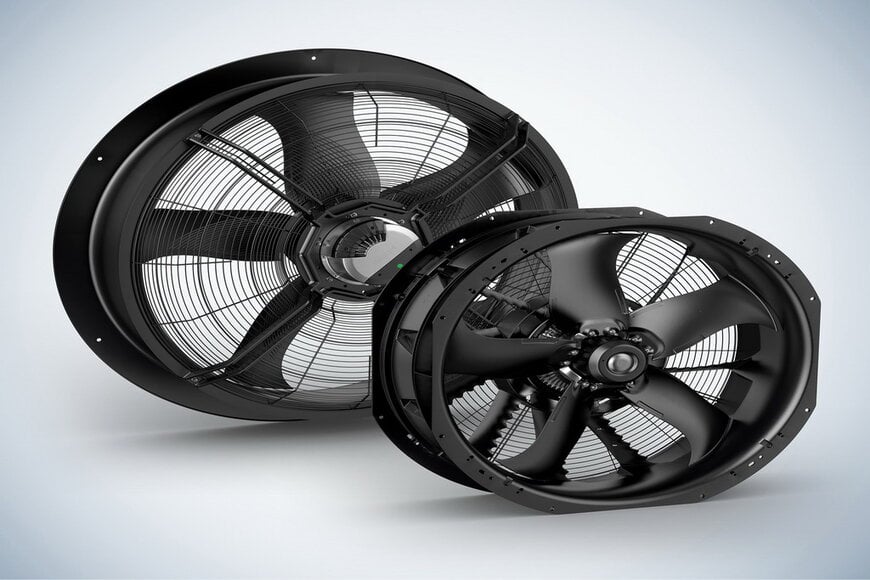
Industrial cooling systems in data centers, commercial refrigeration plants, and process facilities require high volumetric airflow while meeting increasingly stringent acoustic limits and energy conservation mandates. To address these operational constraints, ebm-papst introduced two large-diameter axial fan systems, the 1030 mm AxiBlade.S.Perform and the 1250 mm AxiBlade.S, engineered specifically for air-cooled chillers, condensers, recoolers, and heat dissipation equipment.
Modular Aerodynamic Design and Blade Geometry
Airflow performance in heat rejection equipment depends heavily on balancing system pressure drop against fan acoustics. Rather than treating the fan impeller as an isolated component, the expanded product architecture coordinates the aerodynamic interaction between the impeller blades, nozzle shroud, drive motor, and control electronics.
The 1030 mm AxiBlade.S.Perform utilizes an individual blade mounting architecture. Composite aerodynamic blades attach directly to a central hub ring and can be configured at the factory across multiple blade pitch angles. This modular pitch adjustment permits precise aerodynamic adaptation to specific system resistance curves. The unit generates volumetric flow rates up to 50,000 m³/h under free-blowing conditions and delivers 32,000 m³/h at a backpressure of 330 Pa. It is housed in a composite wall ring optimized for structural damping and installation versatility.
Acoustic Mitigation and Extended Volumetric Capacity
For installations requiring maximum airflow with reduced acoustic emissions, the 1250 mm AxiBlade.S scales the modular blade concept to larger surface-area heat exchangers. Its large impeller diameter allows the fan to move up to 58,000 m³/h in free-blowing operation and 41,000 m³/h against 150 Pa static pressure at lower rotational tip speeds, mitigating aerodynamic turbulence noise. The unit incorporates a sheet-metal wall ring paired with an integrated protective guard grill, making it suited for large industrial chillers, fluid coolers, agricultural facilities, and electrical transformer cooling stations.
Drive Architecture and Digital Ecosystem Connectivity
Both fan models are powered by electronically commutated (EC) external rotor motors delivering output ratings up to 8 kW. The motor electronics operate across an ambient temperature envelope from −40 °C to +70 °C and can be configured with either passive or active power factor correction (PFC) to reduce harmonic line distortions in power distribution networks.
Digital communication is integrated via a standard MODBUS-RTU interface, linking the fans directly into the ebm-papst NEXAIRA digital ecosystem. This bus connectivity transmits continuous operating parameters including speed, power consumption, thermal load, and vibration metrics. System integrators and facility operators can utilize this telemetry for closed-loop demand control, remote diagnostics, and condition-based predictive maintenance.
Compliance and Industry Showcase
The fan systems satisfy the efficiency thresholds established by the European Ecodesign Directive and the upcoming European Fan Regulation (ErP 2026), providing original equipment manufacturers (OEMs) with certified performance data for regulatory compliance. The product line was presented to industrial engineers at the Chillventa trade exhibition in Nuremberg, Germany.
Additional Context
This section details technical specifications and competitive benchmarking not included in the original product announcement.
The regulatory framework governing industrial ventilation in Europe is undergoing a major transition under Commission Regulation (EU) 2024/1834, commonly designated as ErP 2026, which repeals Regulation (EU) 327/2011. Commencing July 2026, this regulation enforces stricter minimum energy efficiency thresholds across industrial fans spanning 125 W to 500 kW, while mandating wire-to-air measurement procedures that evaluate motor, drive electronics, and aerodynamics as an integrated system rather than testing the bare fan shaft.
Within the 1000 mm to 1250 mm diameter class, conventional industrial heat rejection equipment historically employed standard AC asynchronous induction motors paired with belt-drive pulleys or external variable frequency drives (VFDs). Belt drives incur parasitic mechanical transmission losses between 2% and 5% and require routine maintenance, whereas integrated brushless DC/EC permanent magnet motors achieve electrical efficiency levels equivalent to IE5 standards across wide modulation ranges.
In competitive comparisons, modular axial fans in this scale — such as the Ziehl-Abegg ZAplus and FE2owlet series — also target noise reduction through bionic blade designs and integrated diffusers. The engineering advantage of modular blade-angle configuration, as utilized in the AxiBlade architecture, lies in optimizing fan static efficiency (wire-to-air) precisely at the design operating point without requiring aerodynamic throttling or over-sizing drive motors, thereby mitigating broadband vortex shedding and reducing low-frequency blade-pass noise in noise-sensitive urban installations.
Edited by Evgeny Churilov, Induportals Media - Adapted by AI.
www.ebmpapst.com
