
smartbuildingmag.com
11
'26
Written on Modified on
High Airflow Diagonal Fan Solutions for Compact HVAC Systems
EBM-Papst has developed the RadiFlow 630 to optimize energy efficiency and spatial requirements in data centers and industrial climate control infrastructures.
www.ebmpapst.com
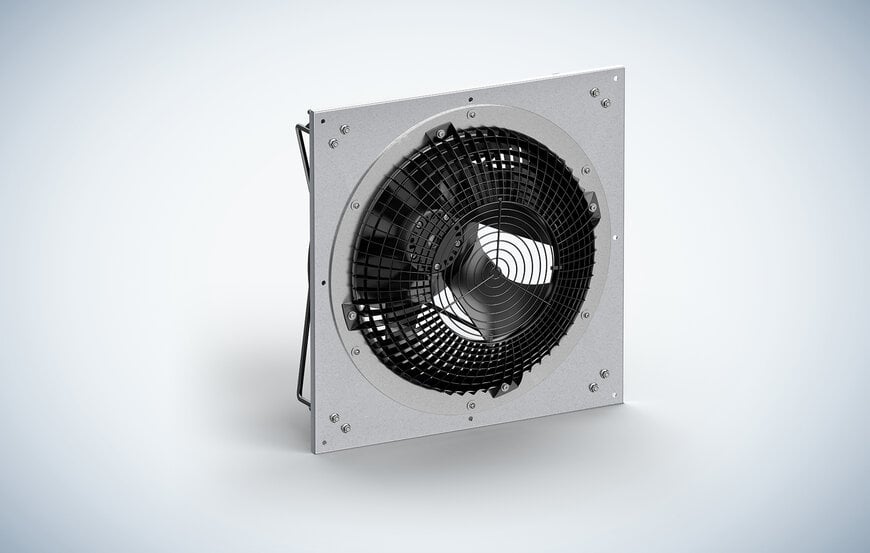
The RadiFlow 630 is a diagonal fan system engineered for high airflow rates in low to medium back-pressure environments, specifically designed for integration into FanGrid arrays, Computer Room Air Handler (CRAH) units, and compact air handling units (AHU). By utilizing integrated EC motor technology and glass-fiber-reinforced composite impellers, the system addresses the increasing power density requirements within the modern automotive data ecosystem and global IT infrastructures.
Aerodynamic Design and Efficiency Parameters
The core of the system is a diagonal impeller featuring six blades constructed from glass-fiber-reinforced composite material. This geometry is specifically designed to minimize flow losses in narrow ducting environments where traditional axial or centrifugal fans often encounter turbulence-induced performance drops. Technical evaluations indicate that this impeller design achieves up to 10% higher efficiency in application-specific scenarios compared to standard market alternatives, particularly in the lower speed ranges common in partial-load HVAC operations.
Spatial Integration in the Digital Supply Chain
In the context of the digital supply chain, where facility footprint directly impacts operational costs, the RadiFlow 630 utilizes a space-saving motor integration strategy. The EC motor is positioned directly within the impeller hub, significantly reducing the axial length of the unit. This compact profile allows manufacturers to design shallower AHUs or increase the density of FanGrid installations. To ensure mechanical longevity despite the compact housing, a multi-point motor suspension system distributes kinetic forces evenly, while integrated resonance detection identifies and bypasses critical frequencies during the startup phase to prevent premature bearing wear.
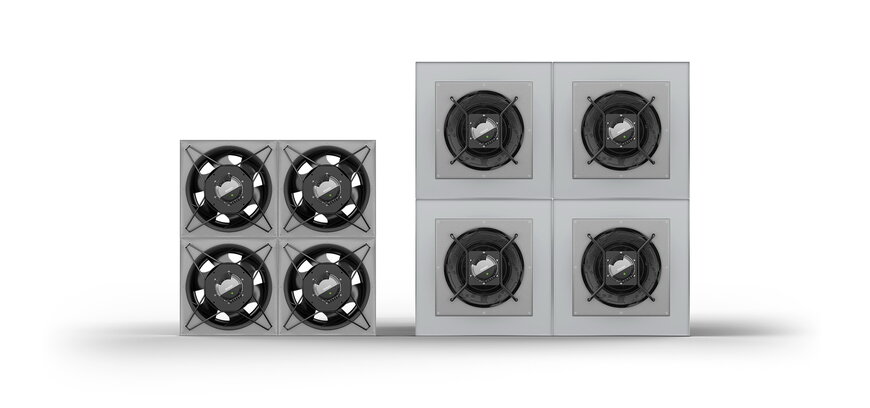
In modular designs, the new fan design enables significant space savings and more efficient use of space.
Electrical Integration and Grid Stability
The fan units incorporate drive technology supporting variable speed control via 0–10 VDC or MODBUS RTU interfaces, facilitating granular climate management. To address power quality in large-scale deployments such as data centers, specific variants include Active Power Factor Correction (PFC). This mechanism reduces harmonic current emissions and grid disturbances, often eliminating the requirement for external filter components. Furthermore, integrated Electromagnetic Compatibility (EMC) filters ensure compliance with international standards, allowing for the implementation of scalable climate control concepts with high power density without necessitating extensive secondary electrical infrastructure.
Technical Performance Comparison
While traditional axial fans provide high volume at low pressure and centrifugal fans manage high pressure at lower volumes, the RadiFlow 630 functions as a hybrid diagonal solution. Compared to standard centrifugal fans of similar diameter used in FanGrid applications, the diagonal flow path allows for a more linear air movement through the unit. This reduces the "system effect" losses — the discrepancy between laboratory-rated performance and actual installed performance — by maintaining laminar flow even when fans are positioned in close proximity to heat exchangers or filters.
Edited by Evgeny Churilov, Induportals Media - Adapted by AI.
www.ebmpapst.com
