
smartbuildingmag.com
25
'26
Written on Modified on
Neutrinovoltaic conversion enables continuous ambient energy use
Neutrino Energy Group develops solid-state technology to complement renewable systems with constant output beyond solar and wind constraints.
neutrino-energy.com
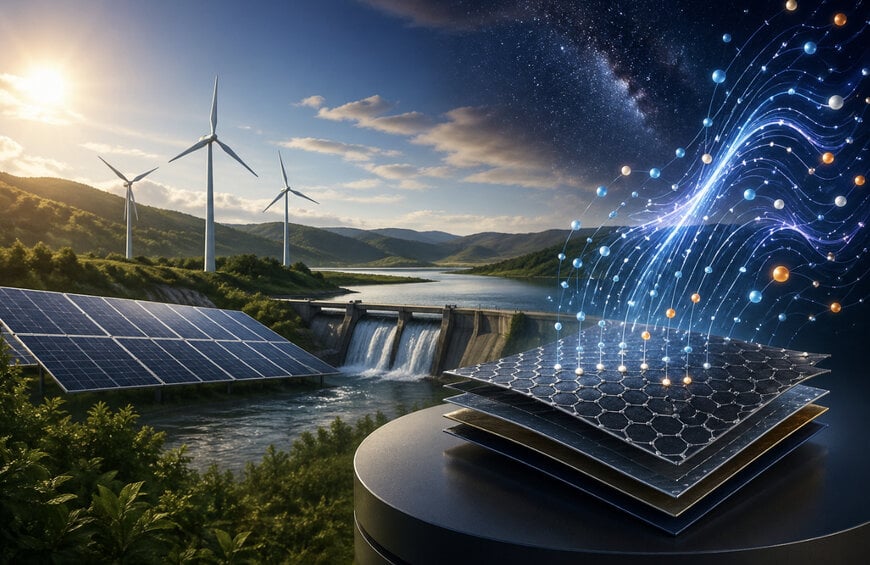
Neutrinovoltaic technology introduces a solid-state approach to energy conversion that operates continuously by coupling with ambient energy fields. Developed by the Neutrino Energy Group, the technology targets applications where stable, weather-independent power generation can complement intermittent renewable sources within the digital supply chain.
Extending the principle of renewable energy conversion
Conventional renewable systems such as solar and wind rely on naturally occurring but variable energy flows. Solar panels convert photon energy into electrical current, while wind turbines transform kinetic energy from moving air. Both systems depend on environmental conditions, resulting in periodic generation profiles.
Neutrinovoltaic systems follow the same physical principle—energy conversion rather than generation—but extend it to continuously available ambient sources. These include particle flux, electromagnetic fluctuations, and thermal gradients present at all times and in all locations.
Solid-state architecture and nanoscale conversion
The technology is based on graphene-based heterostructures engineered at the nanoscale. These materials interact with ambient energy fields, where microscopic excitations are converted into directed electrical current. As a solid-state system, the architecture operates without combustion processes or moving components.
This configuration enables continuous energy conversion under non-equilibrium conditions, meaning the system draws from persistent environmental energy flows rather than relying on discrete or time-dependent inputs.
Continuous operation and energy availability
Unlike solar and wind systems, which are constrained by day-night cycles or atmospheric variability, neutrinovoltaic conversion is not dependent on weather or geographic conditions. Ambient particle flux—such as solar neutrinos, which reach Earth at rates of approximately 65 billion per square centimetre per second—remains constant regardless of external conditions.
The key technical challenge lies in efficient conversion rather than resource availability. Advances in material precision and nanoscale engineering are central to improving the efficiency of these systems.
Role in hybrid energy systems
The integration of neutrinovoltaic technology addresses a structural limitation in renewable energy systems: intermittency. Solar and wind generation require storage or backup solutions to compensate for fluctuations in supply. While battery technologies continue to evolve, large-scale storage remains cost-intensive.
Continuous-output systems can provide a baseline energy supply, reducing reliance on storage and fossil-based backup generation. In this context, neutrinovoltaic conversion does not replace existing renewables but complements them by stabilizing overall system performance.
Physical constraints and conversion limits
As with all energy systems, neutrinovoltaic conversion adheres to fundamental physical laws. Output is limited by the energy available in the ambient fields, and no additional energy is generated. The process involves converting stochastic background excitations into usable electrical output within defined efficiency limits.
The mathematical framework describing these limits has been formalized by Holger Thorsten Schubart, defining measurable parameters for the conversion process and ensuring consistency with established physical principles.
Implications for energy distribution and scalability
Because ambient energy fields are uniformly present, neutrinovoltaic systems are not constrained by geographic resource distribution. Unlike solar or wind, which vary by location, this approach enables consistent deployment across regions without dependence on specific environmental conditions.
This characteristic supports decentralized energy generation and reduces exposure to supply variability linked to geography. It also aligns with efforts to build resilient and distributed energy infrastructures.
Outlook for integration
Neutrinovoltaic technology represents an extension of renewable energy concepts into continuous energy domains. By integrating with existing solar and wind systems, it contributes to a more balanced energy mix capable of delivering both high-output generation and stable baseline supply.
Through advances in materials science and system integration, the technology supports the evolution of energy systems toward greater stability, scalability, and independence from variable environmental inputs.
Edited by Maria Brueva, Induportals editor – adapted by AI.
www.neutrino-energy.com
