
smartbuildingmag.com
31
'26
Written on Modified on
Residential Indoor Air Quality and Ventilation Automation Systems
Hyundai E&C deploys the Allergy Care Solution to systematically regulate airflow and improve indoor air quality through automated room-by-room ventilation.
www.hyundaimotorgroup.com
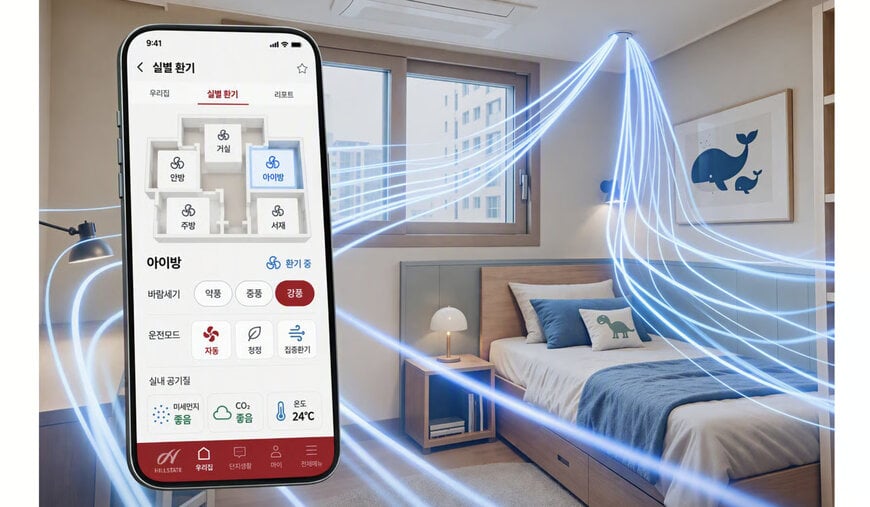
The integration of systematic indoor air quality management into residential infrastructure requires automated airflow regulation and high-performance filtration. To address everyday airborne contaminants in living spaces, a new ventilation and heat exchange system has been developed for residential smart building systems.
Industrial Challenge and Operational Context
Managing indoor air quality systematically is necessary to mitigate environmental health risks and maintain optimal conditions in residential spaces. The core technical challenge involves regulating airflow space by space without compromising the existing climate control infrastructure. To engineer this, the HMG Construction Technology Research Institute, operating as the joint research and development arm of Hyundai E&C and Hyundai Engineering, led the development of data-driven smart residential technologies.
Technical Solution and Architecture
The Allergy Care Solution integrates a high-performance total heat exchanger with a room-by-room ventilation system. The heat exchange unit incorporates electrostatic atomisation, a process that electrolyses moisture in the air to remove up to 99 percent of airborne bacteria. Additionally, the system utilises photoionisation to reduce harmful gases by up to 96 percent, which occurs through the reaction of a specific light source with a photocatalyst. The performance metrics of these filtration mechanisms have been verified by accredited testing facilities, including the Korea Testing Laboratory and Korea Conformity Laboratories.
Deployment and Implementation
The room-by-room ventilation framework automatically regulates airflow distribution, enabling rapid ventilation of specific areas such as kitchens or children's rooms. By actively channelling fresh air into targeted zones, the system achieves an air change rate of six or more air changes per hour (ACH), exceeding the legally mandated baseline of 0.5 ACH. Furthermore, Hyundai E&C is integrating a smart operation feature for the system into its proprietary residential platform applications, namely MY HILLS and MY THE H. A
pplications and Expected Impact
The deployment of this technology within digital infrastructure establishes automated environmental control based on continuous air quality data analysis. The platform configures optimal operating modes, provides real-time space-specific air quality data, and triggers ventilation protocols automatically in response to indoor conditions. The implementation standardises residential air management while improving the operational stability of the building ecosystem.
Edited by Maria Brueva, Induportals editor – adapted by AI.
www.hyundaimotorgroup.com
