
smartbuildingmag.com
28
'26
Written on Modified on
Danfoss advances oil-free compressor technology for R600a
Danfoss and ENGIE Refrigeration develop an oil-free R600a chiller combining the Turbocor TNS385 compressor with an integrated safety platform for large buildings.
www.danfoss.com
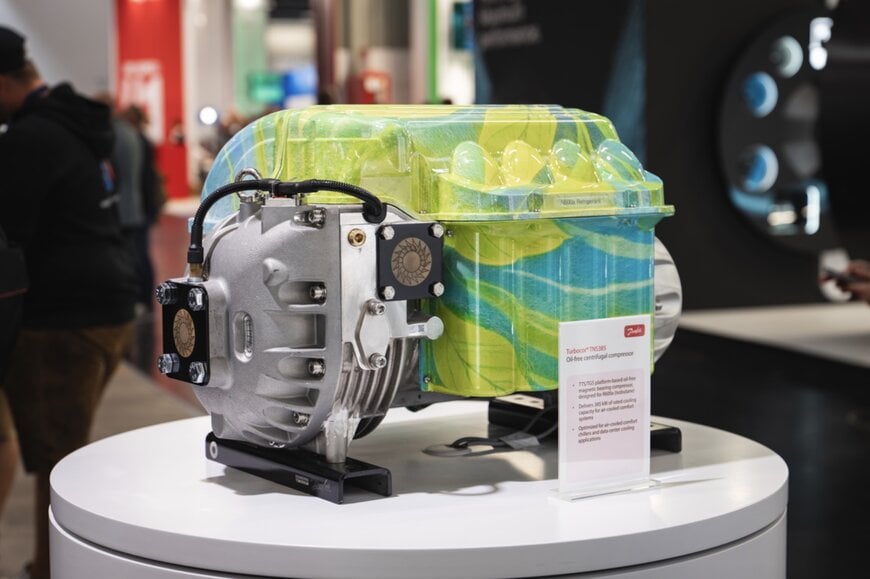
Danfoss and ENGIE Refrigeration have partnered to develop high-capacity centrifugal chiller platforms utilizing isobutane (R600a) for large commercial building applications. Presented at Chillventa, held October 13 to 15, 2026, in Nuremberg, Germany, the joint development program pairs magnetic-bearing compressor architecture with dedicated chiller design to replace fluorinated refrigerants with hydrocarbon alternatives.
Refrigerant Transition and Thermodynamic Requirements
Commercial comfort-cooling systems in district infrastructure and large facilities face regulatory phase-downs of fluorinated greenhouse gases. Transitioning central chilling plants to natural hydrocarbons requires reconciling thermodynamic cycle requirements with flammability parameters. Isobutane operates at lower operating pressures than traditional hydrofluorocarbons and hydrofluoroolefins, enabling charge-volume reduction while delivering favorable thermodynamic cycle efficiency. However, because R600a is classified as an A3 flammable refrigerant under safety standards, scaling capacity to central building scales requires mechanical and electrical safeguards integrated directly into compressor and chiller components.
System Architecture and Mechanical Engineering
The core cooling powertrain integrates the Danfoss Turbocor TNS385 centrifugal compressor within a dedicated ENGIE Refrigeration chiller chassis. Danfoss developed the TNS385 as an oil-free platform engineered specifically for isobutane properties. The compressor uses active magnetic bearings that levitate the motor shaft during rotation, eliminating mechanical contact, hydrodynamic drag, and lubricating oil circuits. Removing lubricant oil maintains heat exchanger surface cleanliness, avoiding thermal resistance penalties typical in oil-contaminated evaporator tubes.
Engineering modifications for R600a encompass redesigned compressor stage aerodynamics, specialized shaft and housing seals, integrated refrigerant leak sensors, and customized motor cooling passages. Under defined comfort-cooling parameters, preliminary performance testing yields a rated cooling capacity of approximately 385 kW.
System Integration and Active Safety Controls
ENGIE Refrigeration designs the mechanical chiller frame, heat exchanger circuits, and system-level control architecture. The chiller incorporates connected intelligence to monitor operational envelopes and handle the thermodynamic behavior of isobutane. To address the A3 classification of the fluid, the chassis integrates continuous vapor leak detection with automated safety interlocks. Upon detection of abnormal pressure changes or trace hydrocarbon levels, system controllers initiate automated protective isolation protocols and deterministic shutdown sequences, venting or securing the low-pressure charge within sealed containment zones.
Development Roadmap and Phased Commercialization
Following laboratory trials at Danfoss development facilities, the compressor is undergoing integrated testing within ENGIE Refrigeration’s prototype chiller. Danfoss plans a controlled commercial release of the Turbocor TNS385 during 2027, focused on pilot validation with selected original equipment manufacturers and site operators. Full system testing of the ENGIE Refrigeration chiller platform continues, with commercial qualification dates to follow completed operational testing.
Operational Performance and Facility Impact
Pairing magnetic-bearing centrifugal technology with low-pressure natural refrigerants eliminates synthetic chemical dependencies while maintaining thermal efficiency in centralized cooling loops. The combined system reduces regulatory compliance risk, eliminates lubrication maintenance overhead, and demonstrates an engineering path for hydrocarbon deployment across high-capacity commercial building systems.
Edited by Romila DSilva, Induportals Editor, with AI assistance.
www.danfoss.com
