
smartbuildingmag.com
05
'26
Written on Modified on
Scalable Energy Management for Existing Stadium Infrastructures
Borussia Dortmund integrates an open architecture from ABB to modernize energy management and building automation at Signal Iduna Park.
global.abb
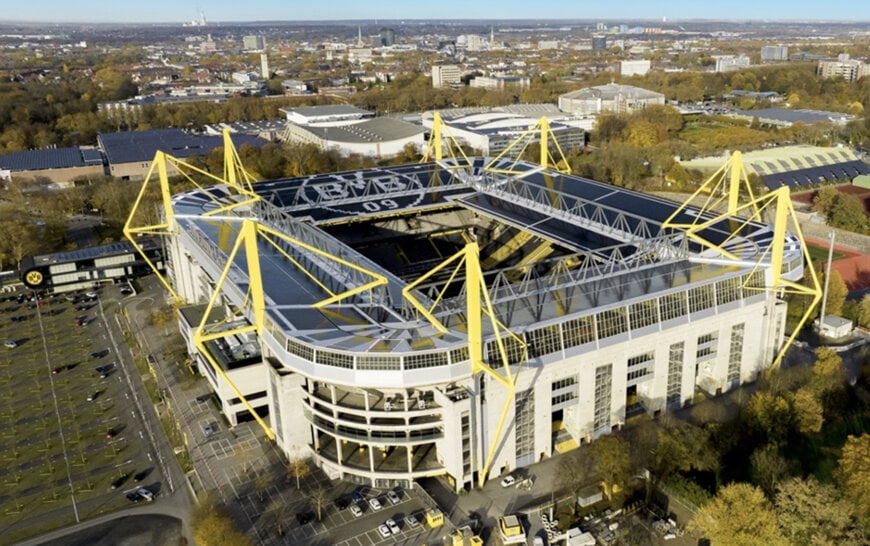
In the field of critical infrastructure and the operation of large-scale event venues, operators rely on scalable energy management systems and building automation to efficiently and sustainably control highly fluctuating energy demands.
Activity and Operational Challenges
With Signal Iduna Park, Borussia Dortmund operates Germany's largest football stadium, which opened in 1974 and accommodates over 81,000 spectators. Operations require managing extreme load variations: on match days, the energy demand for lighting, security systems, broadcasting technology, and catering surges within a few hours from near zero to several megawatts, while smooth operation must be guaranteed at all times. The central challenge was to modernize the highly complex electrical infrastructure of the existing building, which had grown over decades, in a way that meets the club's climate and sustainability goals as validated by the Science Based Targets initiative (SBTi).
Improvement Objectives
The primary project objective was the continuous improvement of energy efficiency and the performance of overall stadium operations. The aim was to increase transparency regarding energy consumption, safely modernize the electrical infrastructure, and intelligently control the existing heating, ventilation, and air conditioning (HVAC) systems. Simultaneously, a scalable foundation was to be established to seamlessly integrate future infrastructure, such as planned EV charging stations and an upcoming battery storage system.
Selected Technical Solution
To achieve these goals, Borussia Dortmund selected ABB as its technology partner. The solution encompasses an open, scalable system architecture that integrates into the stadium's existing ISO 50001-certified energy management system. The implementation combines secure electrification technology with KNX-based building automation to centrally and dynamically control the complex HVAC systems. The system is also designed to incorporate the 5 MWp photovoltaic system installed on the stadium roof, as well as a future 3.75 MWh battery storage system, into the holistic energy management framework.
Deployment and Support
The modernization measures build upon a long-standing technological collaboration between both partners. The system was designed so that the architecture can be flexibly extended to all of the club's properties—from the training ground and youth academy in Brackel to the BVB-FanWelt. During the joint development, ABB's engineers contributed their expertise in building automation, while the club provided its operational experience from running one of Europe's most visited sports venues.
Measurable Results
By bundling energy management, electrification, and building automation into a centralized platform, the transparency of energy consumption in the stadium increases significantly, enabling structured monitoring and continuous optimization of resource usage. The networked infrastructure handles the enormous peak loads on match days more efficiently and ensures the reliable operation of critical systems. This flagship project measurably supports the Bundesliga club in fulfilling its validated sustainability goals and provides a technological blueprint for the modernization of complex existing buildings worldwide.
Written by Maria Brueva, Induportals Editor – adapted by AI.
www.abb.com
