
smartbuildingmag.com
05
'26
Written on Modified on
Making better use of the potential in refrigeration technology
With “Defrost on Demand,” ebm-papst has developed a technology for need-based defrosting based on operating data from EC fans.
www.ebmpapst.com
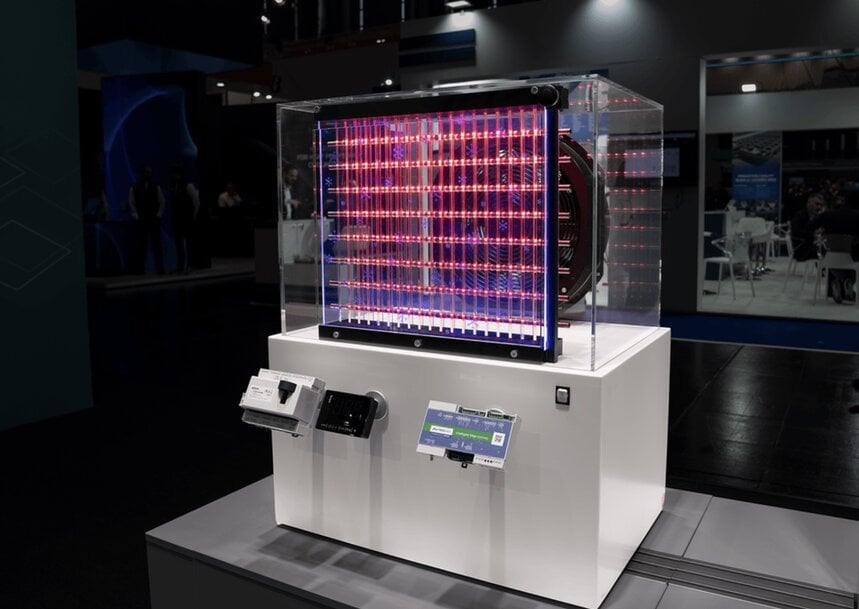
Commercial and industrial refrigeration installations in cold storage hubs and supermarket distribution networks rely on finned-tube evaporators that continuously accumulate frost and ice from atmospheric humidity. Historically, refrigeration management architectures have governed defrosting cycles through rigid time-based intervals. These deterministic timers activate electric resistance heating elements or hot gas bypass loops at fixed multi-hour schedules regardless of whether frost has physically formed on heat-exchanger fins. In low-humidity conditions or periods of minimal door openings, unnecessary heating cycles needlessly introduce thermal loads into the refrigerated cold space, forcing compressors to expend substantial secondary electrical energy to restabilize target temperatures. Conversely, traditional sensory retrofit approaches—such as optical cameras, mechanical differential pressure switches across the coil, or external air-velocity transmitters—suffer from ice blinding, sensor fouling, and calibration drift under sub-zero temperatures. Mitigating unnecessary thermal loads and eliminating redundant defrost cycles requires integrated sensorless assessment methods that evaluate aerodynamic and electrical motor performance directly from existing air-moving machinery.
Aerodynamic Sensing and Multi-Stage Energy Savings
To eliminate redundant defrosting cycles in refrigerated infrastructure, ebm-papst introduced its Defrost on Demand technology, presenting initial field data and development partnerships at the Chillventa trade fair in Nuremberg. The system eliminates dedicated peripheral frost sensors by utilizing the electronically commutated (EC) evaporator fan itself as an integrated aerodynamic sensor.
As frost builds across the evaporator coil, the restricted fin passages increase system air-side flow resistance, changing static backpressure and shifting fan operational dynamics. The internal microprocessor of the EC fan continuously monitors operational variables—including motor speed, input electrical power, DC bus voltage, and torque characteristics. By correlating these motor telemetry metrics against baseline clean-coil aerodynamic curves, the algorithm detects localized airflow restriction and accurately determines real-time evaporator icing severity. Defrost heating is initiated only when ice accumulation degrades heat transfer past predefined performance thresholds. In deep-freeze validation trials conducted at −18 °C, the demand-driven system reduced electrical defrost consumption from 7.8 kWh to 3.4 kWh per week, replacing rigid seven-hour cyclic intervals with three to six demand-triggered cycles weekly and achieving a net energy reduction exceeding 49 percent.
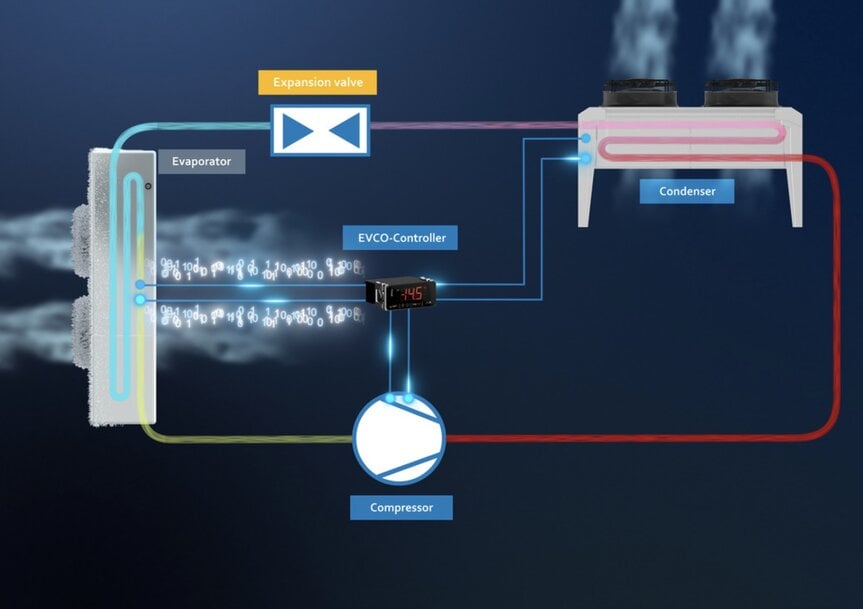
The EVCO controller manages the entire refrigeration cycle and directly integrates Defrost on Demand.
Refrigeration Control Integration and Cloud Analytics
To support field retrofits and OEM equipment engineering, ebm-papst is testing dual architectural integration paths:
- Direct Controller Integration: Working in coordination with refrigeration electronics specialist EVCO, ebm-papst integrates Defrost on Demand algorithms into dedicated cold-room controllers. The EVCO unit governs the complete thermodynamic circuit—modulating electronic expansion valves and compressors—while directly processing fan telemetry to command electric or hot-gas defrost cycles.
- IoT Cloud Analytics: The system can alternatively route real-time motor telemetry through the cloud-based ebm-papst NEXAIRA Gateway. Under this architecture, high-frequency operational metrics are uploaded for edge and cloud processing, enabling remote condition monitoring, preventative maintenance alerts, and predictive system diagnostics across multi-site supermarket estates.
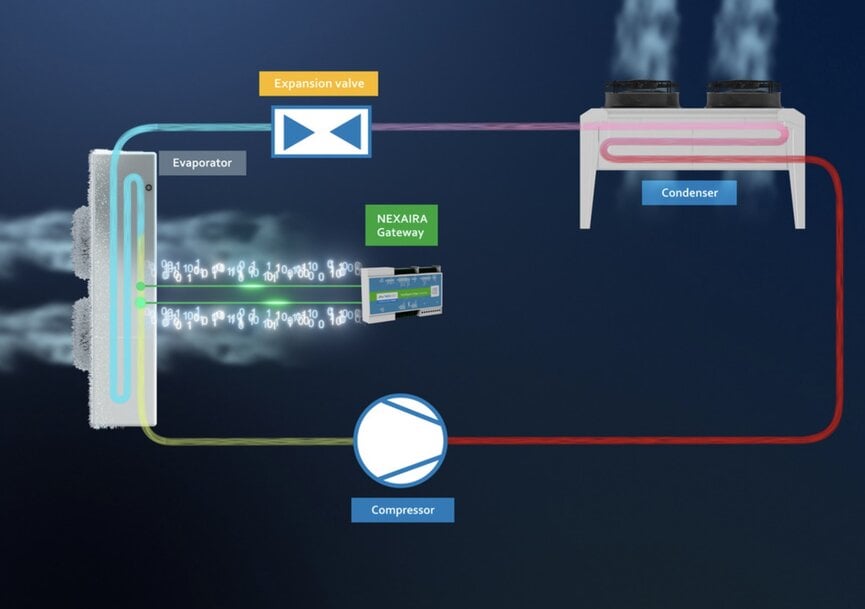
Alternatively, the cloud-based NEXAIRA Gateway from ebm-papst continuously monitors and analyzes the fan’s operating data.
Additional Context
This section details technical specifications and competitive benchmarking not included in the original product announcement.
In industrial refrigeration systems governed by standards such as EN 378 (safety and environmental requirements for refrigerating systems and heat pumps) and ASHRAE guidelines for commercial cold storage, electric defrost systems utilize heating rods drawing several kilowatts per evaporator. During a typical time-initiated defrost, up to eighty percent of heat dissipated by electric rods escapes directly into the refrigerated envelope rather than melting ice, contributing to temperature pull-down spikes that degrade perishable product shelf life. In permanent-magnet brushless EC motors operating via field-oriented control (FOC), the relationship between shaft torque, angular velocity, and back-electromotive force (BEMF) enables calculation of instantaneous aerodynamic load without external pressure transducers. As frost clogs fin spacing—which typically ranges from 4 to 12 millimeters on low-temperature coils—the axial fan's aerodynamic operating point migrates upward along its characteristic P-Q (pressure-volume) performance curve. The onboard motor microcontroller detects the resulting phase-current shift, translating motor load deviations into an accurate proxy for fin blockage.
Within the commercial refrigeration control and fan manufacturing sector, ebm-papst's Defrost on Demand benchmarks directly against demand defrost platforms from controls manufacturers such as Danfoss (Adaptive Defrost algorithms based on temperature difference and suction pressure analysis), Carel (UltraCella with defrost-on-demand modules), and Emerson Climate Technologies (Copeland intelligent store controllers), as well as competing air-movement suppliers like Ziehl-Abegg. While conventional refrigeration controllers rely primarily on secondary thermodynamic calculations—such as evaluating suction saturation temperatures against coil temperature sensor differentials—these external temperature measurements are prone to sensor drift, incorrect probe positioning, and convective thermal lag. By contrast, ebm-papst measures physical air impedance via native EC motor electronics, eliminating additional field-installed sensors and providing industrial walk-in freezers and supermarket display cases with a direct aerodynamic measurement of ice buildup.
Edited by Romila DSilva, Induportals Editor, with AI assistance.
