
smartbuildingmag.com
26
'26
Written on Modified on
Mitsubishi Electric to Demonstrate Smart Building and Smart City Technologies in Berlin
The initiative will include technologies developed and verified at SUSTIETM, Mitsubishi Electric's ZEB (net-zero energy building) technology test facility in Japan.
www.mitsubishielectric.com
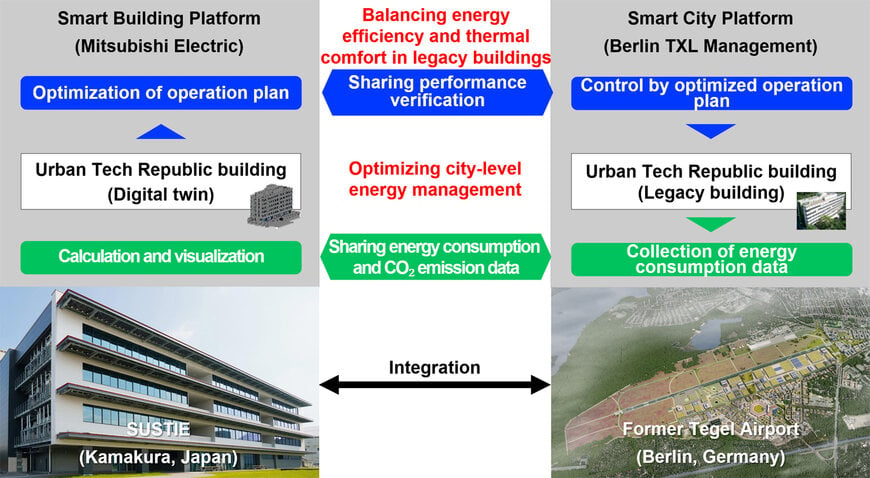
Mitsubishi Electric announced it will deploy and test smart building and smart city management systems within a legacy structure located at the Urban Tech Republic in Berlin TXL—an innovation and research district developed at the former Tegel Airport. The trial, scheduled to begin on September 1, evaluates energy efficiency, indoor thermal comfort, operational efficiency, and district-level energy optimization using operational building metrics such as carbon dioxide emissions.
Digital Twin Modeling and HVAC Optimization
The project applies net Zero Energy Building (ZEB) technologies originally developed and tested at SUSTIE, Mitsubishi Electric's test facility in Japan. This initiative marks the first deployment of these ZEB optimization systems in a legacy building outside of Japan.
The demonstration incorporates two primary software frameworks tested at SUSTIE:
- Digital Twin Building Simulation: Models the thermodynamic behavior and structural parameters of the legacy facility to evaluate predictive accuracy under changing environmental conditions.
- Optimal Operation Planning: Generates predictive operational schedules for heating, ventilation, and air conditioning (HVAC) systems to maintain thermal comfort while minimizing overall power consumption.
District-Scale Data Integration and Global Expansion
Following a partnership agreement signed in May 2024 between Berlin TXL Management GmbH and the German Branch of Mitsubishi Electric Europe B.V., the companies defined building selection and operational parameters.
The initiative tests data interoperability between building management systems and overarching smart city platforms. Energy consumption metrics and calculated carbon dioxide emissions will be shared across platforms to test district-wide load balancing and energy optimization. Mitsubishi Electric plans to use the field data to refine its energy management architectures and scale smart city building solutions globally, beginning in the European market.
Additional Context
This section details technical specifications not included in the original news release.
Digital twin building energy modeling (BEM) utilizes transient thermodynamic simulations governed by heat balance methods. The simulation models calculate sensible and latent heat transfer across building envelopes by resolving multi-layered conduction through legacy building materials, convective surface heat transfer coefficients, internal equipment heat gains, occupant sensible heat release, and solar radiation admitted through fenestration assemblies. When optimizing Net Zero Energy Building (ZEB) performance, model predictive control (MPC) frameworks integrate dynamic weather forecasts with thermal mass storage capacity to pre-cool or pre-heat interior zones, reducing peak electrical demand during periods of high grid carbon intensity.
District-level energy management platforms interface with localized building automation systems through open, vendor-neutral industrial communication protocols, such as BACnet/IP, MQTT, and OPC UA. Building operational metrics—including sub-metered power consumption across chillers, variable refrigerant flow (VRF) condensing units, fan coil assemblies, and indoor environmental sensors measuring temperature, relative humidity, and indoor carbon dioxide levels—are securely published to cloud and edge servers. Real-time greenhouse gas emissions are calculated by applying time-varying grid emission factors to hourly kilowatt-hour power draw figures, allowing district supervisory controllers to execute coordinated demand response, optimize thermal energy storage assets, and minimize primary energy consumption across multi-building developments.
Edited by Romila DSilva, Induportals Editor, with AI assistance.
Following a partnership agreement signed in May 2024 between Berlin TXL Management GmbH and the German Branch of Mitsubishi Electric Europe B.V., the companies defined building selection and operational parameters.
The initiative tests data interoperability between building management systems and overarching smart city platforms. Energy consumption metrics and calculated carbon dioxide emissions will be shared across platforms to test district-wide load balancing and energy optimization. Mitsubishi Electric plans to use the field data to refine its energy management architectures and scale smart city building solutions globally, beginning in the European market.
Additional Context
This section details technical specifications not included in the original news release.
Digital twin building energy modeling (BEM) utilizes transient thermodynamic simulations governed by heat balance methods. The simulation models calculate sensible and latent heat transfer across building envelopes by resolving multi-layered conduction through legacy building materials, convective surface heat transfer coefficients, internal equipment heat gains, occupant sensible heat release, and solar radiation admitted through fenestration assemblies. When optimizing Net Zero Energy Building (ZEB) performance, model predictive control (MPC) frameworks integrate dynamic weather forecasts with thermal mass storage capacity to pre-cool or pre-heat interior zones, reducing peak electrical demand during periods of high grid carbon intensity.
District-level energy management platforms interface with localized building automation systems through open, vendor-neutral industrial communication protocols, such as BACnet/IP, MQTT, and OPC UA. Building operational metrics—including sub-metered power consumption across chillers, variable refrigerant flow (VRF) condensing units, fan coil assemblies, and indoor environmental sensors measuring temperature, relative humidity, and indoor carbon dioxide levels—are securely published to cloud and edge servers. Real-time greenhouse gas emissions are calculated by applying time-varying grid emission factors to hourly kilowatt-hour power draw figures, allowing district supervisory controllers to execute coordinated demand response, optimize thermal energy storage assets, and minimize primary energy consumption across multi-building developments.
Edited by Romila DSilva, Induportals Editor, with AI assistance.
