
smartbuildingmag.com
14
'26
Written on Modified on
Mitsubishi Electric Trane HVAC US Expands Heat Pump Portfolio in 2026
Mitsubishi Electric Trane HVAC US LLC expanded its heat pump and HVAC portfolio during the first half of 2026, with new systems addressing cold-climate heating, hydronic applications, commercial buildings, and low-GWP refrigerant requirements.
www.mitsubishielectric.com
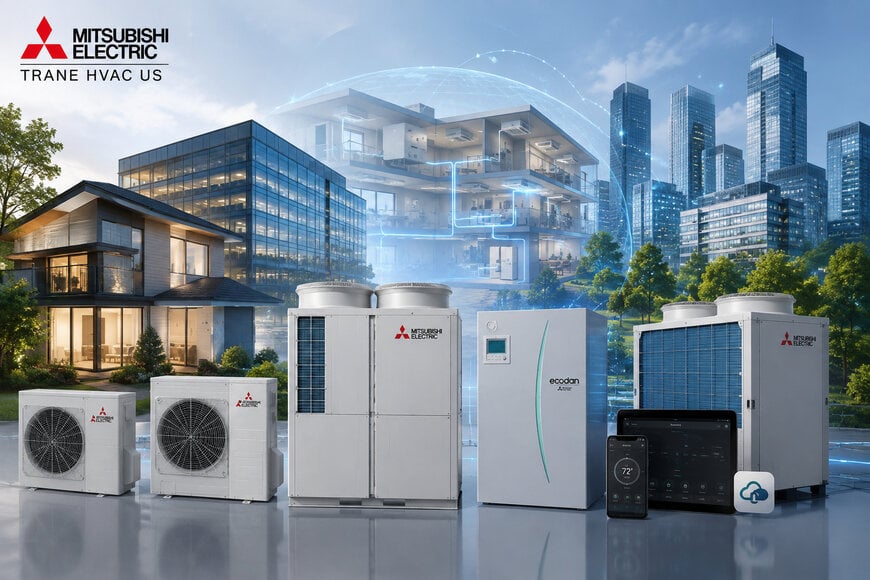
The company introduced several systems during January through June 2026. The additions include ductless and VRF equipment, air-to-water heat pumps, hydronic systems, and digital controls intended for residential, commercial, and institutional applications.
The portfolio expansion also reflects the U.S. HVAC industry's transition toward A2L refrigerants. These refrigerants have lower global warming potential than many legacy options but require equipment and installation practices designed around their mildly flammable characteristics.
Cold-Climate and Hydronic Heat Pump Systems
Mitsubishi Electric Trane HVAC US expanded its SMART MULTI range with a single-phase, 5-ton Hyper-Heating INVERTER outdoor unit. The system is intended to provide additional configuration options for cold-climate applications while incorporating A2L-compliant features and a low-GWP refrigerant.
The company also introduced the single-phase ecodan air-to-water heat pump product line for hydronic heating, cooling, and domestic hot water applications. Air-to-water systems transfer heat between outdoor air and a water-based distribution circuit, allowing integration with hydronic heating and cooling infrastructure.
For three-phase commercial and institutional applications, the ecodanPro range was introduced with the modular CAHV system. Its scalable architecture is intended to support larger hydronic and domestic hot water requirements while using a low-GWP refrigerant.
VRF and Digital Control Developments
Mitsubishi Electric Trane HVAC US also announced the CITY MULTI X-Generation VRF lineup, including a transition to a low-GWP refrigerant for systems above 65,000 Btu/h. VRF architecture allows refrigerant flow to be controlled across multiple indoor units, supporting zoning and independent temperature management in commercial buildings.
The company introduced the Comfort app as a successor to kumo cloud. The control platform provides scheduling, multi-zone connectivity, and communication functions between contractors and homeowners.
Supporting the A2L Transition
Alongside the equipment launches, METUS reported cross-functional activities focused on supporting contractors and distributors during the A2L refrigerant transition. Weekly coordination between internal teams was used to align priorities and address implementation requirements.
The developments indicate a portfolio strategy centered on electrified heating, hydronic heat pump systems, low-GWP refrigerants, variable refrigerant flow technology, and connected HVAC controls. These technologies address different building configurations while supporting the industry's broader transition away from higher-GWP refrigerants.
Edited by Sucithra Mani, Induportals editor – adapted by AI.
www.mitsubishicomfort.com
