
smartbuildingmag.com
13
'26
Written on Modified on
Multi-Chemistry Uninterruptible Power Systems for Edge and Distributed Infrastructure
Schneider Electric has introduced a monolithic uninterruptible power supply platform enabling battery chemistry upgrades across distributed IT and industrial environments.
www.se.com
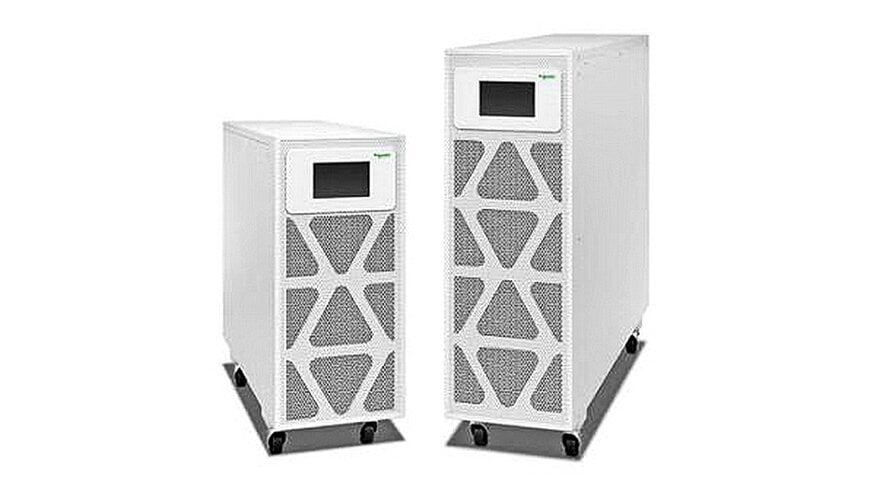
Schneider Electric has introduced a monolithic multi-chemistry uninterruptible power supply platform designed to deliver continuous backup power across distributed IT, medical, and light industrial infrastructure. The system allows operators to update battery topologies — from valve-regulated lead-acid to lithium-ion and future storage technologies — within a single chassis to mitigate battery failure risks and extend hardware lifecycles.
Multi-Chemistry Architecture and Hardware Optimization
Battery failure represents a primary cause of downtime in distributed power protection. Conventional architectures often require complete hardware replacement to transition between energy storage technologies. The platform addresses this limitation through a standardized chassis that accommodates valve-regulated lead-acid (VRLA) units, lithium-ion modules, and future compatible chemistry configurations without structural modifications.
Engineered for high-density environments, the hardware platform provides up to three times the base runtime and 1.4 times the power density compared to previous generations, while reducing internal power losses by up to 40 percent. The physical design integrates up to 57 percent more outlets and supports up to 10 external battery packs for scalable runtime extension. A common management interface and interchangeable spare parts are standardized across power ratings to simplify inventory management for technical teams. The hardware platform debuted at the Xchange channel partner event, held from August 9 to 11.
Manish Kumar, Executive Vice President of Secure Power and Data Centers at Schneider Electric, stated that the multi-chemistry framework allows systems deployed under current requirements to integrate subsequent battery innovations through direct module replacement, preserving initial capital investment.
Cybersecurity Compliance and Integrated Energy Management
The architecture pairs physical power conversion with centralized software controls to ensure network integrity across edge deployments. Remote monitoring is conducted through EcoStruxure IT software, which aggregates performance telemetry, evaluates battery health metrics, and provides predictive alerts to prevent unexpected outages. Automated system shutdown during extended power loss events is executed via PowerChute software.
To protect against network vulnerabilities in connected environments, the integrated network management card holds cybersecurity certification under the IEC 62443 Security Level 2 standard. This framework verifies structured risk analysis, secure development lifecycle practices, and device hardening against unauthorized network intrusion.
Sustainability Metrics and Market Availability
The hardware redesign incorporates sustainable manufacturing principles, utilizing up to 50 percent recycled plastic content and achieving up to a 25.6 percent reduction in lifecycle carbon emissions. The series holds ENERGY STAR for UPS (Version 2.0) certification, reflecting reduced operational energy consumption.
Initial product availability focuses on the SRTD On-Line series in 2.2 kVA and 3 kVA power ratings, targeted at servers and networking hardware within medical facilities, light manufacturing plants, and data center white space. Orders for North American markets open on September 1, 2026, with deployment schedules for additional geographic regions and expanded capacity models to follow.
Additional Context
This section details technical specifications and competitive benchmarking not included in the original product announcement.
Traditional uninterruptible power supplies in the 2.2 kVA to 3 kVA power range traditionally compel operators to choose between VRLA and lithium-ion platforms at the point of purchase. Standard double-conversion online systems, such as the Eaton 9PX or Vertiv Liebert GXT5 series, offer distinct factory configurations for VRLA or lithium-ion batteries, but their internal charging circuitry and firmware parameters are typically fixed to a specific battery chemistry.
Unlike conventional market benchmarks that require a fixed chassis for each specific battery chemistry, the Schneider Electric SRTD Series utilizes a monolithic multi-chemistry architecture capable of supporting VRLA, lithium-ion, and future battery technologies within the same hardware frame. In terms of expansion capability, the system accommodates up to 10 external battery packs, exceeding standard industry benchmarks that typically limit external expansion to four or six packs. While both the SRTD Series and established market alternatives comply with ENERGY STAR for UPS (Version 2.0) efficiency standards, the SRTD series delivers a 40 percent increase in power density over previous-generation baselines. Furthermore, the integration of IEC 62443 Security Level 2 certification provides a hardware-validated cybersecurity framework that goes beyond the standard optional network card interfaces found in legacy double-conversion online units.
The ability to dynamically reconfigure charger profiles and battery management system protocols within a single chassis distinguishes multi-chemistry architecture from dual-model product lines. By providing native firmware support for multiple electrochemical profiles and modular battery enclosures, the system eliminates the technical requirement to replace power conversion electronics when transitioning from VRLA to higher-density lithium-ion storage.
Edited by Evgeny Churilov, Induportals Media - Adapted by AI.
www.se.com
