
smartbuildingmag.com
06
'26
Written on Modified on
Universal Fan Timer Control for Oil Furnace System Retrofits
Hydrolevel has introduced a versatile fan timer solution engineered to simplify wiring and diagnostic processes across varied residential oil heating configurations.
hydrolevel.com
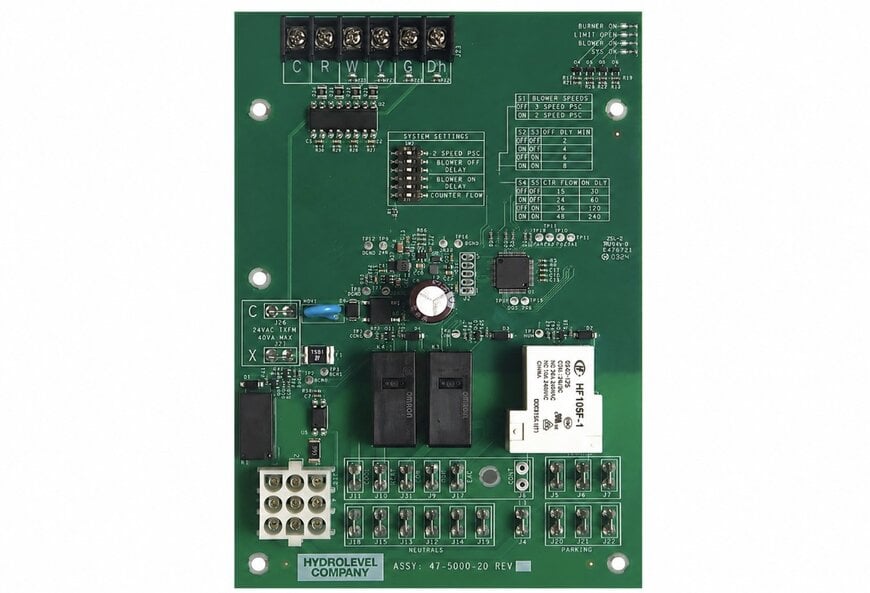
Hydrolevel Company is releasing the OFC-5023 Oil Furnace Fan Timer Control, a centralized relay board designed to manage 2- or 3-speed Permanent Split Capacitor (PSC) motors. This hardware standardizes HVAC retrofits by unifying blower, humidifier, and air cleaner management into a single interface for residential and commercial heating applications.
Relay Architecture and Direct Replacement Parameters
The OFC-5023 is engineered as a direct structural and electrical replacement for legacy oil furnace fan timers, including UTEC Models 1158-100, 110, 120, and the Resideo ST9103A. By adhering to industry-standard wiring terminal layouts, the board mitigates the need for extensive wiring harness modifications during field replacements. The unit manages fan circulation across varied furnace physical orientations and includes a specific counterflow selector switch with an adjustable ON delay to accommodate down-flow architectures.
Voltage Handling and Auxiliary Component Integration
To centralize heating system automation, the board partitions electrical control into distinct voltage sectors. The 24 V section utilizes standard thermostat and transformer terminals to manage low-voltage cooling and dehumidification requests. On the line-voltage side, the control routes 120 VAC to dedicated blower outputs categorized for COOL, HEAT, LOW, and continuous circulation. Additionally, the printed circuit board (PCB) integrates independent 120 VAC outputs for humidifiers (HUM) and electronic air cleaners (EAC), enabling these accessories to draw power directly through the main control without the installation of secondary external relays.
Diagnostic Feedback and Configurable Timing Mechanisms
The board bypasses software-based programming tools in favor of a hardware-level DIP switch array, allowing technicians to mechanically configure blower ON and OFF delays. This timing calibration ensures the blower extracts residual thermal energy from the heat exchanger after burner deactivation, optimizing overall thermal transfer efficiency.
System status is communicated continuously through a surface-mounted diagnostic LED bank. These indicators confirm low-voltage thermostat signals (W, Y, G, Dh), active line-voltage outputs (BURNER ON, BLOWER ON), and critical fault states (LIMIT OPEN, SYS OK) to isolate electrical anomalies at the circuit level. An integrated dehumidification (Dh) terminal further synchronizes blower speed with ambient moisture control inputs, streamlining internal air handling logic.
Additional Context
This section details technical specifications and competitive benchmarking not included in the original news release.
Within the oil furnace control market, legacy circuit boards such as the Resideo ST9103A historically relied on fixed timer profiles and provided limited visual diagnostic feedback. The OFC-5023 differentiates itself by integrating 120 VAC auxiliary outputs for EAC and HUM directly onto the PCB—a specification frequently omitted in older benchmark models, which required separate switching relays to handle accessory loads. Furthermore, transitioning from traditional pin-jumper configurations to a dedicated DIP switch interface provides measurable improvements in calibration precision for blower delays. This specific timing control impacts the system's ability to capture latent sensible heat during the off-cycle, which is a measurable factor in maintaining higher Annual Fuel Utilization Efficiency (AFUE) ratings.
Edited by Aishwarya Mambet, Induportals Editor, with AI assistance.
www.hydrolevel.com
