
smartbuildingmag.com
08
'26
Written on Modified on
Flush-Mounted KNX Interfaces for Automated Environmental Regulation
Theben introduces a new suite of smart room sensors combining architectural hardware with integrated telemetry to optimize commercial HVAC and lighting ecosystems.
www.theben.de
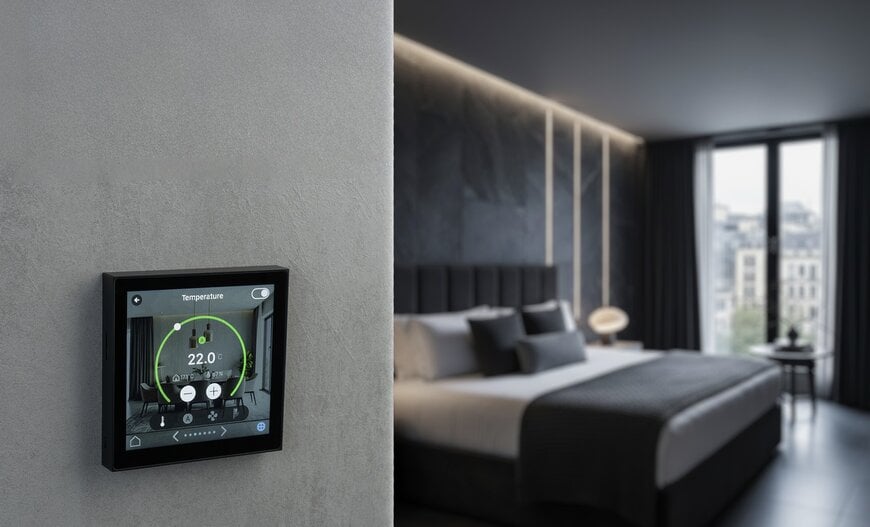
Theben is releasing the iONprime series, a suite of intelligent room sensors and tactile controllers engineered for precise environmental regulation in high-end hospitality, commercial offices, and premium residential spaces. The system functions as a centralized node for smart building automation, bridging interior design constraints with stringent operational efficiency standards.
Regulatory Drivers for Environmental Measurement
Building performance regulations dictate strict requirements for the local control of utility usage. Mandates such as the Building Automation and Control Systems (BACS) decree require precise management of facility equipment to optimize power consumption and occupant comfort. The integration of sensors into localized control points enables building managers to meet these compliance standards by automatically adapting room systems to actual occupancy and ambient conditions.
Flush-Mounted Tactile Control Configurations
The flush-mounted PB KNX interface utilizes an 86-millimeter square footprint designed for demanding architectural environments. Manufactured in seven material finishes, including brushed brass and machined aluminum, the hardware provides two, four, or eight programmable push-button layouts. Each mechanical input features a configurable RGB LED, allowing system integrators to designate specific colors and luminosity levels to denote active functions such as localized lighting, motorized sunshades, or preset environmental scenes.
Centralized Touch Interface Capabilities
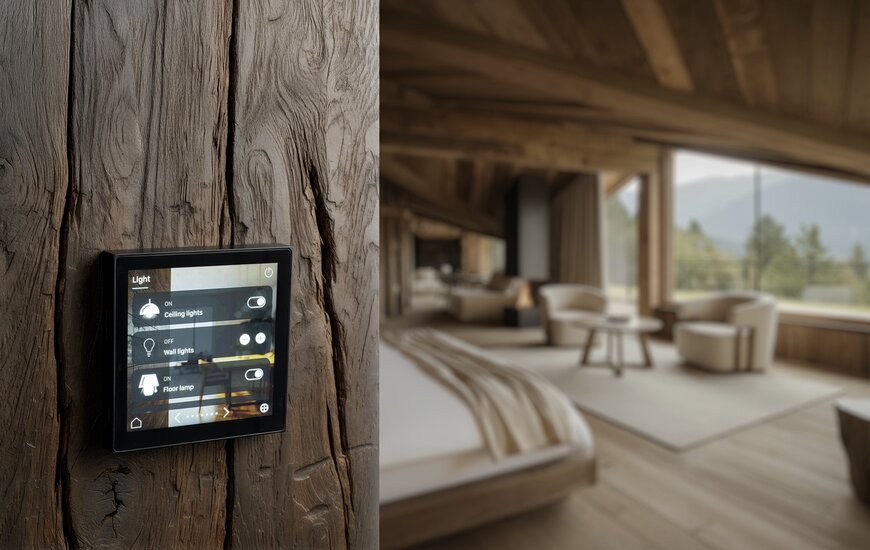
For centralized room management, the CP 4 KNX iteration features a 4-inch capacitive touchscreen. This interface consolidates facility commands, enabling users to regulate lighting arrays, shading systems, and climate control from a single point. The display architecture supports up to 48 distinct programmable functions distributed across six configurable pages, utilizing custom background interfaces to map specific room controls.
Integrated Sensor Telemetry and Logic Processing
Both interface types embed internal sensors to capture continuous telemetry regarding room conditions, measuring temperature, ambient light, relative humidity, and proximity. Crucially, the system measures air quality through internal CO₂ sensors, a metric increasingly utilized for automated ventilation control. The acquired telemetry drives an on-board thermostat capable of directing 2-point and Pulse Width Modulation (PWM) HVAC systems. Furthermore, the controllers execute local boolean logic operations, including AND, OR, and XOR gates, reducing the processing load on centralized building servers.
Standardized Engineering Tool Software Deployment
For system integrators, the hardware utilizes a native architecture requiring no supplementary plug-ins within the standard Engineering Tool Software (ETS) environment. The push-button models utilize a universal electronic baseplate, decoupling the logic and communication hardware from the aesthetic cover. This separation allows facilities to alter the physical finishes during lifecycle renovations without altering the underlying communication bus or reprogramming the node. The physical KNX programming button remains directly accessible on the front panel to facilitate rapid commissioning.
Additional Context
This section details technical specifications and competitive benchmarking not included in the original news release.
In the global market for high-end KNX interfaces, tactile room controllers with integrated telemetry compete against established platforms such as the ABB Tacteo and the Jung LS TOUCH. While many premium KNX keypads utilize capacitive glass surfaces, the PB KNX series opts for mechanical actuation combined with metallic finishes, addressing specific acoustic and tactile feedback requirements in hospitality applications.
From a sensor perspective, the integration of native CO₂ measurement within a standard 86-millimeter keypad or 4-inch display provides a measurable architectural advantage. Competing display units like the Gira G1 offer extensive central control capabilities via a larger screen, but standard mechanical keypads often require separate ceiling-mounted sensors for air quality measurement. Consolidating CO₂ telemetry, PWM HVAC control, and logic gates directly onto the bus-powered node lowers the total component count per room, standardizing the energy management ecosystem for large-scale commercial deployments.
Edited by Aishwarya Mambet, Induportals Editor, with AI assistance.
www.theben.com
