
smartbuildingmag.com
02
'26
Written on Modified on
Connected Fire Detection Technology for Autonomous Buildings
Siemens Smart Infrastructure expands fire safety with Sinteso Nova through cloud connectivity, real-time monitoring, and predictive maintenance.
www.siemens.com
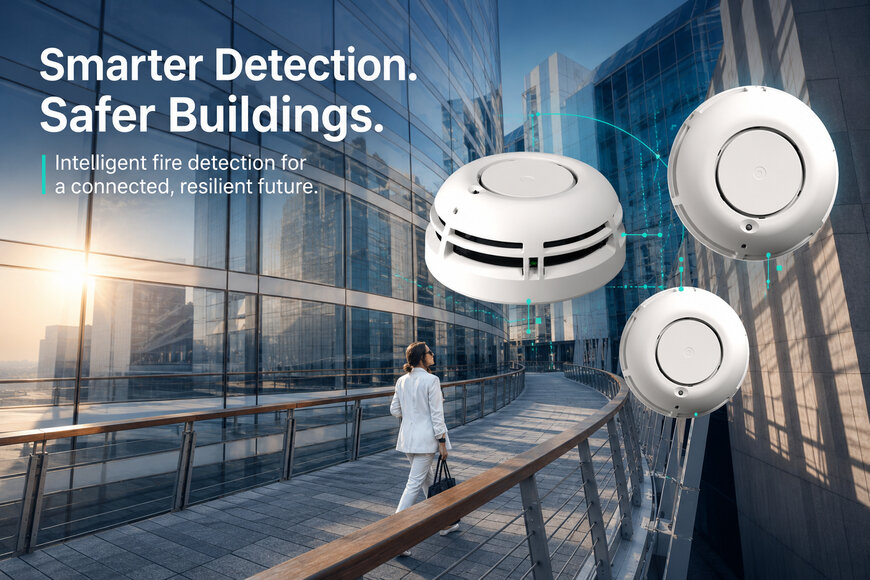
Siemens Smart Infrastructure has introduced its new Sinteso Nova fire detection portfolio. The solution combines high-precision detection technologies with IoT connectivity and cloud-based services to transform fire protection from reactive alarm systems into intelligent, data-driven safety platforms. The technology is designed for hospitals, data centers, universities, hotels, industrial facilities, logistics centers, and commercial buildings.
This approach supports the development of autonomous buildings, where safety systems can be continuously monitored, analyzed, and partially automated. By integrating sensors, cloud services, and digital building management, the solution creates a unified safety ecosystem that improves both operational reliability and maintenance efficiency.
Precise Fire Detection Through Multi-Sensor Technology
A key component of Sinteso Nova is ASAplus (Advanced Signal Analysis) technology. It combines multi-wavelength optical sensing with dual thermal detection to identify fires at an early stage while reducing false alarms. By simultaneously analyzing multiple physical parameters, the system can distinguish real fire incidents from environmental disturbances.
In hospitals, where evacuations can significantly affect patient care and daily operations, reducing false alarms helps maintain service continuity. Continuous monitoring also enables rapid response to potential hazards.
Continuous Performance Monitoring Through Intelligent Sensors
With integrated Smoke Entry Supervision (SES), Sinteso Nova continuously monitors detector smoke-entry openings in real time. This function ensures that sensors remain fully operational and allows contamination or obstructions that could affect performance to be identified quickly.
Operators can therefore schedule maintenance activities before reduced performance affects detection capability. This continuous monitoring represents a significant advancement over traditional systems that rely primarily on periodic inspections.
Cloud Monitoring and Building Data Utilization
The detectors are fully Internet of Things-enabled and can be integrated with cloud applications such as Siemens Building X Fire Connect. These tools provide real-time monitoring, remote diagnostics, and predictive maintenance through a centralized platform.
Operators can monitor the condition of fire protection systems deployed across multiple sites from a single interface. Temperature data collected by the detectors can also be transferred to the Building X platform and used within the Building X Environmental and Air Quality application to improve building energy efficiency and sustainability.
This capability extends the role of fire detectors beyond protecting people and assets, integrating them into a broader digital ecosystem for intelligent building management.
Protection of Critical Infrastructure and Distributed Facilities
Data centers face specific fire protection challenges because of their high energy density and requirement for uninterrupted operation. The new technology helps operators detect overheating or electrical faults early and respond proactively through cloud-based monitoring.
For organizations managing multiple buildings, such as universities, hotel chains, or logistics facilities, digital connectivity provides a centralized view of distributed infrastructure. This simplifies the implementation of consistent safety standards while optimizing maintenance and service operations.
Modernization of Existing Fire Protection Systems
One of the key advantages of the Sinteso Nova portfolio is the ability to modernize existing installations gradually. The new detectors remain compatible with installed fire control panels and can be integrated through a plug-and-play approach that includes automatic transfer of existing configurations.
This compatibility reduces installation costs, minimizes operational risks during upgrades, and simplifies the introduction of new digital functions into existing buildings. It also supports long-term investment strategies for building owners and facility managers.
Sustainability and Digital Building Transformation
The detectors carry the Siemens EcoTech label and incorporate recycled plastics. Their design also follows principles of resource efficiency and circular economy practices. The portfolio forms part of the Siemens Xcelerator platform, which supports the digital transformation of buildings and infrastructure.
According to Siemens, the products were developed and are manufactured in Switzerland. The combination of intelligent sensors, cloud connectivity, and sustainability-focused design highlights the increasing convergence of fire protection and digital building management within modern smart-building architectures.
Additional Context: This section details technical specifications and competitive benchmarking not included in the original product announcement
The intelligent fire detection market is increasingly evolving toward connected and integrated safety platforms. Comparable solutions are offered by Honeywell, Johnson Controls, Bosch Building Technologies, and Schneider Electric. Key evaluation criteria include detection speed, false alarm rates, remote maintenance capabilities, building management system integration, and cybersecurity features.
Multi-sensor detectors combining optical and thermal analysis have become the standard for demanding applications because they provide greater detection accuracy than conventional single-sensor technologies. Cloud-connected systems additionally enable continuous equipment monitoring, automated maintenance planning, and centralized multi-site management.
The integration of fire protection data into digital building management platforms reflects a major trend in the smart-building market. Building operators are increasingly using safety, energy, and environmental data together to reduce operating costs, improve energy efficiency, and automate building operations.
Continuous sensor monitoring through technologies such as Smoke Entry Supervision differentiates modern systems from traditional solutions based on periodic inspections. This approach reduces equipment availability risks and facilitates the implementation of data-driven maintenance strategies suited to modern digital infrastructure.
Edited by Sucithra Mani, Induportals editor – adapted by AI.
www.siemens.com
