
smartbuildingmag.com
19
'26
Written on Modified on
Data Center and Smart Building Variable Frequency Drive Optimization
Danfoss introduces the iC7-HVACR variable frequency drive to improve power quality and integrate decentralized control intelligence in critical infrastructure applications.
www.danfoss.com
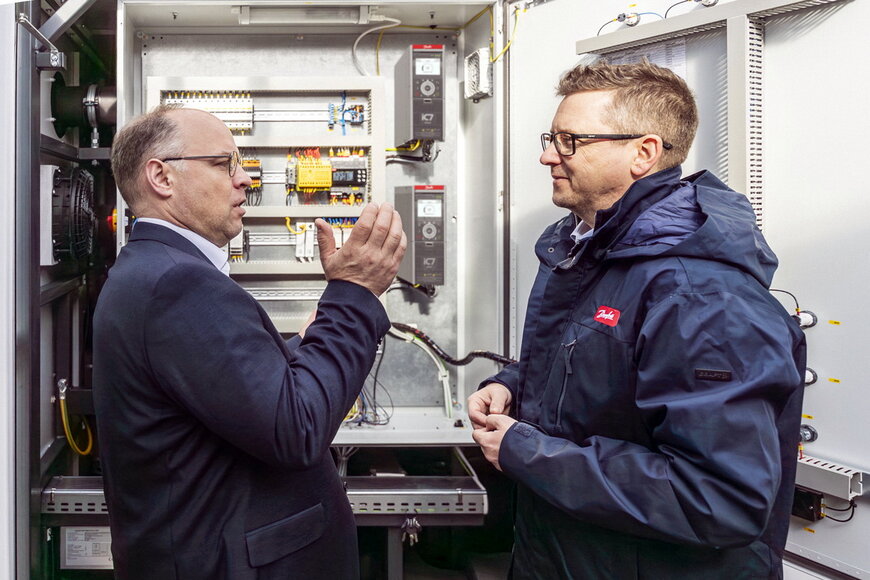
Danfoss has launched the new iC7-HVACR variable frequency drive for heating, ventilation, air conditioning, and refrigeration applications where energy efficiency, power quality, and system availability are critical requirements. The solution is aimed particularly at data centers, hospitals, clean rooms, and smart buildings, where HVACR system stability directly affects operational continuity and energy consumption.
Ultra-low harmonic distortion for critical power networks
The iC7-HVACR portfolio includes an ultra-low harmonic (ULH) variant designed to reduce harmonic distortion fed back into the electrical grid. Harmonic distortion can cause energy losses, place additional stress on electrical infrastructure, and reduce the reliability of sensitive electronics, particularly in data centers, hospitals, and clean rooms.
According to Danfoss, the ULH design combines a compact footprint and lightweight construction with low harmonic distortion, helping facilities comply with grid standards while reducing the need for additional filtering equipment. Stable power quality is especially important in high-availability environments where even minor electrical disturbances can affect servers, ventilation systems, or laboratory operations.
Integrated HVACR intelligence for building automation
The drive’s processing capability has been expanded to allow it to operate simultaneously as a sensor hub and local controller. This reduces the need for external PLCs and simplifies building automation architectures.
The system enables real-time data transfer to Building Management Systems (BMS), supporting indoor air quality management and HVACR equipment optimization. Integrated control functionality can accelerate commissioning and reduce system integration complexity, particularly in large commercial buildings and data center environments.
Danfoss also states that the iC7-HVACR supports energy optimization by helping reduce Power Usage Effectiveness (PUE) values in data centers. PUE is commonly used to measure the ratio between a data center’s total energy consumption and the energy used by IT equipment.
Cybersecurity integrated into critical infrastructure
The iC7-HVACR includes an integrated hardware cryptochip designed to prevent unauthorized access to the drive. Cybersecurity has become a critical requirement in HVACR systems as building automation networks are increasingly connected to cloud platforms and remote management systems. Hardware-level protection can reduce the risk of unauthorized access to critical ventilation or cooling systems in environments such as data centers and healthcare facilities.
Compact design for retrofit and new-build projects
According to Danfoss, the iC7-HVACR is approximately 20 percent more compact than comparable alternative solutions. The reduced physical size simplifies installation in projects with limited cabinet space or in retrofit upgrades of existing infrastructure.
The product also features an intuitive interface, simplified power cable connections, and compatibility with a wide range of HVACR equipment. In addition, Danfoss provides global lifecycle and maintenance support through its DrivePro service network.
Additional Context
Technical specifications and competitive benchmarking not included in the original product announcement
In the HVACR variable frequency drive market, energy efficiency, harmonic mitigation, and cybersecurity have become key benchmarking criteria, particularly in data center and smart building applications. Competing solutions are offered by companies including ABB, Siemens, and Schneider Electric through their HVAC drive portfolios.
Ultra-low harmonic technology is commonly used across the industry to reduce total harmonic distortion below limits recommended by IEEE 519 guidelines. Integrated building automation and IoT capabilities have also become increasingly important in data centers, where HVACR systems can account for a substantial share of total facility energy consumption.
Cybersecurity features such as hardware-based security chips and protected access management mechanisms are similarly becoming important differentiators in automation systems for critical infrastructure.
Edited by Evgeny Churilov, Induportals Media - Adapted by AI.
www.danfoss.com
