
smartbuildingmag.com
17
'26
Written on Modified on
Secure KNX Temperature Control for VRF Air Conditioning Systems
Elsner Elektronik introduces the eTR 103 AC KNX sec to facilitate encrypted climate management and simplified device commissioning within building automation networks.
www.elsner-elektronik.de
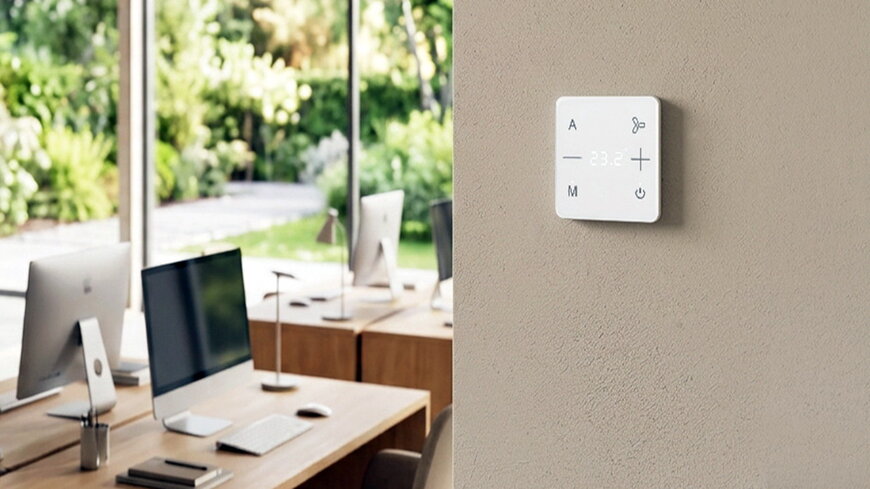
The eTR 103 AC KNX sec is a specialized room temperature controller designed for the management of Variable Refrigerant Flow (VRF) air conditioning systems in commercial and hospitality environments. By integrating sensing, control logic, and secure communication protocols into a single hardware unit, the device provides a standardized interface for complex HVAC infrastructures.
Integration within the Automotive Data Ecosystem and Smart Buildings
While primarily utilized in stationary building management, the demand for secure, interoperable data exchange mirrors the requirements of a modern digital supply chain. The eTR 103 AC KNX sec addresses these needs by implementing KNX Data Secure as a native standard. This protocol ensures end-to-end encryption and authentication of telegrams within the KNX bus system, preventing unauthorized telegram injection or bus manipulation. To further streamline technical deployment, the controller utilizes semantic tagging and Smart Linking, which allow for automated object mapping during the commissioning phase in the Engineering Tool Software (ETS).
Technical Specifications and Sensor Logic
The device functions as a centralized node for room climate data, housing integrated sensors for both temperature and humidity. For larger spatial volumes where a single measurement point is insufficient, the application allows for the weighted combination of internal values with external measurements received via the bus.
The control mechanism utilizes a Proportional-Integral (PI) algorithm to manage VRF specific variables, including fan speed stages, operating modes (heating, cooling, or ventilation), and setpoint offsets. This localized processing reduces the necessity for central automation station resources.
Hardware Interfaces and Application Scope
The hardware includes two physical binary inputs, allowing for the direct integration of window contacts or conventional push-buttons. This configuration enables the following technical behaviors:
- Energy Efficiency: Automatic transition to "Building Protection" mode upon detection of an open window via the binary input.
- Reduced Hardware Footprint: Elimination of separate binary input modules, as external signals are processed directly by the controller’s internal logic gates.
- User Interface: A simplified touch-sensitive surface provides direct access to primary HVAC functions without requiring deep menu navigation, a critical requirement for hotel guest rooms and multi-tenant office spaces.
By consolidating control, sensing, and logic functions into a single bus subscriber, the system reduces the total device count on a line, thereby lowering the potential points of failure and decreasing the total current consumption of the KNX installation.
Edited by Evgeny Churilov, Induportals Media - Adapted by AI.
www.elsner-elektronik.de
Edited by Evgeny Churilov, Induportals Media - Adapted by AI.
www.elsner-elektronik.de
