
smartbuildingmag.com
18
'26
Written on Modified on
Automated weather stations for residential building shading control
The sensor system developed by Elsner Elektronik enables precise environmental data acquisition to optimize automated smart home functions.
www.elsner-elektronik.de
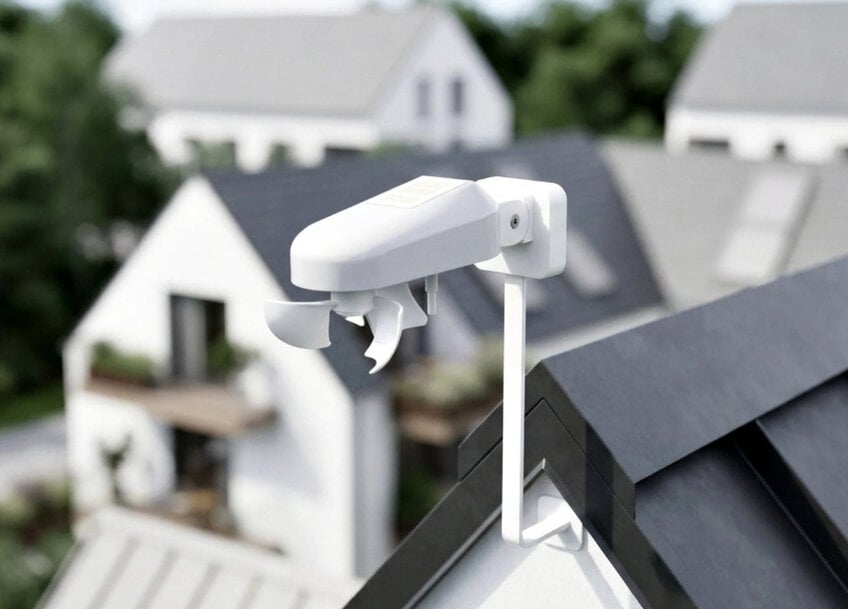
The deployment of intelligent sensor networks within the digital supply chain of smart residential construction enables dynamic environmental control without relying on complex, multi-device architectures. The introduction of integrated weather stations with onboard sun position tracking provides a unified solution for automating single-family home shading systems.
Technical configuration and mechanical wind measurement
For building automation, accurately measuring environmental variables is critical for triggering protection mechanisms and optimizing thermal loads. The Windancer 2.0 GPS KNX sec functions as a combination sensor designed for direct connection to the KNX bus system, uniting weather data acquisition and logic evaluation in a single device. Instead of relying on solid-state thermal mass flow sensors, wind velocity is measured using a mechanical cup anemometer. This mechanism reliably captures wind data, providing essential input for the automated retraction of blinds and awnings during severe weather. Wind data is processed and output in m/s, km/h, or the Beaufort scale.
GPS-based sun calculation and automated shading
Maximizing energy efficiency in residential buildings requires dynamic control over solar heat gain. The weather station utilizes an integrated GPS receiver to calculate the exact astronomical position of the sun based on local coordinates and time. This GPS-based sun position calculation enables sun-position-dependent shading control for up to eight distinct building facades, adjusting blind slats according to the sun's azimuth and elevation. The system incorporates logic functionality featuring integrated AND and OR gates, allowing integrators to create flexible automation routines to protect mechanical infrastructure.
System commissioning and secure communication
Simplifying the deployment process reduces engineering overhead during installation. The device utilizes a completely revised Engineering Tool Software (ETS) application that accelerates project planning. Faster orientation within the software is achieved through an integrated context-sensitive help system. Furthermore, integration effort is significantly reduced by utilizing semantic data formatted for Smart Linking, which streamlines the association of group addresses. The setup allows simpler parameterization by featuring a Live Data Adjustment function, which permits the immediate setting of current measured values as operational limit values. Secure communication across the building network is guaranteed by the implementation of the KNX Data Secure standard, protecting sensor data against unauthorized interception.
Additional Context: This section details technical specifications and competitive benchmarking not included in the original product announcement
Within the KNX building automation market, weather stations are benchmarked based on their sensor configuration, wind measurement mechanisms, and maximum wind speed detection limits. A direct comparable is the Meteodata 140 S KNX from Theben, which offers sun protection control for up to eight facades via three integrated brightness sensors and features a wind speed measurement range of 2 to 30 m/s. Another market alternative is the MDT KNX Weather Station Home, which utilizes solid-state sensors to measure brightness for three cardinal directions and limits shading control to three facades without an integrated GPS module for astronomical sun tracking.
The technical distinction of the evaluated system lies in its mechanical cup anemometer, which provides a reliable operational ceiling for wind alarms, and the integration of GPS-based calculations for continuous slat tracking across eight facades without requiring manual location configuration.
Edited by Maria Brueva, Induportals editor – adapted by AI.
www.elsner-elektronik.com
