
smartbuildingmag.com
10
'26
Written on Modified on
360° Fisheye Cameras Gain Edge AI and Expanded Analytics
Hanwha Vision's second-generation X AI Fisheye Cameras, built on the Wisenet 9 SoC, combine panoramic coverage with on-device analytics and simplified field deployment.
hanwhavision.eu
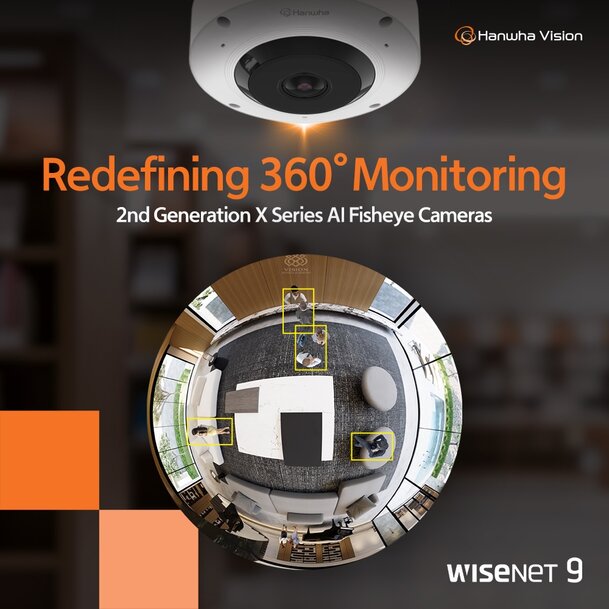
Hanwha Vision has released the X AI Gen 2 Fisheye Camera series, integrating the Wisenet 9 system-on-chip to deliver 360° panoramic surveillance with on-device artificial intelligence processing. The cameras target security and operational monitoring in commercial, public, and industrial environments, reducing the number of devices required to cover large or complex spaces.
A Single Device for Full-Area Coverage
Fisheye cameras have long offered a cost-effective alternative to multi-camera configurations by capturing an unobstructed 360° field of view from a single ceiling or wall-mounted unit. The X AI Gen 2 series maintains this advantage while addressing common limitations of earlier designs, particularly image distortion, installation rigidity, and limited on-device processing capacity.
The cameras feature a compact, low-profile housing suited to environments including retail premises, transport terminals, office facilities, and public buildings. Digital rotation and remote view adjustment allow installers to correct perspective without physically repositioning the lens — a practical improvement that reduces time on-site and lowers the risk associated with working at height.
Dual NPU Architecture Supports On-Device Analytics
The Wisenet 9 SoC incorporates a dual neural processing unit (NPU) architecture, enabling simultaneous execution of AI-based image enhancement and edge analytics without performance trade-offs. This design avoids dependence on centralised server-side processing for real-time tasks, reducing network load and inference latency.
The cameras classify and track people and vehicles, applying attribute metadata — including inferred gender, clothing colour, and vehicle type — to each detected object. This structured data is transmitted to compatible video management systems (VMS), supporting post-incident investigation and reducing the manual review of recorded footage.
Beyond security monitoring, the analytics layer enables operational use cases such as pedestrian flow measurement and occupancy analysis, extending the cameras' utility to business intelligence applications in retail and facility management.
Image Quality Across Variable Lighting Conditions
The Wisenet 9 image processing pipeline applies AI-driven enhancement to manage exposure, noise reduction, and colour accuracy dynamically. This is relevant for fisheye deployments, where a single sensor must simultaneously capture areas of high contrast — such as entrances with mixed natural and artificial lighting — without producing overexposed or underexposed zones that could obscure events of interest.
Audio Input and Sound Classification Readiness
Three integrated microphones provide audio capture with noise reduction. The hardware is described as ready to support AI-based sound classification functions once available via firmware update, allowing future detection of acoustic events such as glass breakage or raised voices without hardware replacement.
Cybersecurity and Privacy Compliance
The X AI Gen 2 cameras implement Hanwha Vision's Wisenet 9 cybersecurity stack, which includes Secure Boot, operating system and storage encryption, and FIPS 140-3 Level 3 certification — a standard applicable to cryptographic modules in government and regulated commercial contexts. Dynamic Privacy Masking (DPM) obscures defined areas of the image in real time, enabling operators to balance evidentiary recording needs with personal data protection requirements under applicable privacy regulations.
Integration and Environmental Ratings
The cameras carry IK10 vandal resistance and IP66 ingress protection ratings, qualifying them for deployment in environments subject to physical impact or dust and water exposure. Connectivity with major VMS platforms and Hanwha Vision's cloud management environment supports centralised configuration, monitoring, and scalability across distributed installations.
Wi-Fi Direct enables initial setup via mobile device, reducing the need for dedicated configuration hardware during commissioning.
Edited by an industrial journalist, Lekshman Ramdas, with AI assistance.
www.hanwhavision.com
