
smartbuildingmag.com
21
'26
Written on Modified on
Edge AI Camera Systems for Unified Audio-Visual Surveillance
Hanwha Vision introduces an indoor security platform that consolidates video analytics, high-decibel communication, and visual alerting to streamline facility monitoring infrastructure.
hanwhavision.eu
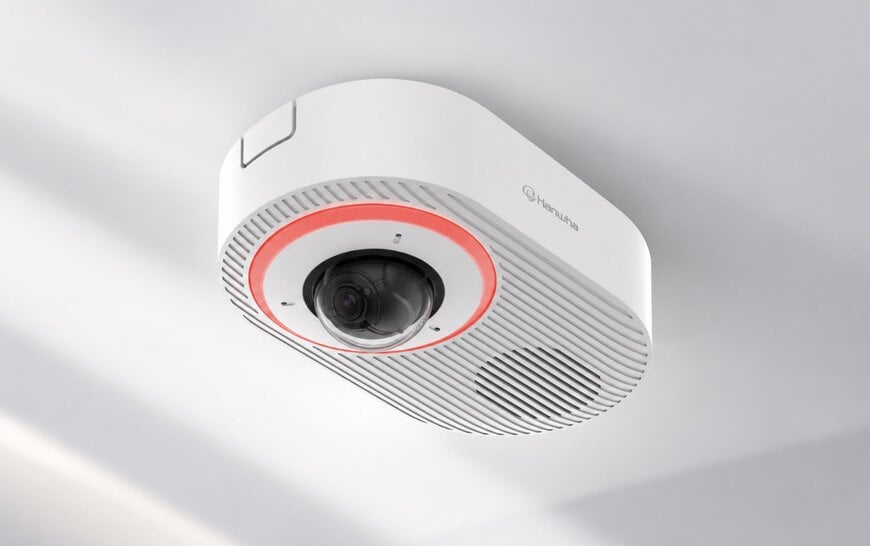
Hanwha Vision is releasing the SPS-A8016, an all-in-one indoor security solution that merges intelligent video analytics, proactive audio messaging, and visual notifications. The device is engineered to reduce installation complexity and hardware requirements across retail, healthcare, educational, and financial environments by facilitating real-time environmental sensing and direct on-site interaction through a single hardware node.
Dual-NPU Architecture and Edge Video Analytics
The SPS-A8016 operates on the proprietary Wisenet 9 System-on-Chip (SoC), which utilizes a Dual Neural Processing Unit (NPU) architecture. This hardware separation ensures that video encoding and artificial intelligence computations run on independent resources, preventing performance degradation in either function. The device features a 5MP sensor equipped with 120dB extreme Wide Dynamic Range (WDR) to manage challenging backlight conditions, alongside WiseStream bandwidth reduction technology.
At the edge, the camera natively performs object classification, categorizing people, faces, vehicles, and license plates while generating detailed attribute metadata. It also processes Business Intelligence metrics without requiring external servers or additional licensing, executing people counting, queue management, and heatmapping. For safety applications, the onboard AI monitors for slip-and-fall incidents, loitering, line crossing, and virtual area breaches to trigger automated responses.
Acoustic Integration and SIP-Based Communication
To facilitate multi-modal security operations, the unit integrates three Micro-Electromechanical Systems (MEMS) microphones—two utilized for beamforming and noise reduction, and a third optimized for extreme decibel environments. When paired with the built-in 90dB speaker, the system delivers full-duplex two-way audio with active echo cancellation.
The audio array supports deep learning-based sound classification, autonomously detecting specific acoustic triggers such as breaking glass, vehicle horns, tire screeches, aggression, screams, and sudden extreme decibel spikes. By incorporating native SIP 2.0 protocol support, the device integrates directly into existing Voice over IP (VoIP) and PBX telephony systems, allowing security operators to communicate directly through the camera from external communication nodes.
Visual Alerting and Cybersecurity Infrastructure
Beyond audio-visual monitoring, the camera functions as an active notification mechanism via a multi-color RGB LED ring. Administrators can program customizable colors and sequential flashing patterns to signal different event classifications visually. The system utilizes Boolean logic to configure complex event triggers and routes real-time notifications via speaker outputs, LED flashes, external alarms, MQTT, FTP, and HTTP/HTTPS/TCP protocols. The hardware is compatible with major Video Management Systems (VMS), including Genetec, Milestone, Wisenet WAVE, and BLAZE.
To secure data streams and prevent physical tampering, the chassis features IK08 impact protection and a built-in case tamper switch. The network infrastructure is secured by a Secure Element certified to FIPS 140-3 Level 3 and Common Criteria EAL6+ standards, alongside EN 303 645 IoT cybersecurity certification, signed firmware, and secure boot processes.
Additional Context
This section details technical specifications and competitive benchmarking not included in the original news release.
Within the intelligent surveillance network sector, endpoint devices are generally evaluated on edge processing capacity and infrastructure interoperability. While manufacturers such as Axis Communications and Avigilon (Motorola Solutions) offer edge-AI cameras and SIP-enabled IP audio speakers, these are typically deployed as discrete hardware units requiring separate Ethernet cable drops, switch ports, and VMS licenses. By housing a 90dB speaker, beamforming microphone array, and a Dual NPU within a single IK08-rated chassis, consolidated platforms reduce physical installation overhead and cabling costs. Furthermore, the inclusion of SIP 2.0 provides an objective interoperability advantage over proprietary audio routing protocols, allowing the surveillance node to function as a standard endpoint within enterprise PBX telephony networks.
Edited by Aishwarya Mambet, Induportals Editor, with AI assistance.
www.hanwhavision.com
