
smartbuildingmag.com
20
'26
Written on Modified on
Reciprocating Compressor Frame Design for Foundationless Industrial Installation
GEA introduces a rigid frame design for Grasso V reciprocating compressors to eliminate concrete foundations and structural constraints.
www.gea.com
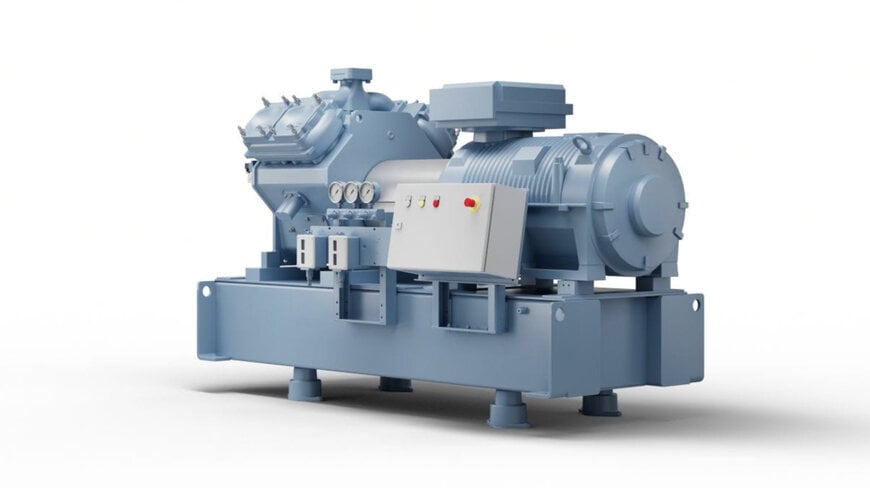
Industrial refrigeration and process heating systems often face structural installation barriers due to dynamic forces and mechanical vibrations transmitted by heavy rotating equipment into building subfloors. To mitigate structural resonance without costly civil engineering interventions, modern equipment architecture integrates rigid mounting bases and specialized damping systems across industrial cooling, cold storage, and data center applications.
GEA presented a new, highly rigid frame design engineered for its Grasso V series reciprocating compressor packages at Chillventa 2026 in Nuremberg. The company plans to roll out this mounting architecture across initial Grasso V series units by the end of 2026, followed by a gradual release for the complete product portfolio to streamline refrigeration installation and plant layout flexibility.
Vibration Isolation and Foundationless Machine Mounting
Reciprocating machinery naturally generates unbalanced reciprocating and rotating inertia forces that propagate into building floors, conventionally requiring heavy poured-concrete inertia blocks to stabilize the machinery. The frame developed by GEA dampens these vibrations at the source through high structural rigidity combined with dedicated vibration dampers or spring isolator systems.
By dissipating residual mechanical oscillations, the assembly meets the vibration limits specified under ISO 20816-8 ("Mechanical vibration – Measurement and evaluation of machine vibration – Part 8: Reciprocating compressor systems"). Meeting this international standard verifies that overall vibration levels on non-rotating components remain within acceptable severity thresholds without relying on an anchored concrete foundation. Consequently, plant planners can position units in previously restricted zones, such as intermediate mezzanines, upper floor levels, lightweight steel superstructures, and structurally constrained retrofit facilities.
Industrial Refrigeration Architecture and Natural Refrigerant Applications
The Grasso V series comprises pre-assembled, factory-tested reciprocating compressor skid packages engineered for industrial refrigeration and heating duties. Each skid incorporates the compressor core, drive motor, oil management system, safety valving, sensor instrumentation, and integrated controls. The compressor units operate predominantly with ammonia (R717), a natural refrigerant favored for zero global warming potential (GWP) and zero ozone depletion potential (ODP) in industrial environments.
Primary industrial application sectors include food and beverage processing, temperature-controlled logistics, industrial heat pumps, and data center cooling infrastructure. By eliminating the mass and footprint of a solid concrete plinth, the redesigned frame reduces the overall operational weight and floor area required by the installation. This reduction in civil construction tasks shortens mechanical installation schedules, minimizes facility disruption during equipment replacements, and lowers total installation expenditures.
Additional Context:
This section details technical specifications and competitive benchmarking not included in the original product announcement.
Industrial reciprocating compressors operating on natural refrigerants like ammonia or carbon dioxide (R744) typically generate low-frequency primary and secondary unbalance forces that challenge vibration isolation. Under ISO 20816-8, reciprocating compressor systems are classified across specific vibration displacement, velocity, and acceleration criteria depending on machine speed, power rating, and support stiffness (rigid versus flexible mounting).
In conventional plant engineering, isolating compressors without a foundation mass typically required either substantial steel sub-bases (often concrete-filled) or active dynamic balancing. Competing industrial compressor packaging solutions from manufacturers such as Bitzer, Sabroe (Johnson Controls), and Vilter (Emerson) address mounting flexibility through diverse engineering methods: Sabroe packages often utilize specialized structural steel bases with elastomeric or helical spring mounts engineered for low dynamic transmissibility, while Vilter single-screw compressors exhibit inherently lower unbalanced reciprocating forces due to balanced rotary compression geometry. Achieving full compliance with ISO 20816-8 on a flexible frame platform eliminates the structural engineering and curing time—often 28 days for structural concrete—required during rapid industrial retrofits.
Edited by Natania Lyngdoh, Induportals editor, with AI assistance.
www.gea.com
