
smartbuildingmag.com
01
'26
Written on Modified on
Hybrid VMS Enables AI Surveillance Scalability
Hanwha Vision introduces BLAZE VMS to unify multi-site surveillance management with AI-powered analytics and hybrid cloud architecture.
hanwhavision.eu
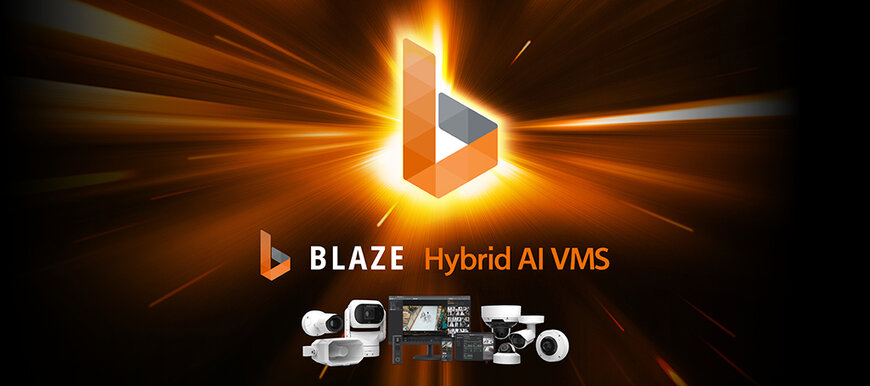
Hanwha Vision has launched BLAZE VMS, a hybrid video management system designed to support scalable, AI-enabled surveillance across distributed environments. The platform combines on-premise performance with cloud-based federation, targeting organisations managing multi-site security operations.
Hybrid architecture for distributed surveillance systems
The increasing complexity of surveillance infrastructures particularly across retail chains, industrial facilities, and critical infrastructure requires systems that balance local processing with centralised control. BLAZE VMS addresses this by integrating on-premise deployment with cloud connectivity, forming a hybrid architecture.
This structure enables each site to maintain local system performance while connecting to a centralised platform for user management and system coordination. Through cloud federation, multiple installations can operate under a single organisational framework, supporting single sign-on and unified access control without reliance on VPNs or port forwarding.
Such an approach aligns with the broader evolution of the digital supply chain in security operations, where distributed data sources are centrally orchestrated for efficiency and governance.
Native integration within a surveillance ecosystem
BLAZE is designed as an end-to-end platform within Hanwha Vision’s ecosystem, supporting a wide range of devices including cameras, intercoms, speakers, and thermal imaging systems. The system automatically detects connected hardware and applies predefined configurations, reducing manual setup requirements.
Bulk device configuration further accelerates deployment, allowing installers to onboard multiple cameras simultaneously. This reduces installation time from hours to minutes, particularly in large-scale deployments with hundreds of endpoints.
By integrating device management and video software into a unified environment, the platform simplifies lifecycle management from installation through daily operation.
AI-driven investigation and search capabilities
A key differentiator of the platform is its AI-native design, particularly in video analytics and search functions. The system integrates with embedded AI in cameras to enable object and attribute-based searches across recorded footage.
More advanced capabilities include similarity-based tracking, where the system identifies and correlates appearances of individuals across multiple cameras. This supports rapid movement tracing in large or multi-site environments.
BLAZE also introduces semantic search powered by generative AI. Unlike traditional systems that rely on predefined metadata, operators can query video archives using natural language descriptions. For example, describing a person’s appearance and location allows the system to retrieve relevant footage without manual tagging.
This capability reflects a shift toward more intuitive human-machine interaction within the automotive data ecosystem of smart surveillance environments, where unstructured queries can be mapped to structured video data.
Scalable architecture for multi-site operations
The platform uses a clustered system architecture, enabling incremental scaling from single-site deployments to distributed, enterprise-level installations. As additional sites are added, system performance and resilience are maintained through distributed processing.
Centralised user management ensures consistent access policies across all connected locations, supporting roles for operators, administrators, and service technicians. Remote access is secured through cloud connectivity, reducing infrastructure overhead.
Deployment optimisation through dedicated appliances
To further simplify implementation, BLAZE is available on purpose-built hardware appliances. These systems are pre-configured and pre-licensed, eliminating the need for operating system management and reducing integration complexity.
This approach is particularly relevant for system integrators and organisations seeking rapid deployment with predictable performance characteristics.
Positioning in video management systems
Hybrid VMS platforms are increasingly replacing purely on-premise or cloud-only systems, particularly in sectors requiring both low-latency processing and central oversight. Compared with conventional VMS solutions, hybrid architectures provide measurable benefits in scalability, deployment flexibility, and operational continuity.
By combining AI-driven analytics, hybrid infrastructure, and native device integration, BLAZE VMS represents a shift toward software-defined surveillance platforms capable of supporting large-scale, distributed security environments.
Edited by an industrial journalist Sucithra Mani with AI assistance.
www.hanwhavision.com
