
smartbuildingmag.com
09
'26
Written on Modified on
High-Temperature Industrial Heat Pumps for Decarbonization
Danfoss is expanding industrial heat pump capabilities to support high-temperature processes and district heating decarbonization.
www.danfoss.com
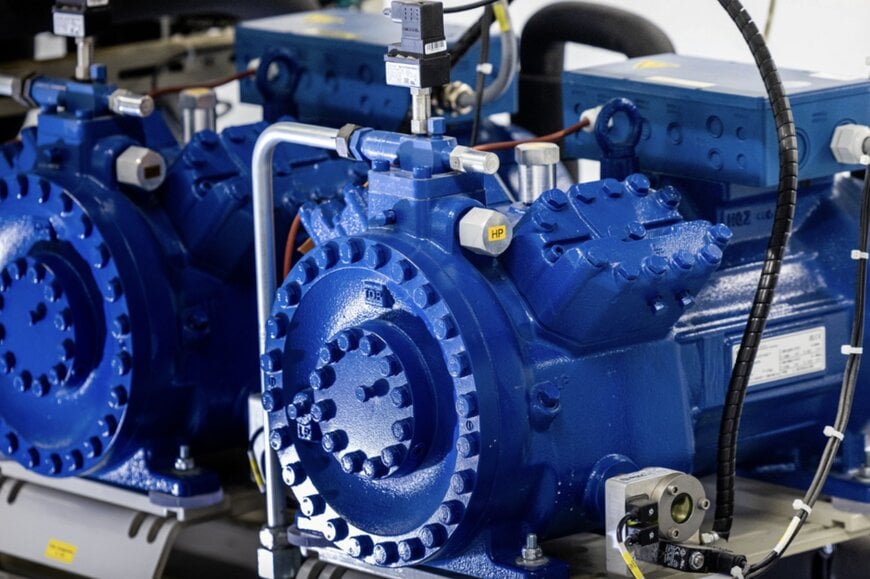
Danfoss is advancing industrial heat pump technology to deliver supply temperatures up to 120 °C, with pathways toward 150 °C, enabling electrification of high-temperature industrial processes and district heating systems.
Rising temperature requirements in industrial decarbonization
Industrial heat pumps are increasingly viewed as a core technology for reducing fossil fuel dependence in energy-intensive sectors such as food and beverage, pulp and paper, chemicals, and textiles. These industries rely on high-temperature water or steam for processes including drying, sterilization, evaporation, and boiling. Similarly, district heating networks—particularly in colder climates—require elevated supply temperatures to ensure system reliability and efficient heat distribution.
Historically, most commercial heat pump systems were limited to supply temperatures of approximately 90–100 °C, restricting their applicability in high-temperature industrial processes. Recent technology developments are now extending this range, enabling heat pumps to replace boilers in applications that were previously considered unsuitable for electrification.
Extending the operating temperature range
Danfoss is addressing this limitation by supporting heat pump system designs capable of reaching 120 °C (248 °F) today, with development pathways targeting 150 °C (302 °F). Achieving these temperatures requires careful system integration, optimized compressor technologies, refrigerant selection, and precise control of operating conditions to maintain efficiency, reliability, and component lifetime.
Higher temperature operation increases the thermodynamic and mechanical demands on compressors, heat exchangers, valves, and lubricants. As a result, component compatibility and system-level optimization become critical to ensure stable long-term operation.
System-level design and application support
Beyond supplying components, Danfoss emphasizes system-level design support to help original equipment manufacturers (OEMs and integrators accelerate development and commercialization of high-temperature heat pump solutions. This includes application expertise and simulation-based optimization using advanced tools such as the A3S program, which supports system modeling and performance analysis under demanding operating conditions.
Application Development Centers provide laboratory testing capabilities, allowing validation of designs under real operating scenarios. This approach supports early-stage concept evaluation, performance verification, and risk reduction prior to market deployment.
Compressor and component portfolio
Danfoss offers a broad portfolio of compressors qualified for industrial heat pump applications, compatible with low-global-warming-potential and natural refrigerants. Technologies include scroll, semi-hermetic reciprocating, screw, and oil-free centrifugal compressors, covering a wide range of capacities and operating envelopes.
Complementing the compressor range is a portfolio of line components and controls designed for high-temperature operation. These include high-temperature electric expansion valves and oil-free system components that contribute to improved reliability, reduced maintenance requirements, and higher overall system efficiency.
Controls and system intelligence
At the control level, Danfoss provides the AlsMart® controller platform, a programmable HVAC control system designed to manage complex heat pump architectures. The platform integrates hardware, software, and monitoring functions, enabling precise control of operating parameters, diagnostics, and performance optimization. In high-temperature systems, advanced control strategies are essential to balance efficiency, component protection, and operational flexibility.
Implications for industrial and district energy systems
By enabling higher supply temperatures, industrial heat pumps become a practical alternative to fossil-fueled boilers in a wider range of applications. This supports electrification strategies aimed at reducing direct emissions while improving energy efficiency, particularly when combined with renewable electricity sources.
For OEMs and system integrators, access to qualified components, simulation tools, and application expertise reduces development time and technical risk. As regulatory pressure and energy costs increase, high-temperature heat pump technologies are positioned to play a central role in the transition of industrial processes and district heating networks toward lower-carbon energy systems.
www.danfoss.com
