
smartbuildingmag.com
23
'26
Written on Modified on
Unified Access Control Systems for Pedestrian & Vehicle Management
Hikvision launches the Quick Pass platform to consolidate biometric pedestrian terminals and automated vehicle barriers under unified management.
www.hikvision.com
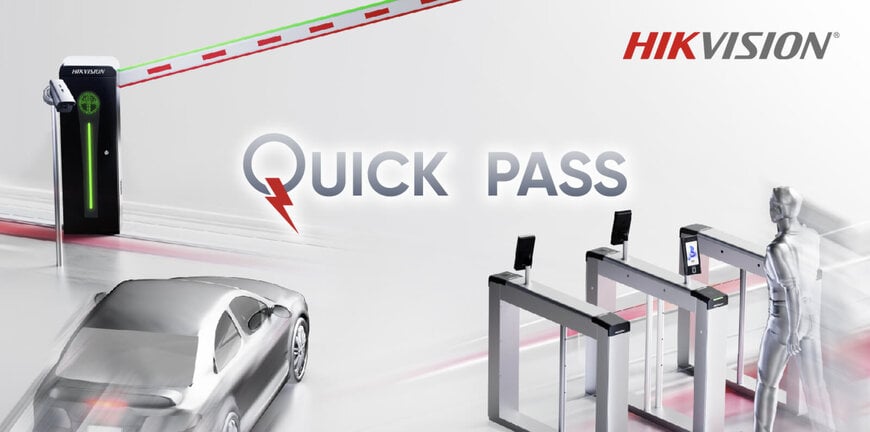
Fragmented physical security architectures that manage perimeter gate barriers and interior pedestrian turnstiles through disjointed software stacks create verification bottlenecks, credential vulnerabilities, and excessive administrative overhead. Physical security manufacturer Hikvision has introduced Quick Pass, a converged access control solution engineered to unify biometric pedestrian authentication and automated number plate recognition into a single operational architecture across commercial facilities and residential communities.
Multi-Modal Authentication and Edge Processing Architecture
Conventional facility access management frequently separates vehicle gates from pedestrian turnstiles and doorway controllers. This division requires security teams to configure permissions across multiple databases, exposing facilities to duplicated maintenance workflows, credential cloning risks, and vehicle queueing at perimeter check points. Quick Pass addresses this operational friction by networking edge recognition devices with centralized permission databases deployed through on-premises servers or cloud architectures via Hik-Connect Team Mode.
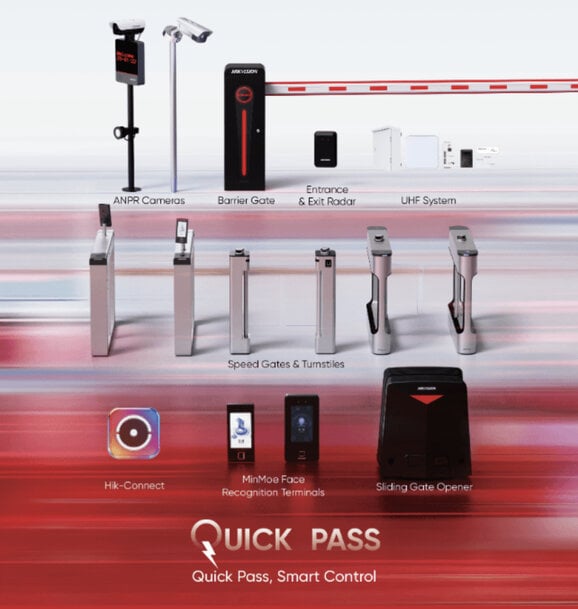
The edge layer deploys MinMoe biometric terminals equipped with dual-lens optical modules combining visible-light and infrared sensors for presentation attack detection. The hardware processes facial recognition within 0.2 seconds while achieving a verification accuracy rating of 99 percent, preventing access spoofing attempts utilizing photographic or video playback media. For vehicle checkpoints, integrated Automatic Number Plate Recognition (ANPR) cameras operate at a plate-reading accuracy of 98.5 percent or higher. In high-throughput industrial sites, the system supports long-range Ultra High Frequency (UHF) radio-frequency identification, while facilities requiring elevated security can configure two-factor verification enforcing simultaneous ANPR plate verification and driver facial recognition before triggering automated barrier arms.
Natural Language Administration and Automated Visitor Workflows
Access administration has historically demanded manual parameter entry for badge credentialing, time-and-attendance calculation, and transient guest tracking. The Quick Pass management software incorporates artificial intelligence engines that parse natural language commands, allowing system operators to assign access schedules, enroll credentials, register visitor permissions, and audit event logs through conversational queries rather than traversing multi-tiered configuration menus.
For visitor processing, the architecture eliminates paper sign-in registers by issuing temporary, time-bound digital credentials directly to guest mobile devices. Integrated employee time-and-attendance tracking synchronizes directly with turnstile barrier events, logging check-in timestamps without requiring secondary proximity card swipes.
Wenson Zhou, Product Marketing Director at Hikvision, explained that the platform combines vehicle and pedestrian entry layers into an integrated architecture to reduce system complexity while deploying artificial intelligence models to assist administrators with routine credentialing and permissions tasks across disparate facility types.
Deployment Topologies Across Commercial and Residential Infrastructure
The platform adapts hardware configurations to match site-specific perimeter and building access profiles:
- Residential and Villa Properties: The architecture integrates external door stations, remote gate actuators, and the Hik-Connect mobile interface, enabling residents to establish two-way audio-video intercom communication, actuate motorized gate locks remotely, and verify audit logs.
- Multi-Tenant Condominiums: MinMoe facial recognition terminals govern common entry portals to eliminate physical key management, while centralized management software allows property administrators to oversee building credentials, visitor time-windows, and parking permissions from a single interface.
- Commercial Offices and Manufacturing Plants: The system integrates MinMoe terminals directly with entrance swing turnstiles, logging employee shift attendance concurrently with physical entry. Vehicle lanes process employee and logistics freight movements using ANPR cameras or long-range UHF readers to avoid peak-hour checkpoint congestion.
Additional Context:
This section details technical specifications and competitive benchmarking not included in the original product announcement.
Modern IP-based physical access control systems are benchmarked against standardized communication protocols, primarily the Open Supervised Device Protocol (OSDP v2.2 / SIA CP-01) and specifications from the Open Network Video Interface Forum (ONVIF Profiles A, C, and M for metadata and access control). These standards replace unencrypted legacy Wiegand wiring interfaces with bidirectional, supervised RS-485 serial communication secured by 128-bit AES encryption. In biometric subsystems, facial recognition algorithms are evaluated under the National Institute of Standards and Technology (NIST) Face Recognition Technology Evaluation (FRTE), which benchmarks false match rates (FMR) and false non-match rates (FNMR) across variable ambient illumination.
In the converged building management and security sector, comparable access ecosystems include the Dahua DeepHub and WizMind access series, Johnson Controls' Software House C•CURE 9000 platform, and the Suprema BioStar 2 environment. While enterprise platforms such as C•CURE 9000 emphasize complex multi-site server integrations across third-party hardware ecosystems via open APIs, systems like Quick Pass and Dahua WizMind focus on vertically integrated, proprietary hardware-software convergence combining ANPR cameras, speed gates, and facial terminals into turnkey platforms.
Furthermore, cloud-managed edge architectures must adhere to data privacy frameworks such as the European Union General Data Protection Regulation (GDPR) and ISO/IEC 27001 certification. Under these compliance frameworks, edge biometric terminals increasingly execute feature extraction directly on the local neural processing unit (NPU), converting facial captures into mathematical vector templates rather than transmitting or storing raw, unencrypted facial imagery across cloud databases.
Edited by Natania Lyngdoh, Induportals editor, with AI assistance.
www.hikvision.com
