
smartbuildingmag.com
17
'26
Written on Modified on
NETZSCH Launches N.Durance Tungsten Carbide Rotor Coating
The fusion coating boosts wear resistance and service life in NEMO progressing cavity pumps for harsh municipal slurries.
www.netzsch.com
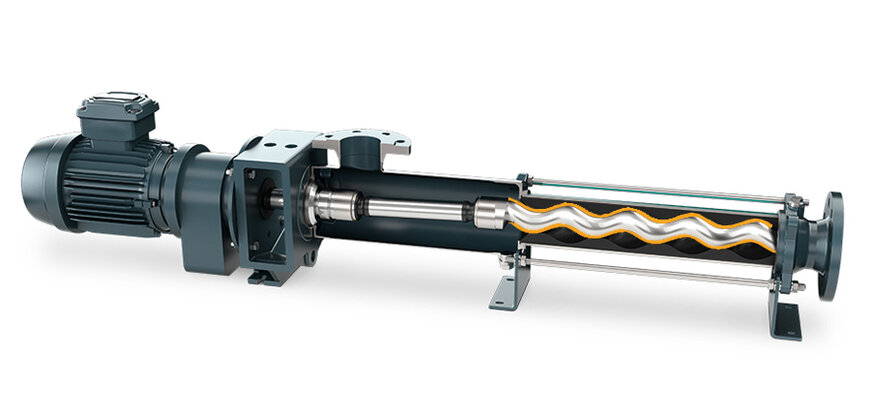
NETZSCH Pumps USA has introduced its N.Durance™ Tungsten Carbide Fusion Coating Technology, engineered to maximize the operational lifespan and reliability of NEMO® Progressing Cavity (PC) Pumps in highly abrasive and corrosive environments. Available in Advanced, Pro, and Ultimate configurations—with the Ultimate model featuring up to seven protective layers—the dense fusion coating achieves an industry-leading hardness of approximately 1,300 Vickers. By minimizing the oxidation and decarburization of tungsten carbide particles while ensuring high splat-layer cohesion, the treatment delivers superior crack and cavitation resistance under severe operating conditions.
Unlike traditional hard chrome plating processes that generate hazardous, carcinogenic hexavalent chromium, N.Durance utilizes an environmentally safe manufacturing method that creates a permanent metallurgical bond with the base rotor metal, preventing flaking or separation caused by under-film corrosion. Produced in-house at the company's Exton, Pennsylvania facility, the technology supports rapid turnaround times—including same-day shipment capabilities—and complies fully with Build America, Buy America (BABA) standards. When paired with NETZSCH's NORIUS™ smart monitoring system, the technology enables municipal wastewater plants, chemical processors, and energy facilities to achieve extended maintenance intervals and lower total lifecycle costs.
Additional Context
This section provides technological and market background not explicitly detailed in the original release.
Progressing cavity pumps operate on the Moineau principle, where a helical metal rotor rotates eccentrically within a stationary elastomeric stator to create progressing cavities that advance fluids. In municipal wastewater and industrial sludge processing, these pumps continually encounter abrasive suspended solids such as grit, sand, and mineral fines. The continuous sliding friction between the rotor and stator accelerates surface wear, which degrades pump volumetric efficiency, increases slip, and ultimately leads to stator blow-by and catastrophic pressure drops.
Historically, hard chrome plating was the primary defense against this abrasion; however, mounting global environmental regulations (such as EPA mandates and European REACH restrictions on hexavalent chromium) are forcing equipment manufacturers to eliminate electrolytic chrome baths entirely. While High-Velocity Oxygen-Fuel (HVOF) and plasma thermal sprays have served as alternatives, they rely primarily on mechanical interlocking rather than atomic bonding. Under the cyclic bending and torsional loads typical of eccentric rotor operation, thermal spray layers are susceptible to micro-cracking and spalling. A high-density metallurgical fusion coating eliminates this interfacial shear failure, providing an impermeable, ultra-smooth boundary layer that minimizes friction against the stator elastomer while resisting severe chemical attack from corrosive sewage and industrial slurries.
Edited by Lekshman Ramdas, Induportals editor – adapted by AI.
www.netzsch.com
