
Mobile Construction Crane Facilitates Roof Transfers in Tight Spaces
Pontáns Kranar deployed an electric mobile construction crane to transfer modular protective roof elements directly between two residential blocks in Uppsala.
www.liebherr.com
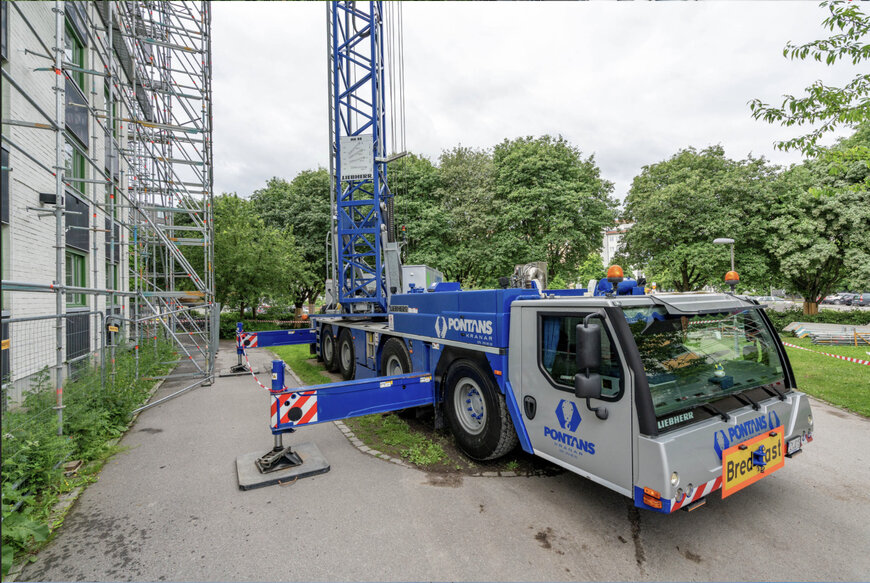
Industry Sector: Crane hire and lifting services, commercial construction
During a renovation project involving two six-storey apartment blocks in Uppsala, Sweden, lifting contractor Pontáns Kranar was tasked with transferring an extensive modular protective canopy from one structure to an adjacent building. The project required relocating approximately 20 aluminium roof segments, measuring up to 20 metres in length and weighing roughly one tonne each, with several elements still covered by fabric membranes.
The primary operational challenge lay in the physical restrictions of the urban job site. The space separating the buildings was constrained by established trees, site obstacles, and pedestrian lawns. Deploying a standard telescopic mobile crane in an equivalent capacity class would have required positioning the vehicle far back on the adjacent roadway, necessitating a considerably larger crane model to manage the required radius, resulting in road closures and elevated setup complexity.
Direct Transfer Strategy and Height Performance
To resolve the access limitations and reduce handling time, the contractor deployed a four-axle mobile construction crane featuring vertical tower geometry and a luffing lattice jib. Because of the vertical mast configuration, the unit could be erected immediately adjacent to the building scaffolding rather than set back at a distance.
Operating with a 15-degree luffing jib angle, the equipment achieved a hook height of approximately 30 metres while preserving sufficient horizontal outreach to bridge the gap between structures. This technical capability enabled the operator to lift approximately half of the roof segments from the primary scaffolding and swing them directly onto the receiving structure, bypassing intermediate ground-level storage entirely. For the segments that required temporary staging on the lawn due to intermediate obstacle angles, the unit was repositioned quickly to lift and place the remaining modules before the close of the shift.
Technical Features Supporting Safety and Site Flexibility
Visual control and site communication were streamlined via the continuously height-adjustable elevator cabin, which allowed the crane operator to align eye level directly with the roof-level installation crews and the suspended loads. This configuration eliminated blind lifts during critical positioning onto the target scaffolding.
Beyond structural agility, the hybrid drive system enabled electric site operation, reducing operational noise within the dense residential quarter. Integrated high-output lighting systems also supported work continuity under low-light conditions common to Northern European seasonal operations.
In addition to handling protective canopies, Pontáns Kranar utilizes this mobile construction crane across the Uppsala, Enköping, and Stockholm regions for heavy concrete placement, formwork installation, structural steel assembly, and the rapid assembly of prefabricated timber structures where constrained footprints preclude traditional tower or telescopic cranes.
Edited by Sucithra Mani, Induportals editor – adapted by AI.
www.liebherr.com
