
smartbuildingmag.com
06
'26
Written on Modified on
AI-Driven Building Operations Optimization Through Airside System Automation
Johnson Controls integrated advanced artificial intelligence tools into the OpenBlue ecosystem to automate facility operations and reduce thermal management energy consumption.
www.jnjmedtech.com
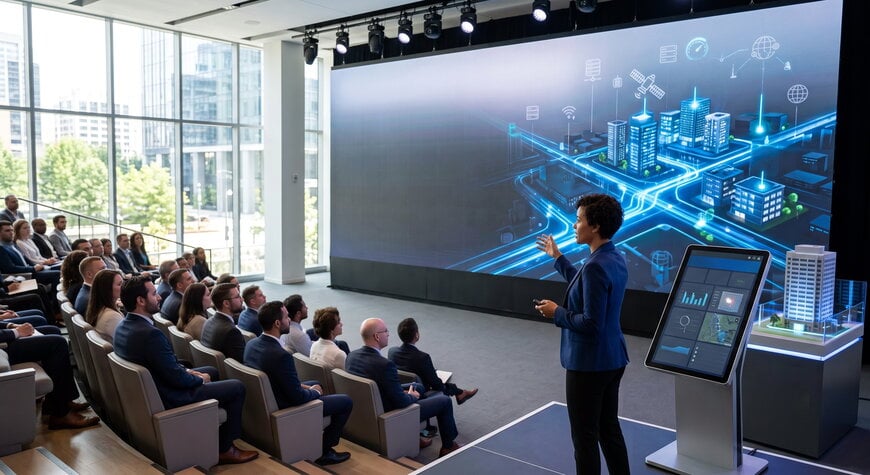
The updated platform introduces autonomous airside control algorithms, agentic AI for workflow automation, and an AI-native data architecture designed for commercial buildings, data-sensitive industries, and large multi-building campuses.
Airside Energy Optimization and Autonomous Control
Heating, ventilation, and air conditioning (HVAC) systems constitute a significant portion of commercial building energy consumption, with airside components such as air handling units (AHUs), fans, and air distribution systems accounting for substantial operational expenditure. The Energy & Comfort Intelligence module, powered by Nantum AI algorithms, calculates real-time efficiency adjustments and executes autonomous control commands across airside equipment.
The system dynamically balances air supply parameters to lower energy usage while maintaining required indoor environmental standards. In trial deployments, including at financial software enterprise DATEV, the system executed thousands of dynamic automated control commands per equipment unit, yielding a 10% reduction in airside energy consumption on targeted hardware without exceeding thermal comfort thresholds or generating occupant complaints.
This precise environmental control is applicable to facilities requiring strict ambient stability, such as semiconductor fabrication plants, battery manufacturing plants, research universities, and healthcare facilities where differential pressure, temperature, and humidity must remain within tight tolerances.
Agentic AI and Workflow Automation
The platform incorporates an agentic AI assistant designated as OBI (OpenBlue Intelligence). Operating under a human-in-the-loop governance structure, OBI processes multivariable data inputs — including space occupancy, indoor air quality metrics, energy consumption trends, and equipment performance indicators — via natural language text and voice interfaces.
Instead of operating strictly as a monitoring dashboard, the agentic framework evaluates operational anomalies, surfaces predictive recommendations, and executes pre-authorized maintenance workflows, such as automatically generating and routing work orders.
Standardized Data Architecture and Cybersecurity Network Protocol
Implementation timelines for large-scale building management systems often extend over several months due to manual device mapping and point-tagging. The updated OpenBlue platform features automated onboarding algorithms that discover network-connected devices, extract data points, and classify them according to standardized industry ontology models. This automated classification reduces system deployment time by up to 95%, shortening setup phases from months to days for facilities with thousands of distinct data nodes.
For custom software integration, an open Application Programming Interface (API) allows third-party applications to ingest normalized building telemetry. Network security is maintained via OpenBlue Airwall, a zero-trust network solution. The protocol enforces micro-segmentation, isolating individual devices and requiring explicit identity authentication prior to connection establishing. Data transfers occur through encrypted peer-to-peer tunnels, restricting third-party vendor access exclusively to designated target devices during specified operational windows, thereby mitigating lateral network attack risks. Economic evaluations conducted by Forrester indicate potential returns on investment of up to 155% for facilities adopting these integrated AI building systems.
Additional Context: Technical Specifications and Competitive Benchmarking
This section details technical specifications and competitive benchmarking not included in the original product announcement.
Building management platforms utilizing artificial intelligence operate in a competitive market alongside solutions such as Honeywell Forge, Schneider Electric EcoStruxure, and Siemens Desigo CC.
- Data Modeling and Onboarding: Standardized point-tagging frameworks within OpenBlue utilize industry ontologies (such as Project Haystack and BRICK Schema) to achieve the noted 95% reduction in onboarding time. Comparable baseline manual integration across competing enterprise platforms typically requires manual binding of thousands of register addresses, leading to multi-week deployment schedules per building.
- Network Security Model: While legacy building automation protocols (such as standard BACnet/IP) rely on perimeter firewalls, OpenBlue Airwall utilizes Software-Defined Perimeter (SDP) architecture and cryptographic isolation (HIP/Host Identity Protocol). This limits internal lateral movement compared to conventional VPN-based facility management architectures.
- Airside AI Optimization: Traditional variable air volume (VAV) control operates on fixed static pressure setpoint resets. The Nantum AI integration continuously models thermal mass and occupancy dynamics, evaluating closed-loop telemetry to alter fan speed vectors dynamically, matching predictive control capabilities present in specialized high-tier industrial plant optimizers.
