
smartbuildingmag.com
10
'26
Written on Modified on
Deploying 5G FWA Broadband via Existing Coaxial Infrastructure
InCoax Networks utilizes existing coaxial cabling to distribute multi-gigabit connectivity throughout dense residential buildings.
www.incoax.com
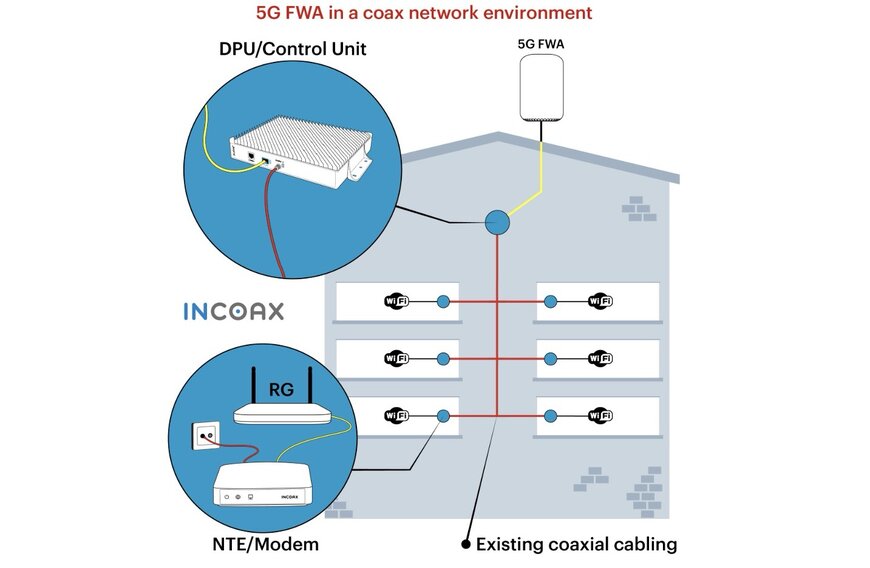
InCoax Networks AB has introduced a deployment model that uses 5G mmWave Fixed Wireless Access (FWA) as a high-capacity backhaul for multi-dwelling units (MDUs). By integrating this with existing in-building coaxial infrastructure, network operators can accelerate broadband availability in dense urban areas without requiring extensive physical rewiring.
Overcoming Indoor Signal Attenuation
High-band 5G and mmWave technologies deliver high capacity over short distances but face significant signal attenuation from physical barriers like low-emissivity windows and concrete floor slabs. To bypass these limitations, the InCoax solution captures the wireless signal at the building's exterior and transfers the data capacity using the property's existing coaxial cable network. This approach provides multi-gigabit capacity directly to individual subscribers, mitigating the indoor penetration constraints of mmWave frequencies.
TR-507 Architecture and Network Distribution
The system is built upon the Broadband Forum’s TR-507 architecture, which establishes a standardized framework for utilizing a single 5G FWA connection as shared backhaul for an entire property. The MoCA Access-based platform distributes this external capacity from a central control unit to network termination equipment located inside each apartment. This network configuration maintains per-subscriber separation, ensures distinct quality of service parameters, and provides full operational control over the internal network.
Recently demonstrated alongside Nokia at Network X in Paris, the multi-tenant architecture was developed to reduce the civil engineering requirements typically associated with MDU fiber installations. Craig Thomas, CEO and President of Broadband Forum, notes that the TR-507 standard treats 5G FWA as shared backhaul to the MDU, utilizing established in-building media to reach individual apartments. Jakob Tobieson, CEO of InCoax Networks, confirms that reusing existing coax with MoCA Access enables scalable FWA deployment in MDUs by eliminating the physical disruption of rewiring.
Scalable Infrastructure Migration
This building-centric deployment preserves a long-term migration path for network operators. The in-building MoCA Access network can initially operate using 5G FWA backhaul and subsequently transition to a direct fiber-optic feed once physical fiber reaches the premises. This ensures the installed distribution hardware remains functional as wide-area network topographies evolve.
Additional Context: This section details technical specifications and competitive benchmarking not included in the original product announcement
Within the broadband distribution sector, deploying full Fiber-to-the-Premises (FTTP) in existing multi-dwelling units requires significant capital expenditure and invasive construction. Alternative networking standards, such as G.fast over twisted-pair copper and G.hn over coax, provide competitive legacy-cable utilization. However, the MoCA Access standard is explicitly optimized for multipoint coaxial topologies, enabling symmetrical gigabit data rates with high immunity to the electromagnetic interference commonly found in dense residential environments. By terminating the 5G mmWave connection at the building's edge and utilizing MoCA Access for the final connection, operators achieve latency and reliability metrics that standard indoor wireless mesh networks cannot replicate through internal structural walls.
Edited by Lekshman Ramdas, Induportals editor – adapted by AI.
www.incoax.com
