
smartbuildingmag.com
30
'26
Written on Modified on
Frequency Inverters for HVAC and Building Automation
Yaskawa introduces the HV600 inverter series for operational efficiency in building automation.
www.yaskawa.eu.com
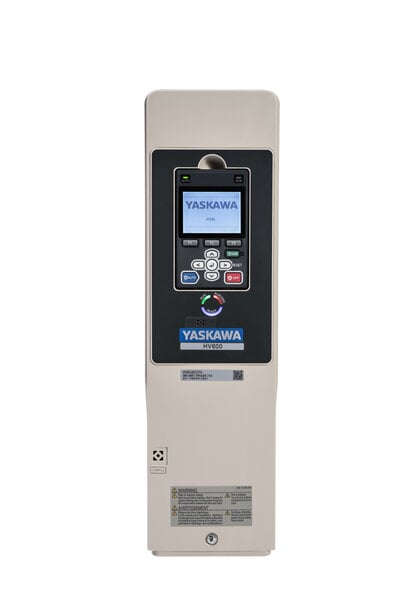
Yaskawa has introduced the HV600 series, a new generation of frequency converters designed specifically for building automation and HVAC (heating, ventilation, and air conditioning) applications. This hardware architecture is optimized for the precise control of fans, pumps, and compressors, ensuring the continuous regulation of the motor's power output based on actual load demand.
Electrical Architecture and Integrated Filters
The HV600 series devices natively integrate a category C2 EMC filter, which is effective for cable lengths up to 100 meters, and a standard direct current inductance (DC-choke) to mitigate harmonics introduced into the electrical grid. The hardware platform is capable of driving various topologies, enabling the management of traditional asynchronous motors, permanent magnet (PM) synchronous motors, and synchronous reluctance motors. Regarding layout and protection, the drives are available in versions with power outputs up to 160 kW in IP20 protection class, and up to 75 kW with an IP55 protection rating for harsher operating environments.
Connectivity and Software Presets
For integration into building management systems, the HV600 incorporates six standard communication protocols for the HVAC sector—including BACnet, Siemens APOGEE, Johnson Controls Metasys, and MEMOBUS/Modbus—eliminating the need to install external network expansion cards. On the software level, the system features preconfigured algorithms for specific application scenarios, such as a Pump Sequencer, Master-Slave configurations, and bypass management. The operator interface includes an LCD control panel with hand-off-auto functionality, a status indicator light ring for immediate visual diagnostics, and a real-time clock (RTC) for accurate system event timing.
Additional Context: This section details technical specifications not included in the original announcement.
In building automation systems (HVAC), Variable Frequency Drives (VFDs) employ Pulse Width Modulation (PWM) techniques to control the rotational speed of electric motors, thereby optimizing power consumption. The integration of a DC-choke is crucial for reducing the Total Harmonic Distortion of current (THDi) generated by the drive's rectifier stage. Without this choke, non-linear harmonic currents would cause overheating in transformers and interference on the building's electrical grid. Furthermore, the category C2 EMC filter (according to the EN 61800-3 standard) ensures that the inverter strictly limits conducted and radiated electromagnetic emissions, making the device suitable for installation in the "first environment" (commercial or residential settings) without disrupting other electronic control equipment or sensitive telecommunication networks. Finally, support for synchronous reluctance motors ensures further energy savings by effectively eliminating ohmic losses (Joule effect) in the rotor, which are otherwise physiological in standard asynchronous induction motors.
Edited by Lekshman Ramdas, Induportals editor – adapted by AI.
www.yaskawa.com
