
smartbuildingmag.com
24
'26
Written on Modified on
Ultra-Fast DC Charging Station for Electric Vehicles
KEBA eMobility launches the 400 kW KeContact DCA20 charger for charging infrastructures.
www.keba.com
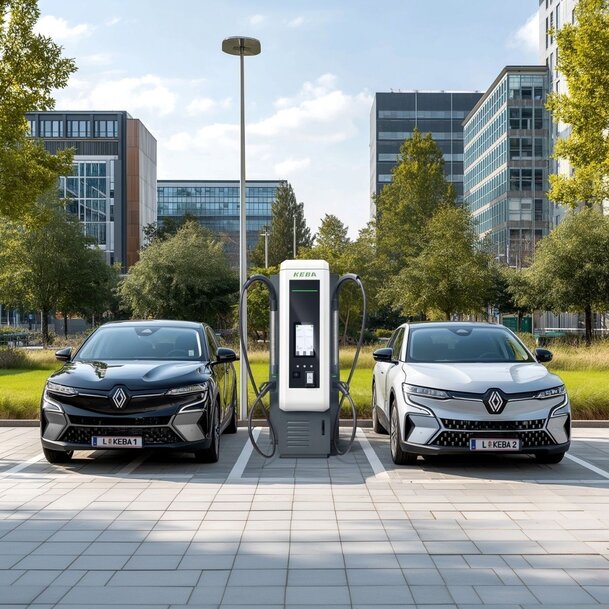
KEBA eMobility has introduced the KeContact DCA20 Autonomous Charger, a new direct current (DC) charging station delivering a maximum output of 400 kW. This all-in-one infrastructure is designed for charge point operators (CPOs) and fleet managers deploying commercial fast-charging networks.
Hardware Architecture and Accessibility
The station's design relies on power electronics fully integrated into the main housing, eliminating the need to install remote power conversion cabinets on site. Ergonomically, the chassis offers lowered access tailored to accessibility standards for persons with reduced mobility (PRM). The cable management system is designed without moving mechanical wear parts to reduce the frequency of hardware maintenance operations. Internal thermal management is also optimized to limit downtime under heavy electrical loads.
Dynamic Balancing and Communication Standards
The system enables dynamic load balancing to simultaneously power two electric vehicles by intelligently distributing the available 400 kW. The hardware architecture is natively compatible with the OCPP 2.0.1 protocol, ensuring standardized and secure communication with supervision systems (backend). Furthermore, the station supports the hardware requirements of the ISO 15118-20 standard, allowing for the future integration of bidirectional charging protocols (V2G) and automated Plug & Charge authentication functionality.
Additional Context: This section details technical specifications not included in the original announcement.
In ultra-high power charging (HPC) infrastructures, distributing 400 kW requires managing currents exceeding 400 to 500 amperes under 800V battery architecture voltages. To prevent overheating due to the Joule effect without using copper cables with a cross-section too heavy to be handled manually, these systems generally integrate active liquid cooling circulating inside the cable sheath. Regarding communication, the ISO 15118-20 standard uses PLC (Power Line Communication) technology superimposed on the control pilot (CP) signal of the CCS connector. This allows an exchange of cryptographic certificates (TLS) between the electric vehicle communication controller (EVCC) and the supply equipment communication controller (SECC), enabling the Plug & Charge (PnC) process, which initiates billing automatically without requiring a physical RFID card.
Edited by Lekshman Ramdas, Induportals editor – adapted by AI.
www.keba.com
