
smartbuildingmag.com
23
'26
Written on Modified on
Trane Launches New Chiller for Temperatures Down to -30°C
New packaged R290 screw compressor chiller delivers reliable, high efficiency performance, and extends Trane’s end-to-end offer for low-temperature process cooling and cold storage applications.
www.trane.com
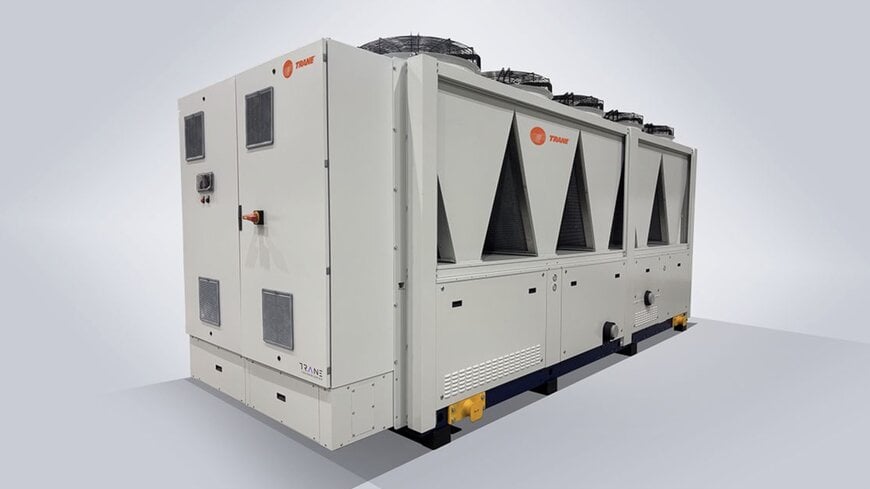
Trane has launched the Aries N Deep Freezing (ASN DF) air-cooled packaged chiller series, engineered to deliver low leaving fluid temperatures down to -30°C. The units utilize R290 (propane), a non-ozone-depleting refrigerant with zero global warming potential (GWP), expanding the company’s industrial cooling portfolio for low-temperature applications.
Industrial Freezing and Packaged Alternatives
The product line is designed for heavy process industries requiring sub-zero fluid production, including the food and beverage sector, refrigerated warehouses, and the pharmaceutical and chemical industries. With cooling capacities scaling up to 360 kW, the series provides a standardized, factory-engineered alternative to custom-built ammonia (NH3) or carbon dioxide (CO2) systems. This packaged configuration helps reduce field construction complexity and engineering installation timelines compared to bespoke field-erected infrastructure, while maintaining high capacity and structural performance.
The new product series complements the company's existing L-STORE portfolio. The cold storage line consists of a compact, plug-and-play container assembly developed to provide temperature-controlled storage with thermal set points down to -25°C. Together, these systems establish a single-source configuration for low-temperature process fluid production and adjacent product storage.
Circuit Configurations and System Mechanics
The chiller line is manufactured across seven distinct sizes, structured in either single-circuit or dual-circuit configurations to match varying load demands. The internal hardware incorporates specific design elements to ensure efficient thermal heat transfer:
- Inverter Compressors: Each individual independent refrigeration circuit features one variable frequency drive (VFD) screw compressor.
- Heat Exchangers: The physical structure integrates microchannel condenser coils working alongside a brazed plate heat exchanger (BPHE) evaporator.
- Operating Map: The mechanical operational map covers leaving glycol fluid temperatures from -12°C down to -30°C under outdoor ambient temperature constraints ranging from -20°C up to +46°C.
- Seasonal Compliance: The entire equipment envelope is certified SEPR-LT compliant, satisfying relevant European seasonal energy performance ratio guidelines for low-temperature process chillers.
Hydrocarbon Safety Systems
Because R290 is a highly flammable A3-classified hydrocarbon refrigerant, the unit incorporates an integrated SDS2E safety protection matrix to handle potential leak risks. This embedded safety system comprises a dedicated electrical components segregation box, an internal refrigerant leak detector, emergency system stop triggers, diagnostic signaling outputs, and an automated ATEX-certified gas expulsion fan to safely vent vaporized hydrocarbons away from spark sources.
Additional Context
This section details technical specifications not included in the original news release.
Deep-freezing industrial chillers traditionally rely on synthetic hydrofluorocarbons (HFCs) like R404A or natural alternatives like ammonia (R717) and carbon dioxide (R744). While ammonia delivers excellent thermodynamic properties, its acute chemical toxicity requires strict containment building envelopes and specialized emergency scrubbing systems under industrial safety standards. Carbon dioxide operating on low-temperature cycles avoids toxicity issues but demands high operating pressures, frequently exceeding 100 bar during transcritical warm-weather states, which increases mechanical strain on system piping and valves. R290 presents an alternative pathway due to its excellent latent heat of vaporization and favorable pressure-density characteristics, allowing nylons, copper lines, and steel vessels to operate at lower pressures while optimizing full- and part-load efficiency.
Achieving stable fluid output temperatures down to -30°C requires precise control of internal pressure-enthalpy characteristics across the brazed plate evaporator. As the brine or glycol solution chills, its fluid viscosity escalates significantly, introducing higher hydraulic pressure drops and lowering the convective heat transfer coefficient inside the internal channels. To counter the associated risk of localized freezing and mechanical plate rupture, the variable frequency drive screw compressor alters its volumetric compression ratio in real time.
The integrated slide valves or variable speed drives modulate the active screw length, matching the mass flow rate of the evaporated R290 gas to the thermal load signature of the process fluid. Concurrently, the use of microchannel condenser coils minimizes the total physical volume of the refrigeration circuit, drastically reducing the total hydrocarbon refrigerant charge required to sustain peak capacity while improving the air-side heat dissipation index through ultra-thin aluminum multi-louver fin structures.
Edited by Romila DSilva, Induportals Editor, with AI assistance.
Because R290 is a highly flammable A3-classified hydrocarbon refrigerant, the unit incorporates an integrated SDS2E safety protection matrix to handle potential leak risks. This embedded safety system comprises a dedicated electrical components segregation box, an internal refrigerant leak detector, emergency system stop triggers, diagnostic signaling outputs, and an automated ATEX-certified gas expulsion fan to safely vent vaporized hydrocarbons away from spark sources.
Additional Context
This section details technical specifications not included in the original news release.
Deep-freezing industrial chillers traditionally rely on synthetic hydrofluorocarbons (HFCs) like R404A or natural alternatives like ammonia (R717) and carbon dioxide (R744). While ammonia delivers excellent thermodynamic properties, its acute chemical toxicity requires strict containment building envelopes and specialized emergency scrubbing systems under industrial safety standards. Carbon dioxide operating on low-temperature cycles avoids toxicity issues but demands high operating pressures, frequently exceeding 100 bar during transcritical warm-weather states, which increases mechanical strain on system piping and valves. R290 presents an alternative pathway due to its excellent latent heat of vaporization and favorable pressure-density characteristics, allowing nylons, copper lines, and steel vessels to operate at lower pressures while optimizing full- and part-load efficiency.
Achieving stable fluid output temperatures down to -30°C requires precise control of internal pressure-enthalpy characteristics across the brazed plate evaporator. As the brine or glycol solution chills, its fluid viscosity escalates significantly, introducing higher hydraulic pressure drops and lowering the convective heat transfer coefficient inside the internal channels. To counter the associated risk of localized freezing and mechanical plate rupture, the variable frequency drive screw compressor alters its volumetric compression ratio in real time.
The integrated slide valves or variable speed drives modulate the active screw length, matching the mass flow rate of the evaporated R290 gas to the thermal load signature of the process fluid. Concurrently, the use of microchannel condenser coils minimizes the total physical volume of the refrigeration circuit, drastically reducing the total hydrocarbon refrigerant charge required to sustain peak capacity while improving the air-side heat dissipation index through ultra-thin aluminum multi-louver fin structures.
Edited by Romila DSilva, Induportals Editor, with AI assistance.
