
smartbuildingmag.com
18
'26
Written on Modified on
Integrated battery energy storage systems for industrial and utility scaling
The high-capacity storage platforms developed by Socomec incorporate integrated data analytics and dual-mode grid configurations for localized and utility-scale installations.
www.socomec.com
The rapid expansion of distributed generation and charging infrastructure requires robust energy management solutions that stabilize local networks while maximizing capacity retention. The implementation of pre-assembled battery energy storage systems (BESS) addresses these balancing challenges across commercial, industrial, and large-scale utility operations.
Technical configurations and dimensional specifications
Fluctuating demand cycles and intermittent renewable generation require modular storage assets that streamline on-site deployment without requiring extensive civil engineering. The SMARTSYS platform functions as an integrated electrical storage and conversion architecture. By pairing electrochemical cells with dedicated power conversion systems (PCS), the infrastructure stabilizes distribution networks under varying loading regimes.
The product range is split into two distinct mechanical and electrical configurations to serve different installation scales:
- SMARTSYS C260 Cabinet System: Engineered as a compact, all-in-one enclosure that unites power conversion circuitry and lithium-ion batteries within a single footprint. It delivers a power output of 125 kVA and an electrical capacity of 261 kWh. The structural layout achieves a 50% reduction in total footprint compared to preceding models. Designed for commercial and industrial environments, such as electric vehicle charging stations and commercial buildings with on-site photovoltaic generation, it supports both grid-tied and islanded (off-grid) operating topologies. It can be scaled in parallel up to a total cluster capacity of 1 MVA / 2 MWh.
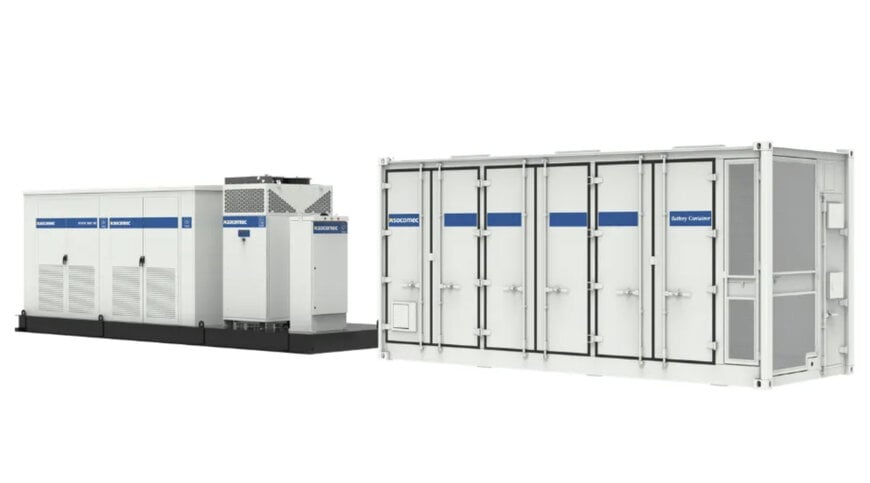
- SMARTSYS M5000 Containerized System: Tailored for large-scale utility infrastructure, independent power producers (IPPs), and transmission or distribution system operators (TSOs/DSOs). The system centers around a 5 MWh Lithium Iron Phosphate (LFP) battery container. This container is paired with a medium-voltage skid that integrates the PCS, control cabinetry, switchgear, and a distribution transformer pre-mounted onto a dedicated metallic structural frame. The utility platform is deployable in multi-megawatt configurations scaling from 2.5 MVA / 5 MWh up to 5 MVA / 20 MWh.
Algorithmic health tracking and structural fire protection
Maximizing the financial return of electrochemical assets inside a digital supply chain depends directly on mitigating cell degradation and maintaining system uptime. Both hardware variants integrate localized data extraction layers that interface with the cloud-based SoLive Pro BESS supervision platform. This framework runs continuous Battery Data Analytics (BDA) to track real-time operational boundaries and thermal profiles.
Executing targeted cell balancing and preventative management via these algorithms extends total battery operational life by up to 20%. Furthermore, the active control loop increases total annual system availability by 3% to 5% and unlocks up to 15% of additional usable capacity, minimizing the total cost of ownership.
For critical field safety, the physical architecture relies on a multi-layered fire protection design compliant with international safety standards to isolate thermal runaway events at the module level. Data security is managed through encrypted communication protocols linked to a proprietary cloud architecture, preventing unauthorized remote access.
Socomec showcased the SMARTSYS product family at the Intersolar Europe exhibition in Munich from June 23 to June 25. The hardware demonstration featured a physical C260 unit alongside architectural overviews of the M5000 and live demonstrations of the BDA telemetry software.
Élodie Hestin, Energy Storage Solutions Marketing Manager at Socomec, stated that "energy demand is becoming more complex, and operators need storage solutions that offer not only capacity, but also visibility and control." The executive noted that "with SMARTSYS, we have leveraged our long experience in battery energy storage solutions to develop products and services that are both smart and designed for sustainable operation, giving operators greater confidence in managing their energy storage systems."
Additional Context: This section details technical specifications and competitive benchmarking not included in the original product announcement
The execution of commercial and utility-scale BESS deployment relies on key industrial benchmarks, specifically round-trip efficiency (RTE), auxiliary power consumption for thermal management, and strict compliance with safety protocols such as UL 9540A for evaluating thermal runaway fire propagation. Integrating power conversion and battery cells into pre-engineered enclosures represents a significant industry trend toward reducing on-site commission errors.
In the global energy storage market, comparable containerized LFP architectures are supplied by large-scale manufacturers. Tesla offers the Megapack 2XL, a fully integrated utility-scale storage system providing up to 3.9 MWh of capacity per unit with an integrated thermal management system and bi-directional inverter technology. Fluence Energy deploys the Gridstack system, which utilizes modular cubicles scaling up to multi-megawatt configurations, focusing on fast-frequency response and strict adherence to utility-grade cybersecurity controls. Additionally, Sungrow Power Supply manufactures the PowerTitan series, a liquid-cooled LFP energy storage system utilizing cluster-level energy management to optimize degradation profiles.
The technical positioning of the evaluated platform relies on its dual approach: serving localized commercial sites with a high-density 125 kVA footprint that integrates seamlessly into a broader automotive data ecosystem for fleet charging, while simultaneously offering a medium-voltage modular skid for utility distribution grids.
Edited by Maria Brueva, Induportals editor – adapted by AI.
www.socomec.com
Maximizing the financial return of electrochemical assets inside a digital supply chain depends directly on mitigating cell degradation and maintaining system uptime. Both hardware variants integrate localized data extraction layers that interface with the cloud-based SoLive Pro BESS supervision platform. This framework runs continuous Battery Data Analytics (BDA) to track real-time operational boundaries and thermal profiles.
Executing targeted cell balancing and preventative management via these algorithms extends total battery operational life by up to 20%. Furthermore, the active control loop increases total annual system availability by 3% to 5% and unlocks up to 15% of additional usable capacity, minimizing the total cost of ownership.
For critical field safety, the physical architecture relies on a multi-layered fire protection design compliant with international safety standards to isolate thermal runaway events at the module level. Data security is managed through encrypted communication protocols linked to a proprietary cloud architecture, preventing unauthorized remote access.
Socomec showcased the SMARTSYS product family at the Intersolar Europe exhibition in Munich from June 23 to June 25. The hardware demonstration featured a physical C260 unit alongside architectural overviews of the M5000 and live demonstrations of the BDA telemetry software.
Élodie Hestin, Energy Storage Solutions Marketing Manager at Socomec, stated that "energy demand is becoming more complex, and operators need storage solutions that offer not only capacity, but also visibility and control." The executive noted that "with SMARTSYS, we have leveraged our long experience in battery energy storage solutions to develop products and services that are both smart and designed for sustainable operation, giving operators greater confidence in managing their energy storage systems."
Additional Context: This section details technical specifications and competitive benchmarking not included in the original product announcement
The execution of commercial and utility-scale BESS deployment relies on key industrial benchmarks, specifically round-trip efficiency (RTE), auxiliary power consumption for thermal management, and strict compliance with safety protocols such as UL 9540A for evaluating thermal runaway fire propagation. Integrating power conversion and battery cells into pre-engineered enclosures represents a significant industry trend toward reducing on-site commission errors.
In the global energy storage market, comparable containerized LFP architectures are supplied by large-scale manufacturers. Tesla offers the Megapack 2XL, a fully integrated utility-scale storage system providing up to 3.9 MWh of capacity per unit with an integrated thermal management system and bi-directional inverter technology. Fluence Energy deploys the Gridstack system, which utilizes modular cubicles scaling up to multi-megawatt configurations, focusing on fast-frequency response and strict adherence to utility-grade cybersecurity controls. Additionally, Sungrow Power Supply manufactures the PowerTitan series, a liquid-cooled LFP energy storage system utilizing cluster-level energy management to optimize degradation profiles.
The technical positioning of the evaluated platform relies on its dual approach: serving localized commercial sites with a high-density 125 kVA footprint that integrates seamlessly into a broader automotive data ecosystem for fleet charging, while simultaneously offering a medium-voltage modular skid for utility distribution grids.
Edited by Maria Brueva, Induportals editor – adapted by AI.
www.socomec.com
