
smartbuildingmag.com
18
'26
Written on Modified on
Active choke technology stabilizes signal efficiency in building automation networks
Phoenix Contact introduces a scalable bus power ecosystem to prevent inductive saturation during high-current data transmission loops.
www.phoenixcontact.com
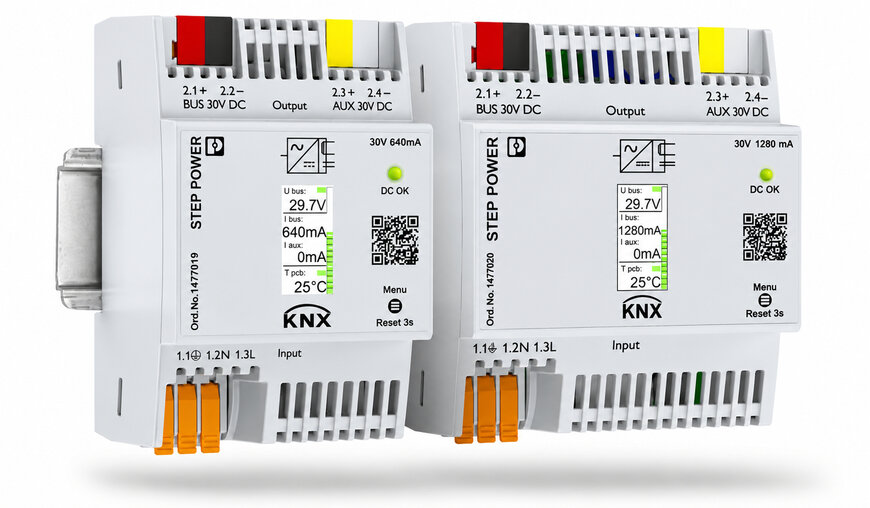
Phoenix Contact has announced the introduction of its expanded KNX Step Power supply portfolio, adding a specialized 1,280 mA module to its standard hardware range. This electrical infrastructure deployment integrates dynamic power-conditioning blocks engineered to sustain complex data transmission lines across decentralized building management systems, ensuring communication reliability at high network density thresholds.
To demonstrate these high-current stabilization capabilities, the hardware platform utilizes a software-independent control architecture developed to adapt gracefully to variable component loads across commercial and corporate facilities. This structural expansion provides building automation networks with the vital overhead capacity needed to absorb rapid hardware footprint scaling.
Active inductive compensation and magnetic saturation prevention mechanisms
The optimization of building automation networks requires the containment of electromagnetic interference and transient loading spikes that compromise packet delivery protocols. Operating as a decentralized power infrastructure layer, the step power architecture incorporates an active inductive choke array to dynamically adjust back-electromotive force in response to shifting current draws. This dynamic regulation scales real-world transmission capacity safely up to a peak throughput of 1,900 mA across the localized bus lines.
By continuously modulating the internal magnetic core fields through an active feedback circuit, the layout prevents magnetic saturation from taking down signaling lines. Standard passive chokes generate elevated core losses and harmonic disturbances when current loads surge, which distorts the digital signal waveforms and drops data packets. The active stabilization circuit maintains an uncorrupted differential voltage envelope across the network, preserving operational timing limits during heavy multi-device signaling bursts.
The physical assembly integrates a wide-range input circuit that accepts both AC and DC current feeds natively, facilitating seamless deployment across diverse regional electrical grids without requiring external transformer modules. This input layer absorbs raw grid voltage swings and macro-fluctuations, preventing upstream line noises from contaminating the low-voltage communication lines. This isolation layout protects the signal processors, extending the operational life expectancy of connected components in unstable industrial environments.
Separated output diagnostics and localized fault tracing controls
For network monitoring during operational maintenance cycles, the hardware envelope features an integrated multi-color display interface that shows real-world diagnostic arrays on site. This local dashboard breaks away from centralized data aggregation dependencies, letting service technicians view system telemetry and localized operational codes directly at the control cabinet. The underlying diagnostic processor splits metrics into independent tracking blocks, analyzing the main data bus outlays and the secondary auxiliary power rails separately.
This structural separation isolates localized grounding faults, short-circuits, and thermal overload behaviors over extended testing runs. When a system reset sequence is initiated, the diagnostic system automatically clears the localized error runtime metric back to zero while preserving the absolute total device machine runtime log intact. This dual-timestamp architecture lets technicians pinpoint exactly when a fieldbus failure occurred, lowering mean-time-to-repair variables across expansive commercial property layouts.
Additional Context: This section details technical specifications and competitive benchmarking not included in the original product announcement
Within the high-reliability building automation power and fieldbus conditioning market, this expanded portfolio enters direct technical competition with established components such as the standard KNX power supply series from Mean Well or the decentralized bus power modules built by Siemens Smart Infrastructure. Objective technical benchmarking reveals distinct engineering trade-offs regarding core material choices and physical space constraints. While conventional comparative power modules rely entirely on dual passive transformer chokes—which increases physical module width on the DIN rail and limits maximum operational current constraints due to heat buildup—the Phoenix Contact platform unifies the step power topology and active choke mechanics inside a tightly condensed housing. This design layout reduces panel spacing requirements and drops installation outlays.
Additionally, the development framework leverages extensive plant automation history to refine its onboard power-fail tracking parameters. This extensive engineering knowledge prevents threat profile distortion when power profiles shift rapidly.
However, achieving maximum signal transmission stability near the upper 1,900 mA current limit demands precise synchronization with proper shield grounding configurations and specific line topology layouts. Sub-optimal termination parameters or high parasitic line capacitances across lengthy cable loops can introduce subtle phase errors on the data bus lines. This communication lag can slightly lower data throughput speeds compared to dedicated strategic fiber optic networks fitted with external localized media conversion links inside a climate-controlled server space.
Edited by Sucithra Mani, Induportals editor – adapted by AI.
www.phoenixcontact.com
