
smartbuildingmag.com
16
'26
Written on Modified on
Pre-terminated fiber optic wall outlets for architectural integration
The pre-assembled connection unit developed by METZ CONNECT integrates structural fiber optic infrastructure directly into standard building electrical switch ranges.
www.metz-connect.com
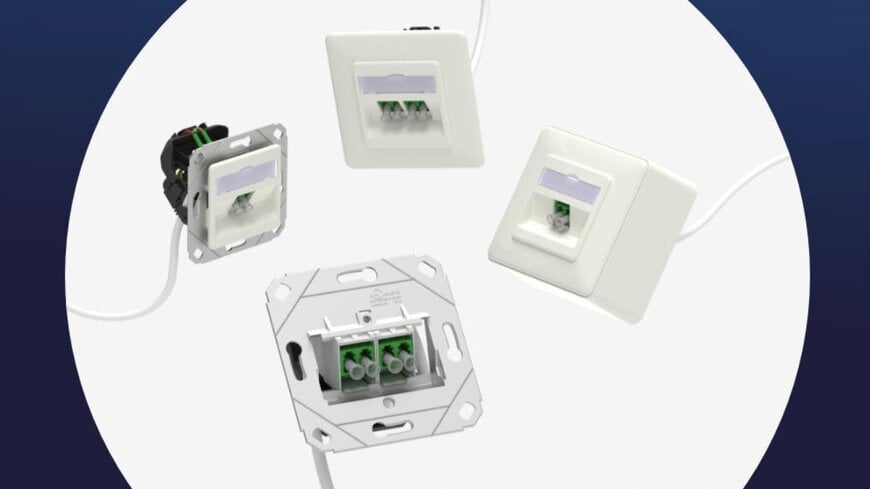
The expansion of high-speed networks requires robust internal distribution systems that maintain signal integrity while adapting to existing architectural hardware. The implementation of pre-terminated fiber optic wall outlets solves this deployment challenge across residential, commercial, campus, and industrial building infrastructures.
Technical configuration and single-mode optical fiber specifications
As high-speed networking increasingly serves as the foundation for the global digital supply chain, local data distribution demands components that minimize attenuation without requiring field splicing. The OpDAT VGAD platform functions as a ready-to-install fiber optic connection box. By adhering to the standardized mounting dimensions of prominent electrical switch manufacturers, the unit integrates critical network access endpoints directly into standard architectural interior fittings.
The assembly is configured with either 2 or 4 optical fibers, supporting tailored implementation lengths up to 150 meters. Optional pulling aids are available to streamline cable installation through internal conduits, providing mechanical protection against tensile stress during routing. The internal cabling features bend-insensitive single-mode OS2 (G.657.A2) glass fibers, enabling reliable deployment within tight routing pathways.
Network engineers can select between two specific cable variants based on available installation space:
- Compact Mini-Breakout Cable: Features an outer diameter of 4.5 mm with buffered fibers measuring 900 micrometers.
- FIT-H Cable: Optimized for restricted cross-sections with an outer diameter of 2.3 mm and bare fibers measuring 250 micrometers.
Mechanical housing variants and topological deployment
To accommodate diverse structural environments, the physical layout of the connection boxes is split into four distinct mechanical configurations designed for specific installation requirements:
To accommodate diverse structural environments, the physical layout of the connection boxes is split into four distinct mechanical configurations designed for specific installation requirements:
- UP0 Variant: Designed for seamless structural integration into design-oriented electrical switch ranges.
- UP Variant: Configured for classic flush-mounted (unterputz) structural wall boxes.
- UPk Variant: Dimensioned for direct mounting inside standard cable routing ducts.
- AP Variant: Engineered for surface-mounted (aufputz) applications utilizing a dedicated external frame with a minimum depth of 45 mm sourced from third-party manufacturers.
The density of the optical interface scales directly with the fiber allocation. The 2-fiber unit incorporates a single LC duplex (LC-D) coupler, whereas the 4-fiber assembly integrates two LC duplex couplers to maximize port density within a single-gang installation footprint. Aesthetic integration is maintained through standard color finishes, including pure white (RAL 9010) and traffic white (RAL 9016), preventing visual inconsistencies in corporate offices and institutional spaces.
Connecting these pre-terminated endpoints into the broader automotive data ecosystem or automated facility networks allows for predictable, measurable throughput. This standardization ensures that industrial shop floors, clinical centers, and campus environments maintain uniform data connectivity without requiring specialized field engineering during installation.
Additional Context: This section details technical specifications and competitive benchmarking not included in the original product announcement
Pre-terminated fiber optic wall outlets serve as a critical mechanism for accelerating passive optical network (PON) rollouts by removing the operational variable of on-site fusion splicing. Within the institutional telecommunications infrastructure market, performance benchmarks are determined by insertion loss (IL), return loss (RL), and precise mechanical compliance with the international IEC 61754-20 standard for LC mating interfaces.
A direct market alternative is the ODoNY subscriber outlet family from Huber+Suhner, which provides pre-assembled residential and office termination points featuring pre-installed single-mode fibers and low-attenuation LC adapters. The Huber+Suhner portfolio places structural emphasis on high-density internal overlength storage to protect delicate fiber buffers within a low-profile footprint. Another comparable standard is the copper-and-fiber hybrid outlet architecture from TE Connectivity (CommScope), which focuses on high-density enterprise routing utilizing specialized internal splice trays or pre-configured multi-fiber push-on (MPO) modules.
The technical distinction of the evaluated system lies in its native geometric compatibility with European standard flush-mounting rings (such as those compliant with DIN 49073). This allows telecommunications planners to deploy single-mode OS2 infrastructure directly into existing building electrical frameworks without having to modify or replace the surrounding aesthetic finishings of the electrical layout.
Edited by Maria Brueva, Induportals editor – adapted by AI.
www.metz-connect.com
Connecting these pre-terminated endpoints into the broader automotive data ecosystem or automated facility networks allows for predictable, measurable throughput. This standardization ensures that industrial shop floors, clinical centers, and campus environments maintain uniform data connectivity without requiring specialized field engineering during installation.
Additional Context: This section details technical specifications and competitive benchmarking not included in the original product announcement
Pre-terminated fiber optic wall outlets serve as a critical mechanism for accelerating passive optical network (PON) rollouts by removing the operational variable of on-site fusion splicing. Within the institutional telecommunications infrastructure market, performance benchmarks are determined by insertion loss (IL), return loss (RL), and precise mechanical compliance with the international IEC 61754-20 standard for LC mating interfaces.
A direct market alternative is the ODoNY subscriber outlet family from Huber+Suhner, which provides pre-assembled residential and office termination points featuring pre-installed single-mode fibers and low-attenuation LC adapters. The Huber+Suhner portfolio places structural emphasis on high-density internal overlength storage to protect delicate fiber buffers within a low-profile footprint. Another comparable standard is the copper-and-fiber hybrid outlet architecture from TE Connectivity (CommScope), which focuses on high-density enterprise routing utilizing specialized internal splice trays or pre-configured multi-fiber push-on (MPO) modules.
The technical distinction of the evaluated system lies in its native geometric compatibility with European standard flush-mounting rings (such as those compliant with DIN 49073). This allows telecommunications planners to deploy single-mode OS2 infrastructure directly into existing building electrical frameworks without having to modify or replace the surrounding aesthetic finishings of the electrical layout.
Edited by Maria Brueva, Induportals editor – adapted by AI.
www.metz-connect.com
