
smartbuildingmag.com
09
'26
Written on Modified on
AI-Based Intelligent Video Search for Network Video Recorders
Hikvision integrates AcuSeek technology into its K/VPro and I/VPro NVR ranges, enabling advanced analysis and edge target localization without dependence on cloud services.
www.hikvision.com
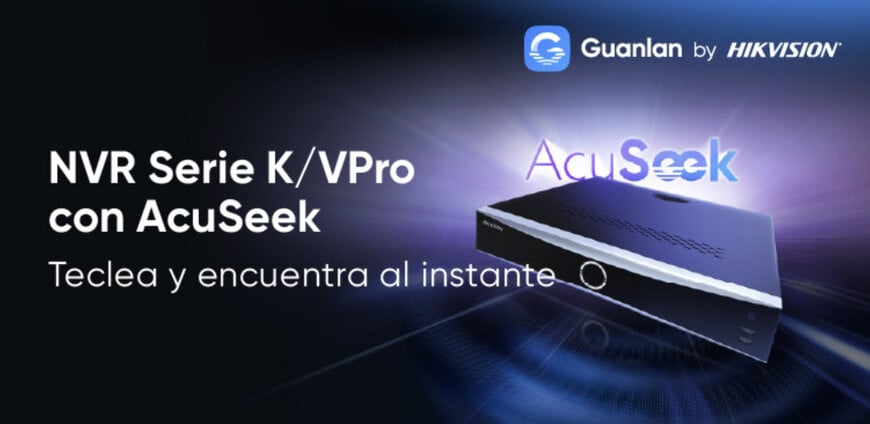
The incorporation of AI-based metadata analysis directly into recording hardware represents a significant step forward for the operational management of closed-circuit television (CCTV) systems. By eliminating the need to manually review hours of footage, this technology optimizes incident response times in demanding sectors such as retail, logistics, transport, and industrial security.
Local AI Processing and Range Segmentation
AcuSeek technology utilizes advanced deep learning models executed locally on the NVR. This allows operators to locate people, vehicles, or animals in seconds using precise natural language descriptions.
To meet the needs of different installation types, Hikvision segments its offering into two performance levels:
- K/VPro Series: Designed for small and medium-sized projects. It enables intelligent searches across up to 32 simultaneous channels and the recovery of critical recordings within a history of up to three days in a fraction of a second.
- I/VPro Series: Geared toward corporate or large-scale environments. It extends processing capacity up to 64 channels, offers native support for multi-language searches, and features greater computing power for complex target modeling.
Trajectory Reconstruction and Multi-Platform Access
One of the main technical advantages of this update is the native interoperability between the AcuSeek and AcuSearch tools. While AcuSeek locates the initial target via text descriptions, AcuSearch allows users to refine visual results and correlate appearances of that target across multiple connected cameras. This synergy facilitates the chronological and spatial reconstruction of a vehicle or individual's trajectory within the facility, integrating physical security as a reliable data node within the corporate digital supply chain.
The system guarantees total operational flexibility by allowing these analytical queries to be performed from multiple software environments, including the NVR's local interface, standard web browsers, and the Hik-Connect and HikCentral centralized management platforms.
Additional Context: This section details technical specifications and competitive benchmarking not included in the original product announcement
In the professional video surveillance market, semantic search based on natural language at the edge is a highly competitive field where Hikvision competes directly with solutions such as Dahua's WizMind series, Avigilon's (Motorola Solutions) Appearance Search software, and Axis Communications' object analytics. Traditionally, searching via complex textual descriptions required dedicated video analytics servers or metadata processing in enterprise-level video management software (VMS) platforms. Hikvision's proposal democratizes this function by integrating it directly into the recorder (NVR) firmware, reducing the total cost of ownership (TCO) and eliminating additional software licenses.
Unlike Axis, which prioritizes generating standardized metadata on the camera itself to be interpreted by a third-party VMS, Hikvision's approach with the K/VPro and I/VPro series centralizes analytical processing in the recorder. This allows the use of standard or more economical IP cameras, shifting the AI computational workload to the NVR processor. Compared to Dahua, which uses rigid attribute classifications (such as clothing color, glasses use, or vehicle type), AcuSeek's natural language engine offers superior semantic flexibility, allowing more human and complex search strings without prior structuring.
The main technical challenge of executing these language and indexing models on embedded architectures lies in managing memory and internal NVR data bus bandwidth. When cross-correlating cameras for trajectory reconstruction, the system generates feature vector maps that must be compared in real time. This predictive and spatial analysis methodology shares algorithmic principles with asset tracking systems used in the automotive data ecosystem, optimizing the precision of generated metadata and ensuring that massive searches do not penalize recording bitrate or live video stream frame rates.
Edited by Maria Brueva, Induportals editor – adapted by AI.
www.hikvision.com
One of the main technical advantages of this update is the native interoperability between the AcuSeek and AcuSearch tools. While AcuSeek locates the initial target via text descriptions, AcuSearch allows users to refine visual results and correlate appearances of that target across multiple connected cameras. This synergy facilitates the chronological and spatial reconstruction of a vehicle or individual's trajectory within the facility, integrating physical security as a reliable data node within the corporate digital supply chain.
The system guarantees total operational flexibility by allowing these analytical queries to be performed from multiple software environments, including the NVR's local interface, standard web browsers, and the Hik-Connect and HikCentral centralized management platforms.
Additional Context: This section details technical specifications and competitive benchmarking not included in the original product announcement
In the professional video surveillance market, semantic search based on natural language at the edge is a highly competitive field where Hikvision competes directly with solutions such as Dahua's WizMind series, Avigilon's (Motorola Solutions) Appearance Search software, and Axis Communications' object analytics. Traditionally, searching via complex textual descriptions required dedicated video analytics servers or metadata processing in enterprise-level video management software (VMS) platforms. Hikvision's proposal democratizes this function by integrating it directly into the recorder (NVR) firmware, reducing the total cost of ownership (TCO) and eliminating additional software licenses.
Unlike Axis, which prioritizes generating standardized metadata on the camera itself to be interpreted by a third-party VMS, Hikvision's approach with the K/VPro and I/VPro series centralizes analytical processing in the recorder. This allows the use of standard or more economical IP cameras, shifting the AI computational workload to the NVR processor. Compared to Dahua, which uses rigid attribute classifications (such as clothing color, glasses use, or vehicle type), AcuSeek's natural language engine offers superior semantic flexibility, allowing more human and complex search strings without prior structuring.
The main technical challenge of executing these language and indexing models on embedded architectures lies in managing memory and internal NVR data bus bandwidth. When cross-correlating cameras for trajectory reconstruction, the system generates feature vector maps that must be compared in real time. This predictive and spatial analysis methodology shares algorithmic principles with asset tracking systems used in the automotive data ecosystem, optimizing the precision of generated metadata and ensuring that massive searches do not penalize recording bitrate or live video stream frame rates.
Edited by Maria Brueva, Induportals editor – adapted by AI.
www.hikvision.com
