
smartbuildingmag.com
29
'26
Written on Modified on
Door Technology for Fire Protection and Accessibility in Building Services
GEZE GmbH’s new system solutions integrate mechanical and automated closing technologies to meet fire protection requirements in commercial buildings.
www.geze.de
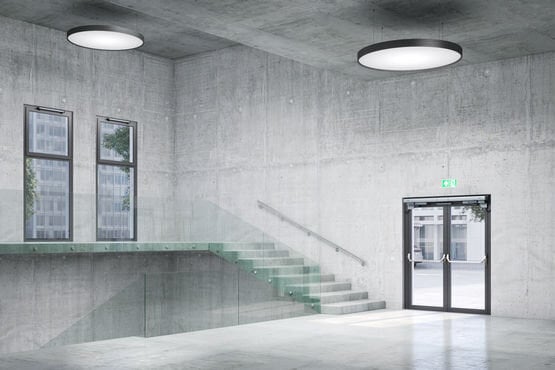
In modern building services engineering, combining passive fire protection with barrier-free escape routes requires precisely coordinated door and window control systems. The integration of mechanical door closers, automated drive solutions, and electronic motor lock controls enables compliance with current safety regulations in commercial and public buildings. Corresponding technological solutions for preventive fire protection will be presented at the FeuerTrutz trade fair, taking place in Nuremberg on June 24–25, 2026.
Mechanical Door Closers for Safety-Critical Escape Routes
The TS 7000 door closer is designed for use in airlocks and escape routes where reliable closing performance is required without temperature-related readjustments. Its integrated valve technology compensates for thermodynamic viscosity fluctuations in the hydraulic fluid, ensuring a consistent closing speed throughout all seasons. A high mechanical efficiency reduces door opening resistance, helping meet accessibility requirements defined by DIN 18040 and DIN Spec 1104. The design is based on a standardized closer body that supports different installation methods through a dedicated mounting plate. The system is engineered for more than one million operating cycles, reducing maintenance requirements in high-traffic passageways.
Automated Drives in Pressurized Stairwells
In fire compartments, particularly pressurized stairwells, doors must close securely during an emergency while still enabling self-evacuation for people with limited mobility. The Powerturn F/R drive addresses this requirement by providing electromechanical assistance during door opening. When a hold-open system is released, the automatic drive supports opening either manually or via push-button activation. In the event of a localized alarm, the door can be opened against the positive pressure within the stairwell before subsequently closing passively and in compliance with regulations. This mechanism ensures that workplace accessibility requirements defined by German workplace regulations (ASR) are fulfilled without compromising the fire door’s compartmentalization function.
Centralized Control for Smoke and Heat Exhaust Systems
Reliable fresh-air intake for smoke and heat exhaust ventilation systems (SHEV) requires precise synchronization between the SHEV control center and door locking systems. The GC Lock Control SHEV motor lock control unit functions as a relay and control interface that simplifies the electrical infrastructure. The system requires only two cable connections between the air intake door and the SHEV control center, minimizing wiring complexity and installation effort. Its open-system architecture supports the integration of standard motor locks from various manufacturers, making it suitable for both new construction projects and retrofit applications in existing buildings.
Additional Context: Technical Specifications and Competitive Benchmarking
This section details technical specifications and market comparisons not included in the original product announcement.
In the segment of electromechanical swing-door operators for fire and smoke protection doors, systems such as the Powerturn compete with solutions including the dormakaba ED 250 and the Record DFA 127. A measurable benchmark for such drives is the manual opening force required during power failure or purely mechanical operation. While conventional systems with strong spring-force storage can create significant physical resistance during manual opening, modern drives utilize gearbox decoupling functions to facilitate manual operation and meet accessibility standards.
In the hydraulic door closer segment, technical competition increasingly focuses on thermostatic valve technology. The ability to compensate for seasonal temperature fluctuations without manual recalibration of closing-force valves is becoming a standard requirement in large commercial building tenders, helping to reduce ongoing maintenance costs.
Edited by industrial technology journalist Lekshman Ramdas, with AI assistance.
www.geze.com
