
Control system for building automation with flexible system architecture
Phoenix Contact designs a scalable hardware platform for the integration of building infrastructures while considering established industrial communication standards.
www.phoenixcontact.com
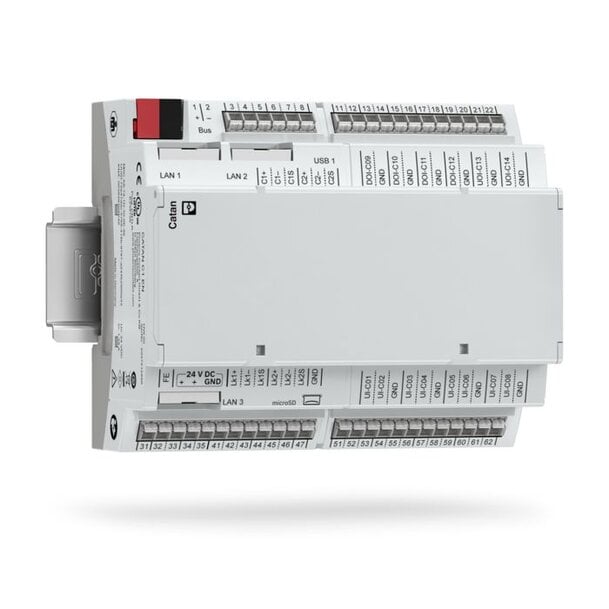
For technical building equipment, Phoenix Contact provides a programmable logic controller based on an open platform logic. The system is designed for room and building automation and supports the control of lighting, shading, heating, ventilation and air conditioning (HVAC), as well as data acquisition for energy management in commercial and industrial facilities.
System architecture and interoperability
The hardware of the Catan C1 controller is modular in design and scales from single-room control to the management of complex, cross-disciplinary systems. The control unit uses the PLCnext Technology ecosystem, a Linux-based operating system for industrial automation. This architecture enables the parallel execution of IEC 61131 programs and high-level language applications. For connection to the sensor and actuator level, the system features modular input and output modules as well as lateral terminal rows that structure physical signal processing within the control cabinet.
Network integration and building infrastructure
For integration into existing or new building management systems, the platform supports established communication protocols. A central function is integration into KNX networks, implemented via IP-based interfaces and software solutions such as Symcon. This interoperability enables direct data exchange between the field level and higher-level IT or cloud systems. As a result, load management, monitoring and fault message processing can be orchestrated within a unified topology without requiring separate hardware gateways for protocol routing.
Hardware design and maintainability
The device design complies with industrial standards for control cabinet construction. The system offers tool-free mounting options and structurally separates power supply, communication and I/O levels from one another. The hardware design fulfills the requirements of Cradle-to-Cradle certification (Bronze). The mechanical development focused on material transparency and a modular structure that supports retrofit scenarios through the partial replacement of components and extends the operational lifespan of the installation in the field. Integrated color displays and expansion modules support local diagnostics and direct operation on the controller.
Operational application areas
The control system is primarily used in modernization projects and in the construction of hybrid infrastructures where existing installations must be migrated step by step. Steffen Mehnert, Head of Industry Management and Automation at Phoenix Contact, explained the hardware orientation: “With the Catan C1, we provide integrators and operators with an open, modularly expandable platform that can be integrated into KNX-based environments. This allows existing infrastructures to continue being used and enables projects in both existing buildings and new constructions.”
Additional context: This section details technical specifications and competitive benchmarks that were not included in the original product announcement.
In building automation, open Linux-based control platforms such as Phoenix Contact’s PLCnext Technology compete with programmable logic controllers such as the PFC200 from WAGO or the CX embedded PCs from Beckhoff Automation. One objective differentiating factor is the runtime environment architecture: while conventional automation controllers often use proprietary runtime environments for routing, open ecosystems such as PLCnext allow the direct execution of third-party software on the controller. This reduces the hardware required for the integration of fieldbus systems such as KNX. In addition, hardware certification according to Cradle-to-Cradle standards in industrial control engineering represents a measurable parameter for material circularity, which is used as a technical criterion in the evaluation of lifecycle costs and in public tenders for sustainable building infrastructures.
Edited by industrial journalist Lekshman Ramdas, with AI assistance.
www.phoenixcontact.com
