
smartbuildingmag.com
27
'26
Written on Modified on
Explosion-Proof Unit Heaters for Hazardous Processing Environments
Marley Engineered Products expands heating systems for hazardous locations, combining certified protection, corrosion resistance, and controlled airflow for industrial and food processing applications.
www.marleymep.com
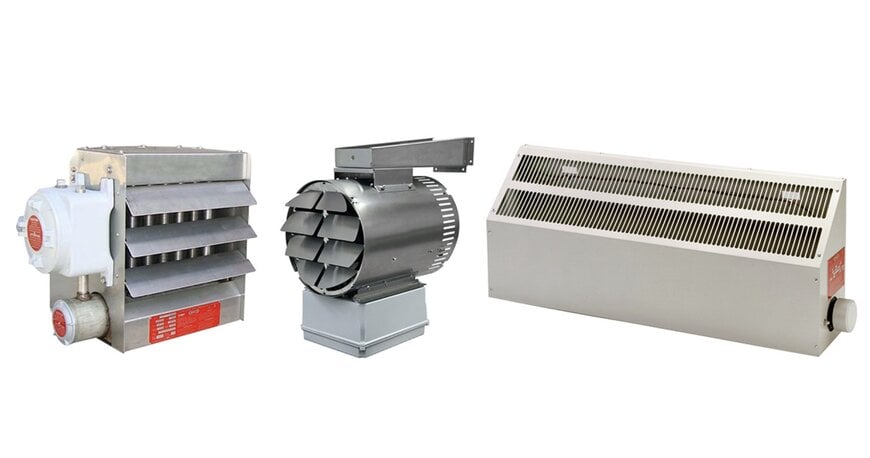
Heating systems used in hazardous industrial environments must meet strict safety classifications while maintaining stable performance across variable operating conditions. In this context, Marley Engineered Products has introduced a new generation of explosion-proof unit heaters designed for food and beverage processing and other high-risk industrial settings.
Built for classified hazardous locations
The new systems, marketed under the QMark GUX Series and Berko RUX Series, are designed for environments where flammable gases, vapors, dust, or fibers may be present. These include food processing plants, chemical facilities, grain handling sites, and oil and gas operations.
The units comply with multiple hazardous location standards, including Class I, Divisions 1 and 2, Groups C and D, and Class II, Divisions 1 and 2, Groups E, F, and G. Additional compliance with Class I, Zones 1 and 2, Group II extends their applicability across globally recognized classification systems. These certifications define the types of explosive atmospheres and operating conditions in which the heaters can be safely deployed.
Materials and coatings for corrosive environments
Food and beverage processing environments often involve high humidity, cleaning chemicals, and airborne contaminants that accelerate material degradation. To address this, the heaters use cold-rolled steel cabinets with powder coating, combined with corrosion-resistant materials.
Optional configurations include 316 stainless steel construction and Heresite coating, both commonly used in environments exposed to aggressive chemicals or washdown conditions. These material choices are intended to maintain enclosure integrity and extend service life under continuous exposure to corrosive agents.
Thermal control and safety mechanisms
The heaters are designed to operate across a wide temperature range while maintaining controlled surface temperatures. A T3C temperature classification limits maximum surface temperature to 320°F, reducing ignition risk in classified zones.
Integrated protection systems include automatic and manual reset overtemperature cutouts, which interrupt operation if internal temperatures exceed predefined thresholds. A relief valve set at 70 PSIG manages internal pressure, providing an additional safeguard against system stress under abnormal conditions.
Airflow performance and installation flexibility
Air distribution is a critical factor in maintaining uniform heating across large industrial spaces. These units provide airflow ranging from 550 to 3850 CFM, supporting heat distribution in facilities with varying layouts and ceiling heights.
The heaters incorporate industrial-grade cabinets and louvers designed for durability in demanding environments. An IP55-rated motor ensures protection against dust ingress and water jets, while a Type 4 enclosure supports operation in outdoor or washdown conditions.
This configuration enables deployment in applications such as aircraft hangars, compressor stations, spray booths, sewage treatment facilities, and processing areas where environmental exposure and safety compliance must be addressed simultaneously.
Integration into industrial heating and safety frameworks
The design reflects the increasing need to align thermal systems with broader industrial safety and digital supply chain requirements. In facilities where uptime, compliance, and environmental resistance are tightly linked, explosion-proof heating systems must operate reliably without introducing ignition risks or maintenance bottlenecks.
By combining certified hazardous location compliance, corrosion-resistant construction, and controlled airflow performance, the new unit heaters address operational constraints typical of high-risk processing environments.
Edited by Aishwarya Mambet, Induportals Editor, with AI assistance.
www.marleymep.com
