
smartbuildingmag.com
16
'26
Written on Modified on
GEA presents new air spring concept for chillers and heat pumps
GEA introduces an active leveling air spring system to isolate reciprocating compressor vibrations and eliminate heavy concrete foundations in industrial heat pump applications.
www.gea.com
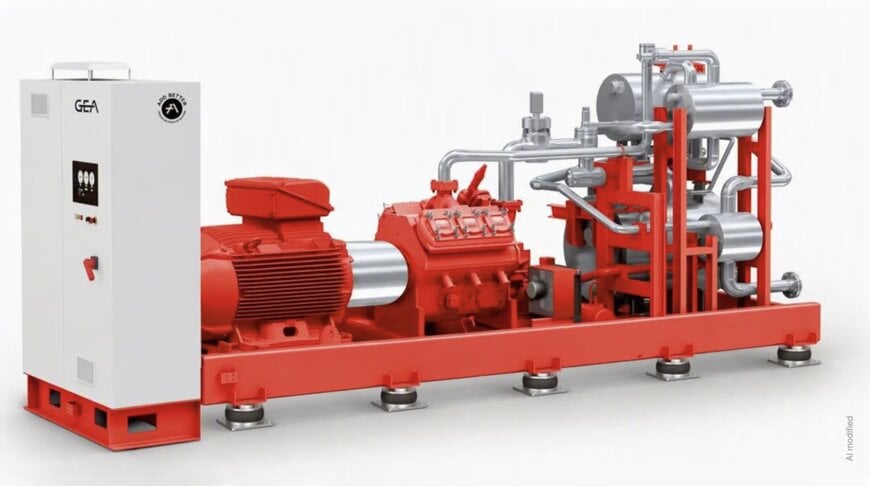
GEA RedGenium covers industrial heat pump applications with supply temperatures of up to 95°C. The photo shows the GEA RedGenium heat pump with the air springs. (Photo: AI modified)
Pneumatic Vibration Isolation and Dynamic Self-Leveling
At the Chillventa 2026 trade exhibition in Nuremberg, Germany, GEA introduced an electronically controlled air spring mounting system designed for chillers and heat pumps driven by reciprocating compressors. The system positions pneumatic isolators between the equipment base frame and the floor slab, utilizing the volumetric elasticity of pressurized air columns to decouple compressor-induced dynamic loads from the building structure.
The assembly integrates an electronic leveling system that continuously monitors and corrects operating installation height. The control system automatically compensates for foundation surface unevenness of up to 25 millimeters, simplifying alignment and equipment commissioning. To prevent minor vertical deflections from exerting mechanical strain on stationary plant piping, the system utilizes flexible hose assemblies or inline expansion joints at fluid connection flanges.
Site Utility Requirements and Structural Integration
The air spring modules feature a maintenance-free design that relies on a continuous pneumatic feed from an on-site compressor or high-pressure gas cylinder. Operational utility parameters require a compressed air supply regulated up to 6 bar alongside an electrical supply of 24 V DC at a maximum current draw of 1.6 A, with support for standard 100 to 240 V AC power supplies.
When supported by an uninterrupted compressed air source, the active pneumatic system serves as an equivalent engineering alternative to a dedicated concrete foundation. Eliminating the concrete foundation slab removes substantial structural weight from the building, simplifying floor-loading assessments and expanding equipment placement options in tight mechanical rooms or existing facility retrofit projects.
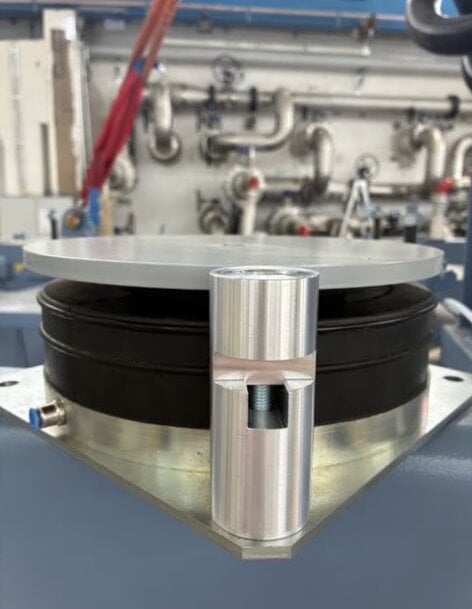
The electronically controlled self-leveling air springs isolates the chiller or heat pump base frame from the building’s supporting structure, reducing the transmission of dynamic forces and vibrations. (Photo: GEA)
Equipment Deployment and Commercial Availability
The pneumatic mounting option is designed for GEA compressor-driven platforms, including the GEA BluGenium compact ammonia (R-717) chiller, the GEA RedGenium high-temperature industrial heat pump capable of supply temperatures up to 95°C, and the GEA Blu-Red Fusion combined heating and cooling system. Following completed field trial validations, GEA plans to integrate the electronically leveled air spring system into its RTSelect equipment configuration software in early 2027.
Additional Context
This section details technical specifications and competitive benchmarking not included in the original product announcement.
In industrial reciprocating machinery isolation, vibration transmissibility depends on the ratio between operating excitation frequencies and the natural frequency of the mounting support. Conventional passive isolation systems—such as helical steel springs or elastomeric pads—typically establish natural frequencies between 3 Hz and 6 Hz. When variable-frequency drives modulate reciprocating compressors to lower running speeds, the primary running frequency approaches the mounting system resonance band, risking excessive vibration amplification. In contrast, electronically managed air spring isolators maintain a lower natural frequency between 1.5 Hz and 2.5 Hz across varying dynamic pressures, providing isolation efficiencies exceeding 90 percent throughout modulated compressor operating curves.
Across the industrial heating and cooling sector, competing original equipment manufacturers such as Johnson Controls, Carrier, and Trane traditionally mitigate reciprocating and screw chiller vibration using rigid structural steel skid bases paired with field-poured concrete inertia bases mass-ratioed at one to two times the total machine operating weight. Meeting industrial mechanical vibration guidelines, such as ISO 10816-6 for reciprocating machines, typically mandates these high-mass structural foundations. Replacing poured inertia blocks with an active pneumatic leveling system provides an alternative approach to structural vibration isolation, removing civil construction lead times and facilitating roof-level or mezzanine machine room installations without requiring secondary floor reinforcement.
Edited by Romila DSilva, Induportals Editor, with AI assistance.
www.gea.com
