
smartbuildingmag.com
08
'26
Written on Modified on
Autodesk connects building design workflows with Forma integration
Cloud-connected data and AI-enabled tools link early-stage design with detailed modeling to reduce rework across architecture and construction projects.
www.autodesk.com
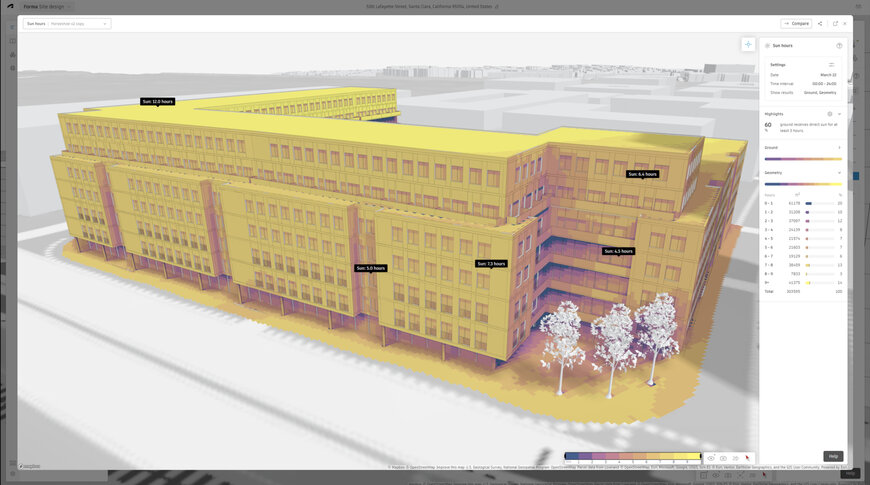
Architecture, engineering, construction, and operations (AECO) sectors increasingly rely on connected digital workflows to manage complex projects from planning through delivery. In this context, Autodesk introduces Forma Building Design alongside deeper cloud integration with Revit to enable continuous data flow across the building lifecycle.
The update focuses on addressing a common limitation in building design workflows: fragmentation of project data between planning, schematic design, and detailed modeling. By shifting from file-based exchanges to cloud-connected environments, the solution allows teams to preserve design intent and reuse data across stages instead of recreating it.
Early-stage design integrated with detailed modeling
Forma Building Design is developed specifically for the schematic design phase, where key decisions about layout, performance, and feasibility are made. The platform enables users to quickly set up geolocated sites and generate building concepts, including facades, floor plans, and unit configurations.
Built-in analysis tools evaluate parameters such as daylight exposure, sun hours, and carbon impact during early design stages. Once a concept is selected, the model can be transferred directly into Revit as a native, geolocated project, preserving site context and design elements.
This continuity reduces rework typically associated with transitioning from conceptual design to detailed documentation, a key challenge in building information modeling (BIM) workflows.
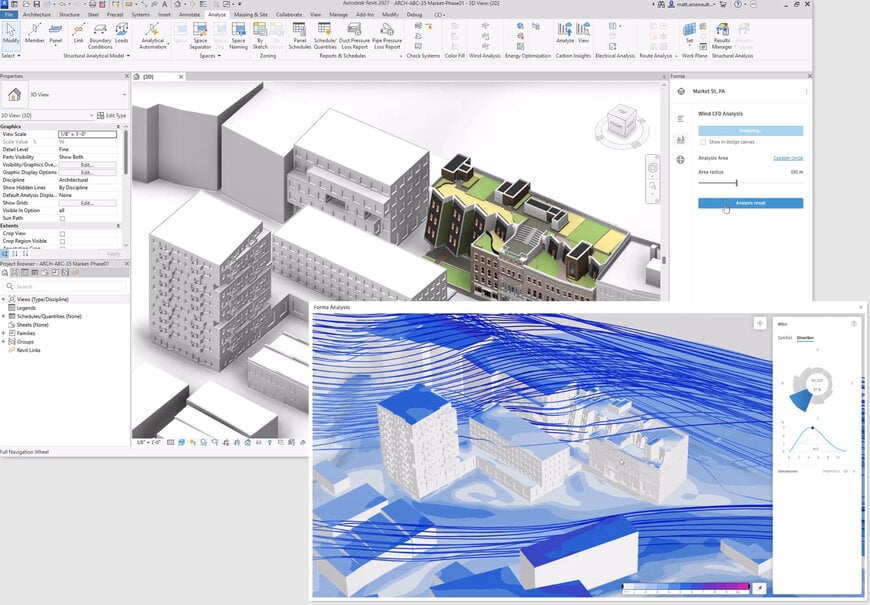
Cloud-connected workflows replace file-based exchanges
A central component of the update is the introduction of Revit as a Forma Connected Client (Tech Preview). This integration enables direct data transfer between Forma and Revit without manual file handling, improving alignment between teams and reducing version conflicts.
Project data, including environmental context and design inputs from the Forma Data Marketplace, can be accessed and updated within Revit. This supports real-time decision-making and ensures that design changes remain consistent across disciplines.
By maintaining a shared data environment, teams can coordinate more effectively across architecture, structural design, and construction planning.
Carbon analysis and sustainability insights
The integration also introduces Forma Carbon Insights across both Forma Building Design and Revit. This feature enables early-stage carbon analysis and allows sustainability considerations to be carried forward into detailed design.
For engineering teams, this supports lifecycle-based decision-making, where material choices and design strategies can be evaluated based on their environmental impact from the outset.
AI-enabled assistance within design tools
AI capabilities are further integrated through Autodesk Assistant, now available in Revit (Tech Preview). The assistant provides contextual guidance based on project data, enabling users to execute tasks, identify potential issues, and maintain consistency in modeling workflows.
Additional AI-driven enhancements extend across tools such as AutoCAD and Civil 3D, supporting applications like infrastructure alignment analysis and collaborative editing of shared design files.
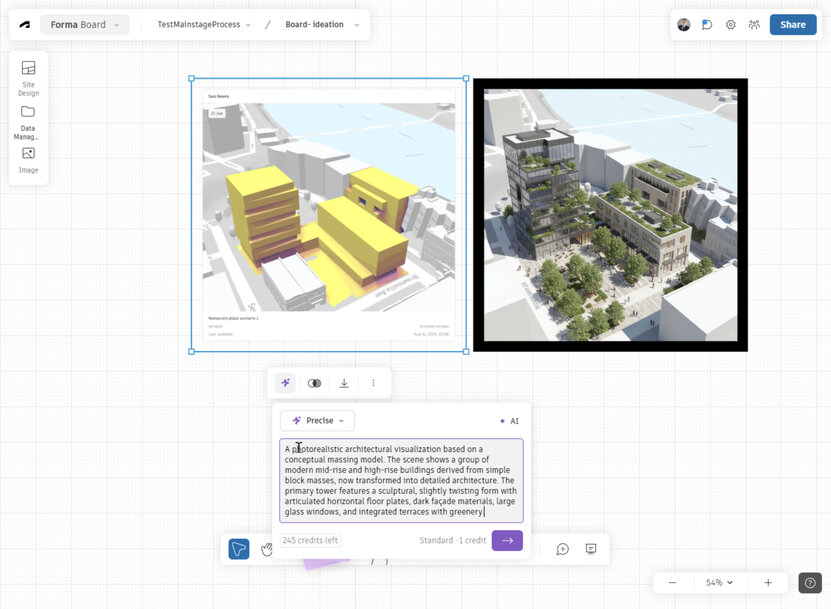
Expanding connected data across the AECO ecosystem
The update also broadens access to Forma tools, including site design, collaboration boards, and data management features, across Autodesk’s software ecosystem. This unified environment supports visual collaboration, shared project context, and coordinated decision-making throughout the project lifecycle.
Enhancements in AutoCAD introduce partial file checkout capabilities, allowing multiple users to work on different parts of a design simultaneously. In Civil 3D and water infrastructure tools, performance improvements and integration with GIS platforms such as Esri enable more consistent data management across planning and operations.
Toward continuous design and make intelligence
Within the broader BIM and AECO software landscape, similar cloud-based collaboration approaches are emerging from providers such as Bentley Systems. These platforms also aim to improve data continuity across project phases.
Autodesk’s approach emphasizes “design and make intelligence,” where project data, decisions, and analytical insights persist throughout the lifecycle. By integrating early-stage design tools with detailed modeling and AI-driven assistance, the platform aims to reduce workflow fragmentation and improve project outcomes.
These developments illustrate a shift toward cloud-connected, data-centric workflows in building design, where continuity of information becomes a critical factor in efficiency, sustainability, and project coordination.
Edited by Natania Lyngdoh, Induportals Editor — Adapted by AI.
www.autodesk.com
