
smartbuildingmag.com
02
'26
Written on Modified on
Handle-Free Drawer Systems Redefine Cabinet Engineering
Grass America highlights minimalist drawer systems enabling ergonomic storage and digital supply chain resilience in modern cabinetry design.
www.grassusa.com
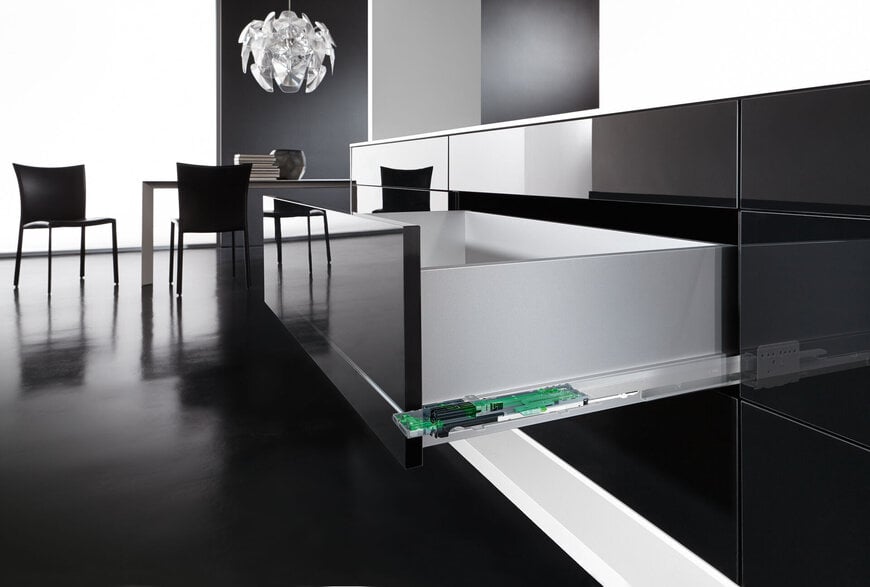
Minimalist, handle-free cabinetry systems are gaining traction across residential and commercial interiors, driven by advances in drawer mechanics and materials. These systems combine wide-drawer architectures, push-to-open actuation, and metal construction to improve usability, durability, and manufacturing efficiency.
Shift toward wide-drawer architectures
Cabinetry design is evolving toward larger drawer formats that replace multiple smaller units. This transition is enabled by synchronized slide mechanisms that prevent racking and ensure consistent motion across wider spans.
Historically, drawer width was constrained by mechanical limitations such as uneven load distribution and friction. Recent developments in undermount slide systems with synchronized movement now allow wide drawers up to approximately 1200 mm (47 inches) to operate with stable alignment and uniform opening force.
From a storage perspective, fewer, larger drawers reduce material usage associated with internal partitions and side panels. This contributes to improved space utilization, particularly in compact residential environments.
Ergonomics and user interaction
Wide-drawer configurations also address ergonomic challenges. By consolidating storage into fewer access points, users reduce repetitive bending and searching across multiple compartments. Internal modular inserts allow flexible organization within a single drawer volume, supporting kitchen, bathroom, and workspace applications.
User interaction is further streamlined through push-to-open actuation systems. These mechanisms enable hands-free access using light pressure, which is particularly relevant in kitchen environments where users handle hot or contaminated items.
When combined with soft-close damping systems, the result is controlled motion characterized by reduced closing velocity and noise, contributing to consistent user experience across repeated cycles.
Metal drawer systems and material considerations
Material selection is shifting from traditional wood-based drawer boxes toward steel-based systems. Metal drawers provide dimensional stability across varying humidity and temperature conditions, reducing risks of warping or misalignment.
From a manufacturing standpoint, steel drawer systems offer standardized production processes and shorter fabrication cycles compared to dovetail wood construction. They also support integration with laminates and engineered panels commonly used in contemporary cabinetry.
In the context of a digital supply chain, metal drawers mitigate raw material variability linked to timber sourcing and geopolitical disruptions. Many systems incorporate recycled steel content, aligning with lifecycle and sustainability targets in construction and interior design.
Integrated push-to-open and soft-close mechanisms
A key technical development is the integration of push-to-open functionality with soft-close damping into a single mechanical unit. Earlier systems often required separate components or different configurations depending on drawer size and load capacity.
Recent designs use adjustable force mechanisms that allow calibration across varying drawer weights. This is achieved through spring-based or mechanical tuning systems that regulate opening force without requiring component replacement.
The integration reduces part complexity, simplifies inventory management, and supports modular installation. Tool-free assembly and clip-in mechanisms enable faster installation and retrofitting onto existing drawer systems.
Standardization and installation efficiency
Modern drawer systems increasingly emphasize platform compatibility. A single actuation unit can operate across multiple drawer systems and slide platforms, reducing SKU proliferation for manufacturers and installers.
This standardization supports scalability in production and aligns with industrialized cabinetry workflows. It also improves serviceability, as components can be replaced or upgraded without structural modification to the cabinet.
Application scope and performance considerations
Handle-free drawer systems are used across kitchens, bathrooms, office storage, and institutional environments. Performance requirements include load-bearing capacity, cycle durability, and consistent motion under asymmetric loading.
Synchronized undermount slides combined with integrated actuation systems address these requirements by ensuring even force distribution and controlled motion profiles.
Engineering example in modular actuation systems
An example of this approach is a mechanical push-to-open and soft-close system designed for compatibility with multiple drawer platforms. The unit supports wide drawers up to 47 inches, incorporates a synchronization rod for uniform activation, and allows three-stage adjustment of opening force without tools.
Such systems are engineered to maintain performance across varying load classes while minimizing installation complexity. Their low-profile design enables retrofitting without modification to drawer bases or cabinet structures.
Implications for modern cabinetry systems
The adoption of handle-free cabinetry reflects broader trends in interior engineering: increased focus on ergonomics, modularity, and lifecycle performance. Advances in motion hardware enable larger, more efficient storage units while maintaining smooth operation.
For manufacturers and designers, the selection of drawer systems increasingly depends on measurable criteria such as load capacity, adjustability, installation time, and material stability. Systems that integrate multiple functions into standardized components support both production efficiency and long-term reliability.
As cabinetry systems continue to evolve, motion hardware remains a critical factor in defining both functional performance and user experience.
Edited by an industrial journalist Sucithra Mani with AI assistance.
www.grassusa.com
