
smartbuildingmag.com
27
'26
Written on Modified on
tado° Launches System-Specific Control Mode for Smart Heating
New Control Mode for the tado° X Smart Thermostat adapts control logic to boilers, underfloor heating and heat pumps to improve comfort and efficiency.
www.tado.com
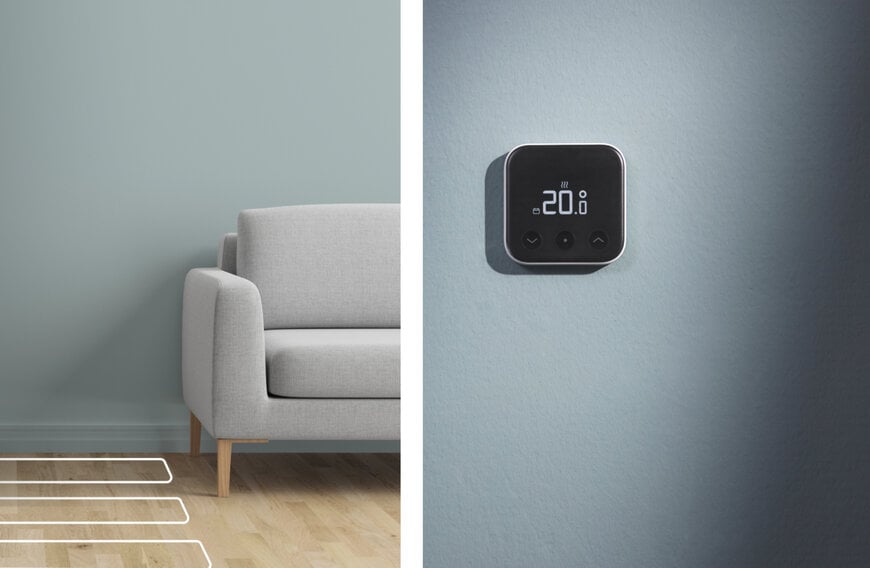
Targeting residential heating, heat pump retrofits and underfloor heating installations, tado° has introduced Control Mode for its X Smart Thermostat, enabling system-specific control behaviour to optimise temperature stability, energy efficiency and operational performance.
Why Universal Thermostat Logic Is Not Always Optimal
Most smart thermostats historically apply a single control algorithm, typically designed around the fast response characteristics of traditional gas boiler systems with radiators. While such logic remains compatible with heat pumps and underfloor heating systems, it does not always reflect their thermal dynamics.
Radiator-based systems respond quickly to heat demand, whereas underfloor heating operates with significantly higher thermal inertia. Heat pumps, in turn, achieve maximum efficiency when frequent on/off cycling is avoided and stable operating periods are maintained.
Applying the same control strategy across all these technologies can lead to temperature overshooting, unnecessary cycling or reduced system efficiency.
Control Mode: Adapting to the Installed Heating System
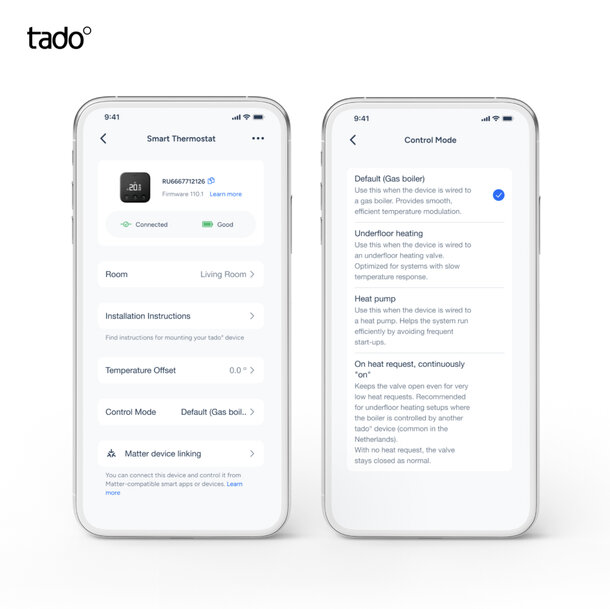
With the introduction of Control Mode, tado° enables users to select control behaviour directly within the app according to the heating technology installed in the home. The feature is available for the tado° X Smart Thermostat and provided as a free update.
Dedicated settings are available for:
- Traditional boiler systems
- Underfloor heating
- Heat pumps
- Underfloor heating systems where the boiler is managed by another tado° device
The latter configuration is particularly relevant in installations, such as those common in the Netherlands, where the heating valve must remain open even during very low heat demand.
By tailoring control logic to the physical characteristics of each system, the thermostat modifies heating cycles and response curves to better match system behaviour.
Performance Improvements in Comfort and Efficiency
System-specific control enables measurable operational benefits. In radiator-based systems, it can deliver faster and smoother heat-up behaviour where required. In underfloor heating systems, it reduces temperature overshoot by accounting for slower response times and accumulated heat in the floor mass.
For heat pump installations, limiting frequent start-stop cycles supports more stable operation and can improve seasonal performance by maintaining efficient load conditions over longer intervals.
As a result, Control Mode contributes to:
By tailoring control logic to the physical characteristics of each system, the thermostat modifies heating cycles and response curves to better match system behaviour.
Performance Improvements in Comfort and Efficiency
System-specific control enables measurable operational benefits. In radiator-based systems, it can deliver faster and smoother heat-up behaviour where required. In underfloor heating systems, it reduces temperature overshoot by accounting for slower response times and accumulated heat in the floor mass.
For heat pump installations, limiting frequent start-stop cycles supports more stable operation and can improve seasonal performance by maintaining efficient load conditions over longer intervals.
As a result, Control Mode contributes to:
- More stable room temperatures
- Reduced temperature overshooting
- Improved operational efficiency
- Enhanced performance alignment for heat pumps
This approach aligns thermostat behaviour more closely with the thermodynamic and hydraulic characteristics of each heating system.
Integrated Heating Expertise in Software
According to Christian Deilmann, Co-founder and Managing Director at tado°, the development of Control Mode reflects the company’s system-level understanding of heating technologies. Rather than applying a universal control model, the feature adapts the thermostat’s behaviour to the heating infrastructure present in the home.
tado° supports over one million connected households across Europe and is compatible with a broad range of residential heating systems, including gas boilers, hydronic underfloor heating and heat pumps.
With Control Mode, the company introduces a configurable control architecture that addresses the growing diversity of residential heating technologies, particularly as electrification and heat pump adoption increase across European markets.
By embedding system-specific logic into the thermostat software, tado° expands the functional scope of smart heating control beyond scheduling and remote access, positioning adaptive control algorithms as a core component of modern energy-efficient home heating systems.
www.tado.com
Integrated Heating Expertise in Software
According to Christian Deilmann, Co-founder and Managing Director at tado°, the development of Control Mode reflects the company’s system-level understanding of heating technologies. Rather than applying a universal control model, the feature adapts the thermostat’s behaviour to the heating infrastructure present in the home.
tado° supports over one million connected households across Europe and is compatible with a broad range of residential heating systems, including gas boilers, hydronic underfloor heating and heat pumps.
With Control Mode, the company introduces a configurable control architecture that addresses the growing diversity of residential heating technologies, particularly as electrification and heat pump adoption increase across European markets.
By embedding system-specific logic into the thermostat software, tado° expands the functional scope of smart heating control beyond scheduling and remote access, positioning adaptive control algorithms as a core component of modern energy-efficient home heating systems.
www.tado.com
