
smartbuildingmag.com
26
'26
Written on Modified on
Daikin Expands Propane Heat Pump Capacity to 2000 kW
Platform combines compact and modular systems with integrated safety architecture for industrial processes and large building HVAC applications.
www.daikin.com
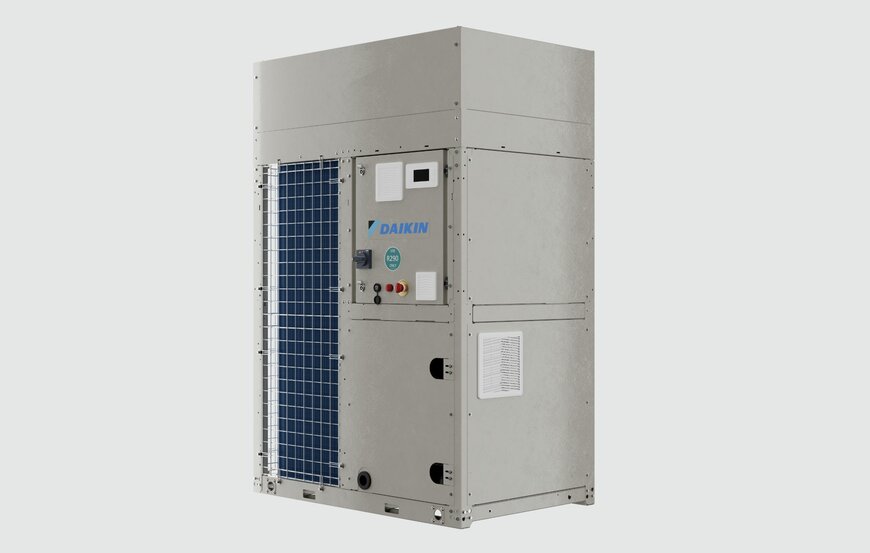
Industrial electrification and heat recovery strategies are increasing demand for high-temperature heat pumps using natural refrigerants. To address applications ranging from decentralized plant rooms to large process heating, Daikin introduced a full R-290 heat pump platform covering outputs from 20 kW to 2000 kW.
The system combines monobloc and modular configurations and incorporates a unified safety architecture designed for regulated industrial environments.
Two architectures, one scalable capacity range
The platform consists of EWA/YK-CZ air-to-water monobloc units rated between 20 and 85 kW and EWYK-QZ modular heat pumps configurable in multi-array systems up to 2000 kW. Together they form a continuous capacity ladder for complex buildings and industrial processes.
The EWA/YK-CZ units operate as heat pumps or chillers and support medium-temperature processes with leaving water temperatures up to 75 °C. They are suited to localized plant integration or decentralized installations while maintaining compatibility with larger installations built on the modular platform.
For higher capacities, the EWYK-QZ modular structure allows installed output to follow actual load demand and to expand later without redesigning the entire installation. Individual module isolation enables continued operation during maintenance or faults, supporting operational continuity in production facilities where downtime affects the digital supply chain.
Safety architecture for propane refrigerant systems
Because R-290 (propane) is flammable, the platform incorporates a system-level safety concept called the Daikin Safety Shield.
Critical safety functions — leak detection, ventilation and alarms — are powered by a dedicated electrical line separate from the main circuit to remain active during power interruptions. The electrical enclosure operates as a controlled environment under slight overpressure and is continuously monitored by refrigerant sensors. If abnormal concentrations are detected, ATEX-certified ventilation activates automatically along with visual and acoustic alarms.
The refrigerant circuit stores factory-charged refrigerant in dedicated tanks to reduce handling risk during transport and installation. Mechanical safety valves manage overpressure events, and discharge devices direct refrigerant outside the compressor enclosure during abnormal conditions. Control logic performs a controlled shutdown after leak detection. The hydronic circuit includes an isolation valve to prevent refrigerant migration beyond the unit boundary in case of water-side leakage.
The same safety architecture is applied across the entire 20–2000 kW range, enabling standardized risk management and maintenance procedures across industrial sites.
Capacity control and plant management
The units use inverter-driven scroll compressors and EC brushless fans to adjust output continuously according to load. Plant control is handled by the Multiple Unit Sequencer in single arrays and by the Daikin Intelligent Chiller Manager (iCM) in multi-array configurations, enabling dynamic load distribution and stable operation under varying demand profiles.
Validation under industrial operating conditions
The platform was developed and validated at the Daikin Applied Europe Research and Development Center in Italy, opened in 2025. Testing included dynamic load simulations, operation under extreme environmental conditions and safety verification on high-capacity units representative of industrial production environments.
By combining scalable capacity, standardized propane safety measures and load-adaptive control, the system targets both building HVAC and industrial process heating applications where electrified heat supply replaces combustion-based equipment.
www.daikinapplied.com
