
smartbuildingmag.com
05
'26
Written on Modified on
Oil-Free Centrifugal Compressors for Commercial HVAC
Trane Technologies and Garrett Motion are collaborating to develop next-generation oil-free centrifugal compressors for commercial HVAC systems.
www.trane.com
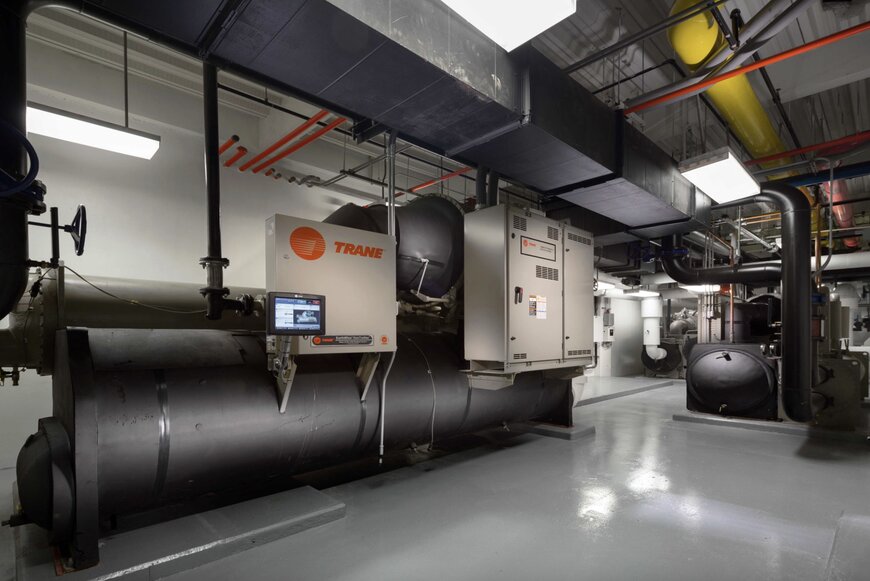
Trane Technologies and Garrett Motion have announced a strategic collaboration to accelerate the development and deployment of oil-free, high-speed centrifugal compressor technology aimed at improving efficiency and reducing environmental impact in commercial HVAC applications.
Advancing compressor technology in commercial HVAC
Compressors are a central determinant of efficiency, reliability, and environmental performance in heating, ventilation, and air conditioning systems. As commercial buildings face rising energy costs and stricter decarbonization targets, demand is increasing for compressor technologies that reduce mechanical losses, improve part-load performance, and support the use of ultra-low global warming potential refrigerants.
The collaboration between Trane and Garrett Motion is intended to address these requirements by combining system-level HVAC engineering with oil-free centrifugal compressor technology that eliminates oil management losses and associated maintenance complexity.
Oil-free centrifugal compressor approach
Garrett Motion’s high-speed oil-free centrifugal compressor technology is designed to operate without lubrication oil in the compression process. Removing oil from the system reduces parasitic losses, improves heat transfer, and simplifies overall system architecture. According to testing conducted by Trane, the technology has demonstrated measurable gains in energy efficiency compared with conventional compressor designs.
High-speed centrifugal operation also enables compact designs and smoother compression characteristics, which are relevant for variable-load commercial HVAC environments.
Integration across HVAC system portfolios
Under the collaboration, the companies will jointly develop and integrate advanced compressor solutions across a wide range of Trane commercial HVAC products. Targeted systems include unitary rooftop units, modular chillers, and large-capacity chillers used in commercial, institutional, and industrial facilities.
By addressing multiple product categories, the collaboration aims to ensure that oil-free centrifugal technology can be scaled and adapted to different capacity ranges and installation requirements, rather than being limited to niche applications.
Refrigerants and environmental performance
A further objective of the joint development effort is to support the adoption of ultra-low global warming potential refrigerants. Compressor compatibility is a critical factor in enabling refrigerant transitions, as material selection, operating speeds, and thermal characteristics must align with new refrigerant properties.
The companies have indicated that the next-generation systems will be engineered to combine improved energy efficiency with lower direct and indirect emissions, aligning with regulatory trends and customer sustainability objectives.
Development timeline and validation
Field testing and initial production of the jointly developed compressor technology are planned to begin in 2026. This phase is intended to validate performance, reliability, and serviceability under real operating conditions across different regions and applications.
The collaboration framework includes shared engineering, design, and testing activities across global markets, enabling coordinated development and faster progression from prototype to commercial deployment.
Future applications and scalability
Beyond near-term product integration, the collaboration also includes joint exploration of future applications for high-speed centrifugal compressor technology. These include potential use in smaller-capacity HVAC systems, distributed cooling architectures, and emerging cooling requirements driven by changes in building design and energy usage patterns.
Such scalability is relevant as commercial HVAC systems evolve to support more decentralized and flexible cooling strategies.
www.trane.com
