
smartbuildingmag.com
22
'26
Written on Modified on
Next-Generation Passive Infrared Sensor with Wide Field Detection
Panasonic Industry introduces its new Flat Wide Detection Type sensor to enhance motion detection performance for building automation and lighting control applications.
www.panasonic.com
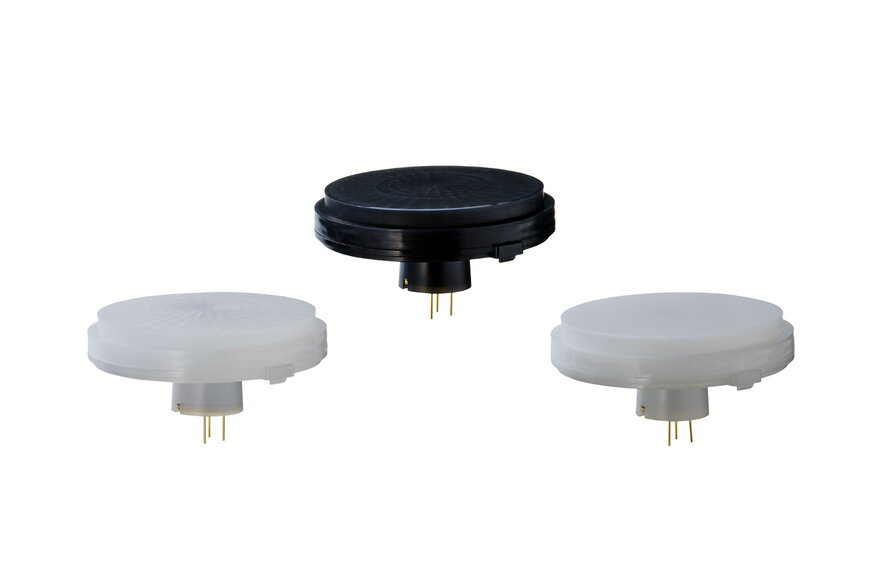
Panasonic Industry has developed a new passive infrared (PIR) motion sensor featuring a flat wide-angle lens and next-generation pyroelectric detection technology, designed to improve motion detection accuracy and coverage for technical use cases such as automated lighting systems, occupancy monitoring, and building automation controls. The sensor’s design targets environments where wide coverage and sensitivity to small movements are critical, including commercial offices, educational facilities, and residential installations.
Advancements in PIR Detection Technology
The newly introduced Flat Wide Detection Type sensor incorporates Panasonic’s PaPIRs+ technology, which represents a technical progression over the preceding PaPIRs series. By redesigning the internal pyroelectric elements, PaPIRs+ delivers approximately twice the sensitivity compared to its predecessor, enabling the sensor to reliably detect minimal motion across an extended area. This increased sensitivity is achieved without proportional increases in power consumption, supporting deployment in energy-efficient systems where current draw is a technical constraint.
Panoramic coverage is an important parameter in motion sensing for automation systems. The flat-profile lens yields a field of view of about 136.4° by 135.4°, which expands detection coverage significantly relative to conventional narrow-angle PIR lenses. Technical measurements performed under the IEC 63180 measurement standard demonstrate that, when mounted at a typical ceiling height of 3.0 m, the sensor can achieve a maximum radial detection diameter of approximately 15 m, encompassing a large interior space without requiring multiple discrete devices.
Technical Specifications and Design Features
The sensor’s detection capabilities are facilitated by its optical and mechanical design. The flat lens, measuring 32.6 mm in diameter, supports 416 distinct detection zones to provide near-continuous coverage of the monitored area. Interface options include both digital open-drain and analogue outputs via an operational amplifier, supporting integration with a range of control systems. The device operates within an ambient temperature range of –20 °C to +60 °C, aligning with common specifications for industrial and building-level sensor components.
The form factor of the new sensor shares physical dimensions with Panasonic’s “Ultra-Wide and Long-Distance Detection Type (11-lens)” model, potentially simplifying design integration for system engineers who deploy multiple sensor types within standardized housings. Lens colour options in white, pearl white, and black accommodate aesthetic considerations in applications where sensor appearance complements architectural or interior design requirements.
Application Areas and System Integration
In automated lighting and occupancy control systems, broad and sensitive motion detection reduces the need for multiple discrete sensors and enhances uniform response to human presence. The sensor’s capacity to detect small movements — including those from seated occupants — supports technical requirements for energy-saving building systems that adapt lighting and HVAC (heating, ventilation, and air conditioning) based on real-time occupancy. The low current consumption variants (ranging from approximately 1 µA to 170 µA depending on configuration) further support energy-constrained deployments, such as battery-powered IoT nodes or distributed control panels.
Testing and Standards Compliance
Performance validation was conducted in Panasonic’s laboratories using standardized procedures aligned with IEC 63180 norms. This ensures objective measurement of detection range and sensitivity under controlled conditions, enabling technical purchasers and system designers to benchmark performance against other PIR solutions.
Competitive Context
Although multiple manufacturers supply PIR motion sensors for building automation and related fields, the combination of a flat wide-angle lens and enhanced sensitivity through PaPIRs+ positions this sensor variant within a segment that prioritizes wide coverage and small-movement detection. Comparable PIR technologies typically trade off between field of view and sensitivity; the technical approach taken here aims to address both parameters without significantly increasing device footprint. Detailed side-by-side benchmark data against alternative PIR architectures is not broadly published but remains a key consideration for system architects evaluating sensor platforms for large-area coverage.
www.industry.panasonic.eu
