
smartbuildingmag.com
08
'26
Written on Modified on
Panasonic Industry Launches PaPIRs+ Motion Sensor Technology
With up to 2× higher sensitivity, PaPIRs+ delivers significantly enhanced detection performance for a wide range of applications - even in demanding installations.
www.panasonic.com

Panasonic Industry Europe has announced the expansion of its passive infrared (PIR) motion sensor portfolio with the introduction of PaPIRs+. Positioned as a technological evolution of the company's established PaPIRs product line, the new technology delivers upgraded spatial detection thresholds to meet strict design and functional criteria within modern building automation networks and smart infrastructure installations.
Pyroelectric Optimization and Detection Sensitivity
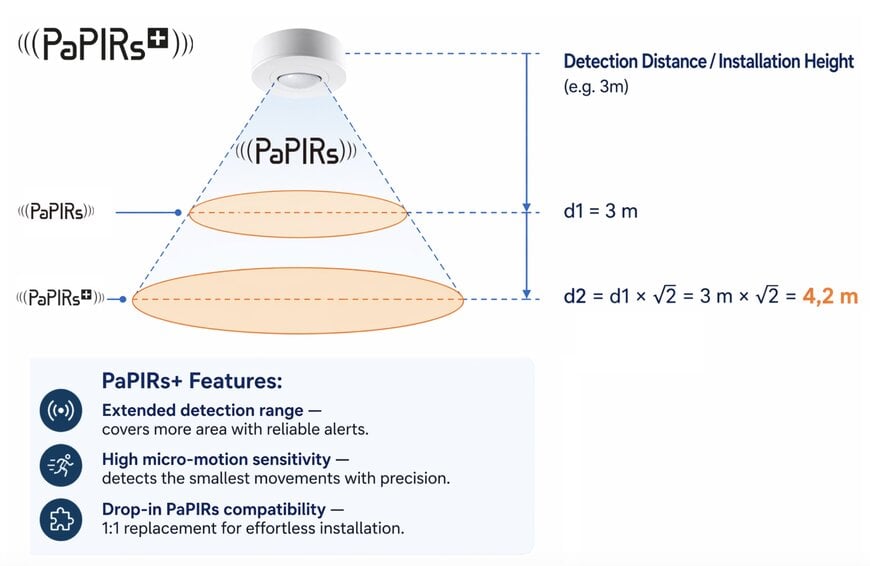
The structural upgrade underlying the PaPIRs+ platform focuses on entirely redesigned internal pyroelectric measurement elements. The updated hardware layout incorporates enlarged, optimized infrared sensing structures that expand the physical absorption surface area of the active crystals. This geometric modification delivers up to twice the thermal sensitivity compared to standard, conventional PaPIRs variants.
The elevated sensitivity parameters provide more precise tracking of microscopic human movements across extended capture distances and expanded field-of-view matrices. By closing structural coverage gaps and reducing localized sensor blind spots, the technology addresses demanding application requirements across specific smart environment installations, including:
- Modern Lighting Control: Maximizing occupancy-based dimming profiles and energy optimization loops.
- HVAC Systems: Synchronizing continuous airflow and localized climate adjustment based on subtle passive occupancy indications.
- Smart Building Solutions: Supporting real-time workspace optimization, building logistics management, and facility asset tracking.
The enhanced manufacturing methodology is engineered to remain cost-efficient. The platform provides a significant upgrade in absolute perceptual performance with only a marginal impact on total system component cost.
Discreet Product Design and Portfolio Extensions
To address the simultaneous demands of technical functionality and contemporary spatial aesthetics, the company has integrated the PaPIRs+ architecture into its newly launched Flat Wide Detection Type product family. This product configuration couples the high-sensitivity internal electronics with an ultra-flat lens design providing a wide field of view. The thin physical profile supports discreet, flush installation into space-constrained and design-sensitive architecture, such as corporate office settings, schools, and residential buildings.
According to Robert Spiegler, Lead Product Manager at Panasonic in Ottobrunn, Germany, the PaPIRs+ series is not intended to substitute for the existing, field-proven PaPIRs technology line, but rather to expand the vendor's total application scope. Spiegler noted that conventional PaPIRs sensors remain an effective technical choice for standard commercial applications that demand reliable base-level motion monitoring. The introduction of PaPIRs+ establishes a high-performance alternative for engineering teams requiring amplified detection sensitivity, wider volumetric tracking, or operation within specialized environmental parameters, granting industrial customers the flexibility to select specific performance tiers tailored to distinct application parameters.
Additional Context
This section details technical specifications not included in the original news release.
Passive Infrared (PIR) sensors operate by detecting the dynamic changes in localized thermal radiation patterns emitted by moving objects, primarily human bodies radiating heat in the long-wave infrared spectrum around 9.4 micrometers. The primary sensing element inside a PIR module consists of a pyroelectric thin-film crystal substrate, typically manufactured from lithium tantalate or lead zirconate titanate. This crystalline material possesses spontaneous electrical polarization that shifts dynamically in response to minute changes in temperature. When an individual enters the sensor's perimeter, the localized infrared flux alters the surface temperature of the crystal, liberating surface electrical charges that generate a measurable differential current across an internal field-effect transistor (FET) preamplifier stage.
Traditional PIR configurations slice this incident thermal energy into alternating zones using a multi-faceted segmented Fresnel lens array, which redirects infrared photons onto small, dual-element or quad-element balanced crystal blocks. This standard configuration struggles to register fine or stationary motion because the signal generation requires an object to completely cross between separate positive and negative optical zones.
Upgrading the platform to a high-sensitivity framework like PaPIRs+ relies on optimizing the micro-topography of the pyroelectric elements and expanding the active pixel dimensions. By increasing the physical thickness uniformity and surface area of the individual crystal zones, the module reduces thermal mass inertia and lowers the sensor's equivalent noise charter, allowing the device to register lower thermal contrasts and micro-movements—such as typing, hand gestures, or respiratory chest displacement—over wider distances.
Concurrently, pairing these enlarged elements with ultra-flat, high-density micro-lens configurations allows for a higher concentration of overlapping detection zones per unit of area, significantly reducing the spatial gap between zones to minimize physical dead space and ensure uniform tracking consistency across wide, flat architectural boundaries.
Edited by Romila DSilva, Induportals Editor, with AI assistance.
Discreet Product Design and Portfolio Extensions
To address the simultaneous demands of technical functionality and contemporary spatial aesthetics, the company has integrated the PaPIRs+ architecture into its newly launched Flat Wide Detection Type product family. This product configuration couples the high-sensitivity internal electronics with an ultra-flat lens design providing a wide field of view. The thin physical profile supports discreet, flush installation into space-constrained and design-sensitive architecture, such as corporate office settings, schools, and residential buildings.
According to Robert Spiegler, Lead Product Manager at Panasonic in Ottobrunn, Germany, the PaPIRs+ series is not intended to substitute for the existing, field-proven PaPIRs technology line, but rather to expand the vendor's total application scope. Spiegler noted that conventional PaPIRs sensors remain an effective technical choice for standard commercial applications that demand reliable base-level motion monitoring. The introduction of PaPIRs+ establishes a high-performance alternative for engineering teams requiring amplified detection sensitivity, wider volumetric tracking, or operation within specialized environmental parameters, granting industrial customers the flexibility to select specific performance tiers tailored to distinct application parameters.
Additional Context
This section details technical specifications not included in the original news release.
Passive Infrared (PIR) sensors operate by detecting the dynamic changes in localized thermal radiation patterns emitted by moving objects, primarily human bodies radiating heat in the long-wave infrared spectrum around 9.4 micrometers. The primary sensing element inside a PIR module consists of a pyroelectric thin-film crystal substrate, typically manufactured from lithium tantalate or lead zirconate titanate. This crystalline material possesses spontaneous electrical polarization that shifts dynamically in response to minute changes in temperature. When an individual enters the sensor's perimeter, the localized infrared flux alters the surface temperature of the crystal, liberating surface electrical charges that generate a measurable differential current across an internal field-effect transistor (FET) preamplifier stage.
Traditional PIR configurations slice this incident thermal energy into alternating zones using a multi-faceted segmented Fresnel lens array, which redirects infrared photons onto small, dual-element or quad-element balanced crystal blocks. This standard configuration struggles to register fine or stationary motion because the signal generation requires an object to completely cross between separate positive and negative optical zones.
Upgrading the platform to a high-sensitivity framework like PaPIRs+ relies on optimizing the micro-topography of the pyroelectric elements and expanding the active pixel dimensions. By increasing the physical thickness uniformity and surface area of the individual crystal zones, the module reduces thermal mass inertia and lowers the sensor's equivalent noise charter, allowing the device to register lower thermal contrasts and micro-movements—such as typing, hand gestures, or respiratory chest displacement—over wider distances.
Concurrently, pairing these enlarged elements with ultra-flat, high-density micro-lens configurations allows for a higher concentration of overlapping detection zones per unit of area, significantly reducing the spatial gap between zones to minimize physical dead space and ensure uniform tracking consistency across wide, flat architectural boundaries.
Edited by Romila DSilva, Induportals Editor, with AI assistance.
