
smartbuildingmag.com
24
'26
Written on Modified on
The Transition to Heat Pump Chillers for Simultaneous Heating and Cooling
As commercial facilities push for decarbonization, traditional HVAC designs are being replaced by 4-pipe thermal management systems that recover heat from cooling cycles, pushing efficiencies up to 400%.
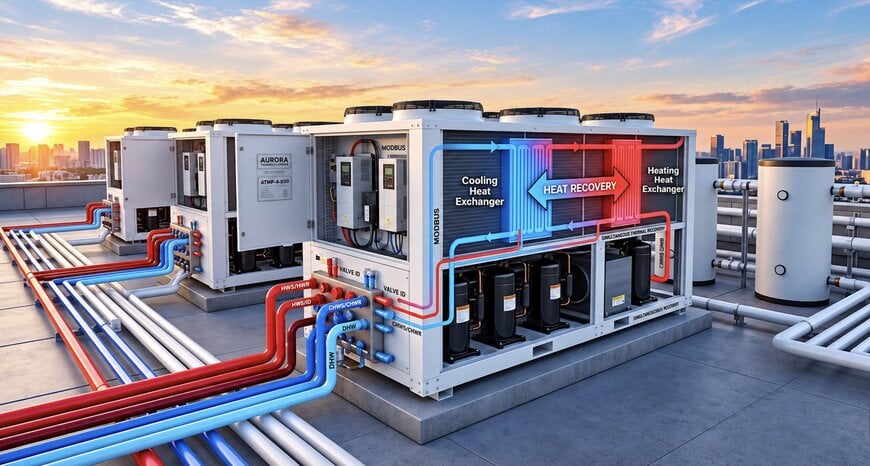
AI-generated image.
The push for rapid commercial decarbonization is fundamentally reshaping how facilities manage thermal loads. For decades, traditional HVAC engineering relied on deeply fragmented infrastructure: gas-fired boilers for heating and mechanical chillers for cooling.
In environments requiring constant temperature and humidity control, such as hospitals, laboratories, district energy plants, and mixed-use commercial buildings, this disconnected approach wastes massive amounts of thermal energy. During shoulder seasons or in dehumidification modes where constant reheat is required, traditional systems reject heat into the atmosphere via cooling towers while simultaneously burning fossil fuels to generate heat just a few floors away.
Thermal energy can no longer be treated as a disposable byproduct. Driven by stringent emissions penalties, grid capacity limits, and building electrification mandates, engineers are transitioning facilities from isolated equipment to integrated thermal networks. The solution bridging this gap is the 4-pipe heat pump chiller.
The Engineering Shift: Thermodynamics and Hydronics
The most significant physical evolution in the mechanical penthouse is the shift to a 4-pipe hydronic architecture. Unlike standard reversible heat pumps that mechanically toggle an entire building between heating and cooling modes, 4-pipe systems feature four dedicated hydraulic connections: two for the hot water supply and return, and two for the chilled water supply and return. This configuration ensures that hot and cold water are continuously and independently available on demand.
Maximizing the Total Efficiency Ratio (TER)
In a simultaneous heating and cooling heat pump, the system acts as a thermal recycling engine. By utilizing specialized brazed plate heat exchangers, the system captures the thermal energy extracted during the chilled water cooling cycle. Rather than venting this rejected heat into the ambient air, the refrigerant cycle elevates the heat and transfers it directly into the building’s heating loop. When operating in this heat recovery mode, the combined Coefficient of Performance (COP), often measured as the Total Efficiency Ratio (TER), can push past 400%, with a COP of 4.0 to 6.0 or higher. For every 1 kW of electricity consumed, the system delivers 4 to 6 kW of combined thermal utility to the facility.
Managing Lift and Hydronic Stability
Extracting high temperature hot water up to 140°F (60°C) from a simultaneous cooling cycle requires managing thermodynamic lift, which is the temperature difference between the evaporator and condenser. To achieve this without stalling the compressors, engineers deploy Variable Frequency Drives (VFDs) and electronic expansion valves (EEVs) tied to predictive PID control loops. Furthermore, central plant designs now heavily incorporate thermal buffer tanks to add inertia to the hydronic loops. This hydronic decoupling prevents the compressors from short cycling when building loads fluctuate rapidly.
The Refrigerant Transition
This hardware transition is happening concurrently with strict regulatory refrigerant phase downs, such as those outlined by ASHRAE 15 and the EPA. Next generation commercial heat pump plants are built around low Global Warming Potential (GWP) A2L refrigerants like R-454B. Adopting these refrigerants limits the long term liability of the equipment as older hydrofluorocarbons face steep production quotas and price spikes.
The Strategic Shift: CapEx, OpEx, and Compliance
For decision makers and industrial facility managers, evaluating a 4-pipe heat pump chiller requires abandoning traditional siloed budgeting.
Historically, cooling CapEx and heating CapEx were distinct line items. Integrated 4-pipe systems consolidate these into a single, higher upfront capital cost, but they dramatically alter the OpEx trajectory. By eliminating natural gas consumption for baseload heating, facilities hedge against volatile fossil fuel markets while avoiding impending carbon tax penalties. Furthermore, because the commercial heat pump plant recovers existing heat rather than generating it from scratch, the overall electrical demand profile is flattened. This load matching capability helps facilities avoid triggering peak demand charges from local utilities.
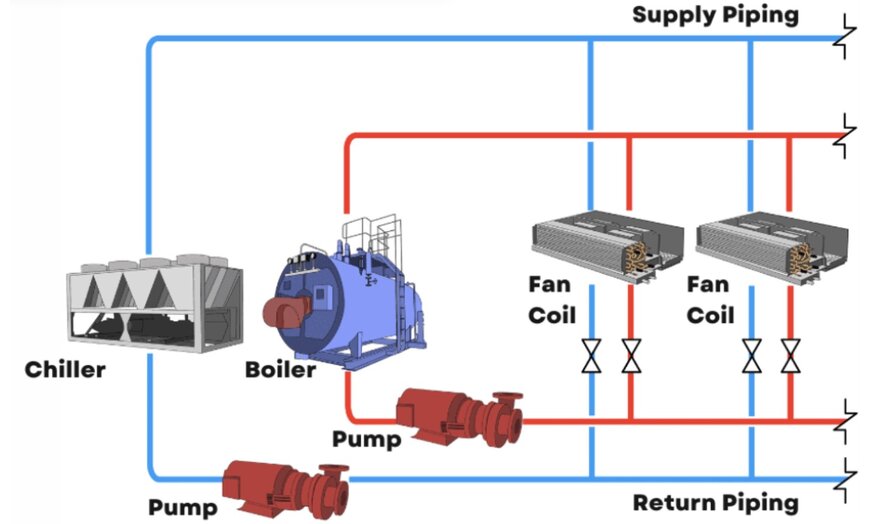
4-pipe heat pump chiller diagram.
Vendor Ecosystem: OEM Approaches to 4-Pipe Architectures
As the transition to electrified thermal networks accelerates, major equipment manufacturers are developing distinct engineering strategies to address space constraints, part load efficiency, and extreme ambient operation.
Trane
Trane addresses the market with a highly modular, scalable approach via its Thermafit MWS Multi-Pipe units. Designed as a water source system, this architecture features three independent brazed plate heat exchangers for each loop (cooling, heating, and source). Engineered for space constrained urban retrofits, Trane modules can be banked together to scale capacity. The system specifically targets high lift applications to produce up to 140°F hot water strictly from recovered waste heat.
Carrier
Carrier roots its strategy in flexible, variable speed integration. Its AquaSnap 30FQ 4-Pipe Heat Pump is engineered for dynamic simultaneous loads. By utilizing scroll compressors and EC variable speed fans, Carrier focuses on part load efficiency, which is where commercial buildings operate 95% of the time. The platform is designed to operate in extreme ambient conditions down to -4°F (-20°C) while maintaining reliable leaving hot water temperatures, making it a primary replacement for baseload gas boilers.
Johnson Controls
Johnson Controls attacks the large scale commercial space through robust, high capacity platforms under its YORK brand. To address the demands of simultaneous 4-pipe operation in cold climates, systems like the YORK YCPB utilize Enhanced Vapor Injection (EVI) scroll technology. EVI injects mid pressure refrigerant vapor directly into the compression cycle. This significantly expands the operating envelope and boosts heating capacity at low ambient temperatures down to -13°F (-25°C), without sacrificing dedicated cooling efficiency.
The Path Forward: Thermal Recycling as the New Baseline
The commercial HVAC market is moving toward a model where thermal energy recovery is engineered into a building from day one. The era of isolated gas boilers and standalone chillers is rapidly closing, replaced by integrated hybrid plants that view a facility's entire thermal footprint as a single equation.
For facility operators and consulting engineers, the challenge is no longer simply sizing equipment for peak design days. They must model building load profiles hourly to determine exactly how effectively waste heat can be captured, stored in hydronic loops, and redistributed. As the industry standardizes on 4-pipe architectures, the ability to orchestrate simultaneous thermal loads through intelligent building automation controls will become the primary driver of commercial real estate value and decarbonization compliance.
Edited by Aishwarya Mambet, Induportals Editor, with AI assistance.
www.smartbuildingmag.com
The push for rapid commercial decarbonization is fundamentally reshaping how facilities manage thermal loads. For decades, traditional HVAC engineering relied on deeply fragmented infrastructure: gas-fired boilers for heating and mechanical chillers for cooling.
In environments requiring constant temperature and humidity control, such as hospitals, laboratories, district energy plants, and mixed-use commercial buildings, this disconnected approach wastes massive amounts of thermal energy. During shoulder seasons or in dehumidification modes where constant reheat is required, traditional systems reject heat into the atmosphere via cooling towers while simultaneously burning fossil fuels to generate heat just a few floors away.
Thermal energy can no longer be treated as a disposable byproduct. Driven by stringent emissions penalties, grid capacity limits, and building electrification mandates, engineers are transitioning facilities from isolated equipment to integrated thermal networks. The solution bridging this gap is the 4-pipe heat pump chiller.
The Engineering Shift: Thermodynamics and Hydronics
The most significant physical evolution in the mechanical penthouse is the shift to a 4-pipe hydronic architecture. Unlike standard reversible heat pumps that mechanically toggle an entire building between heating and cooling modes, 4-pipe systems feature four dedicated hydraulic connections: two for the hot water supply and return, and two for the chilled water supply and return. This configuration ensures that hot and cold water are continuously and independently available on demand.
Maximizing the Total Efficiency Ratio (TER)
In a simultaneous heating and cooling heat pump, the system acts as a thermal recycling engine. By utilizing specialized brazed plate heat exchangers, the system captures the thermal energy extracted during the chilled water cooling cycle. Rather than venting this rejected heat into the ambient air, the refrigerant cycle elevates the heat and transfers it directly into the building’s heating loop. When operating in this heat recovery mode, the combined Coefficient of Performance (COP), often measured as the Total Efficiency Ratio (TER), can push past 400%, with a COP of 4.0 to 6.0 or higher. For every 1 kW of electricity consumed, the system delivers 4 to 6 kW of combined thermal utility to the facility.
Managing Lift and Hydronic Stability
Extracting high temperature hot water up to 140°F (60°C) from a simultaneous cooling cycle requires managing thermodynamic lift, which is the temperature difference between the evaporator and condenser. To achieve this without stalling the compressors, engineers deploy Variable Frequency Drives (VFDs) and electronic expansion valves (EEVs) tied to predictive PID control loops. Furthermore, central plant designs now heavily incorporate thermal buffer tanks to add inertia to the hydronic loops. This hydronic decoupling prevents the compressors from short cycling when building loads fluctuate rapidly.
The Refrigerant Transition
This hardware transition is happening concurrently with strict regulatory refrigerant phase downs, such as those outlined by ASHRAE 15 and the EPA. Next generation commercial heat pump plants are built around low Global Warming Potential (GWP) A2L refrigerants like R-454B. Adopting these refrigerants limits the long term liability of the equipment as older hydrofluorocarbons face steep production quotas and price spikes.
The Strategic Shift: CapEx, OpEx, and Compliance
For decision makers and industrial facility managers, evaluating a 4-pipe heat pump chiller requires abandoning traditional siloed budgeting.
Historically, cooling CapEx and heating CapEx were distinct line items. Integrated 4-pipe systems consolidate these into a single, higher upfront capital cost, but they dramatically alter the OpEx trajectory. By eliminating natural gas consumption for baseload heating, facilities hedge against volatile fossil fuel markets while avoiding impending carbon tax penalties. Furthermore, because the commercial heat pump plant recovers existing heat rather than generating it from scratch, the overall electrical demand profile is flattened. This load matching capability helps facilities avoid triggering peak demand charges from local utilities.
4-pipe heat pump chiller diagram.
Vendor Ecosystem: OEM Approaches to 4-Pipe Architectures
As the transition to electrified thermal networks accelerates, major equipment manufacturers are developing distinct engineering strategies to address space constraints, part load efficiency, and extreme ambient operation.
Trane
Trane addresses the market with a highly modular, scalable approach via its Thermafit MWS Multi-Pipe units. Designed as a water source system, this architecture features three independent brazed plate heat exchangers for each loop (cooling, heating, and source). Engineered for space constrained urban retrofits, Trane modules can be banked together to scale capacity. The system specifically targets high lift applications to produce up to 140°F hot water strictly from recovered waste heat.
Carrier
Carrier roots its strategy in flexible, variable speed integration. Its AquaSnap 30FQ 4-Pipe Heat Pump is engineered for dynamic simultaneous loads. By utilizing scroll compressors and EC variable speed fans, Carrier focuses on part load efficiency, which is where commercial buildings operate 95% of the time. The platform is designed to operate in extreme ambient conditions down to -4°F (-20°C) while maintaining reliable leaving hot water temperatures, making it a primary replacement for baseload gas boilers.
Johnson Controls
Johnson Controls attacks the large scale commercial space through robust, high capacity platforms under its YORK brand. To address the demands of simultaneous 4-pipe operation in cold climates, systems like the YORK YCPB utilize Enhanced Vapor Injection (EVI) scroll technology. EVI injects mid pressure refrigerant vapor directly into the compression cycle. This significantly expands the operating envelope and boosts heating capacity at low ambient temperatures down to -13°F (-25°C), without sacrificing dedicated cooling efficiency.
The Path Forward: Thermal Recycling as the New Baseline
The commercial HVAC market is moving toward a model where thermal energy recovery is engineered into a building from day one. The era of isolated gas boilers and standalone chillers is rapidly closing, replaced by integrated hybrid plants that view a facility's entire thermal footprint as a single equation.
For facility operators and consulting engineers, the challenge is no longer simply sizing equipment for peak design days. They must model building load profiles hourly to determine exactly how effectively waste heat can be captured, stored in hydronic loops, and redistributed. As the industry standardizes on 4-pipe architectures, the ability to orchestrate simultaneous thermal loads through intelligent building automation controls will become the primary driver of commercial real estate value and decarbonization compliance.
Edited by Aishwarya Mambet, Induportals Editor, with AI assistance.
www.smartbuildingmag.com
