
smartbuildingmag.com
21
'26
Written on Modified on
KEBA enables depot charging for electric truck fleets
Centralised load management and modular charging points support reliable overnight charging under grid and space constraints.
www.keba.com
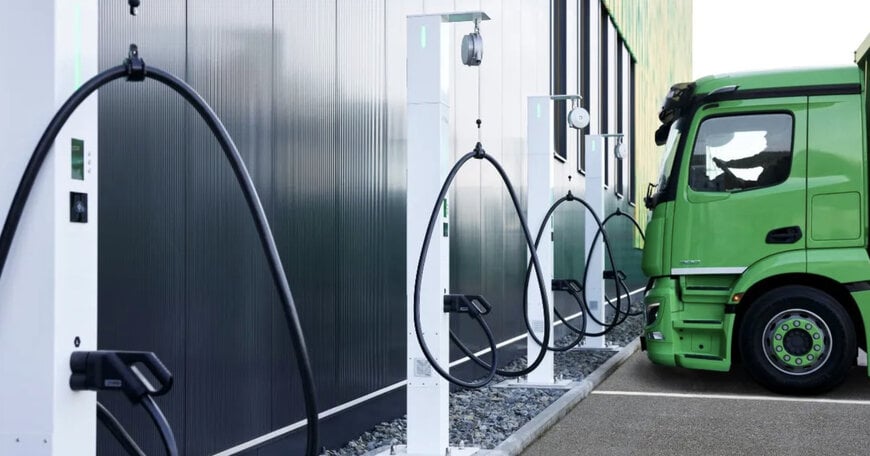
Electric mobility, logistics, and EV charging infrastructure are increasingly converging as fleet operators transition to battery-powered trucks. In this context, KEBA has implemented a depot-based charging solution for Braucommune Freistadt, demonstrating how centralized energy management and modular hardware can ensure operational readiness for electric truck fleets.
The project addresses a common challenge in fleet electrification: ensuring that vehicles covering fixed daily routes are fully charged and ready for deployment within limited time windows. At the Freistadt site, trucks travel approximately 300 km per day and require around 400 kWh of energy per vehicle, with charging carried out overnight at the depot.
Managing parallel charging under grid constraints
Depot charging environments often involve multiple vehicles charging simultaneously, limited grid connection capacity, and space constraints within existing infrastructure. These factors make conventional one-to-one charging setups inefficient or impractical.
To address this, the system is based on a central power unit, the KeContact DCU10, which distributes energy to multiple charging points (KeContact DCL10). This architecture enables dynamic allocation of available power across all connected vehicles.
Key operational capabilities include:
- Dynamic load management: Available grid capacity is distributed in real time to optimize charging across multiple trucks
- Parallel charging support: Multiple vehicles can be charged simultaneously without exceeding infrastructure limits
- Centralized monitoring: Charging processes are controlled and analysed via a dedicated service platform
This approach ensures that all vehicles reach the required state of charge within the available overnight window.
Modular infrastructure for scalable deployment
The charging system is designed to accommodate gradual fleet expansion. Additional charging points or increased capacity can be integrated without major infrastructure changes.
From a layout perspective, the separation of power unit and charging dispensers offers practical advantages:
Modular infrastructure for scalable deployment
The charging system is designed to accommodate gradual fleet expansion. Additional charging points or increased capacity can be integrated without major infrastructure changes.
From a layout perspective, the separation of power unit and charging dispensers offers practical advantages:
- Compact footprint: Each charging point requires less than 0.5 m², allowing installation in constrained areas such as loading docks
- Flexible placement: Charging units can be positioned close to parking or operational zones
- Robust installation: Centralized power electronics can be located in protected environments, improving durability in harsh conditions
This modular design supports both retrofit installations and new depot configurations.
Integration of renewable energy sources
Part of the charging demand at the Freistadt depot is supplied by an on-site photovoltaic system. This integration helps reduce peak loads on the grid and lowers operational energy costs.
By combining charging infrastructure with local energy generation and potential storage systems, the depot becomes an active component of the energy system rather than a passive consumer. This setup supports more efficient energy utilization and contributes to overall sustainability objectives.
Data transparency and operational control
The system also incorporates RFID-based vehicle identification, enabling precise tracking of charging sessions. This facilitates:
Integration of renewable energy sources
Part of the charging demand at the Freistadt depot is supplied by an on-site photovoltaic system. This integration helps reduce peak loads on the grid and lowers operational energy costs.
By combining charging infrastructure with local energy generation and potential storage systems, the depot becomes an active component of the energy system rather than a passive consumer. This setup supports more efficient energy utilization and contributes to overall sustainability objectives.
Data transparency and operational control
The system also incorporates RFID-based vehicle identification, enabling precise tracking of charging sessions. This facilitates:
- Transparent energy usage: Clear allocation of energy consumption to individual vehicles
- Operational insights: Data-driven analysis of fleet charging behaviour
- Regulatory compliance: Support for funding mechanisms requiring metered and traceable energy usage
Such features are increasingly relevant as fleet operators seek to optimize costs and comply with evolving regulatory frameworks.
Depot charging as a foundation for fleet electrification
The Freistadt project illustrates how depot-based charging infrastructure can address key operational challenges in electric truck deployment. By combining centralized energy management, modular hardware, and renewable integration, the solution ensures reliable vehicle availability while maintaining flexibility for future expansion.
As logistics operators scale their electric fleets, such depot-centric approaches are becoming essential for balancing energy demand, infrastructure constraints, and operational efficiency.
Edited by Natania Lyngdoh, Induportals Editor — Adapted by AI.
www.keba.com
Depot charging as a foundation for fleet electrification
The Freistadt project illustrates how depot-based charging infrastructure can address key operational challenges in electric truck deployment. By combining centralized energy management, modular hardware, and renewable integration, the solution ensures reliable vehicle availability while maintaining flexibility for future expansion.
As logistics operators scale their electric fleets, such depot-centric approaches are becoming essential for balancing energy demand, infrastructure constraints, and operational efficiency.
Edited by Natania Lyngdoh, Induportals Editor — Adapted by AI.
www.keba.com
